A Social-Media Ban Still Has to Beat the VPN Button
Age and location rules can make platforms demand stronger proof from everyone. They cannot guarantee less access, especially when a free VPN can move a device across a border in seconds.
August 21, 2026 · 8 min read
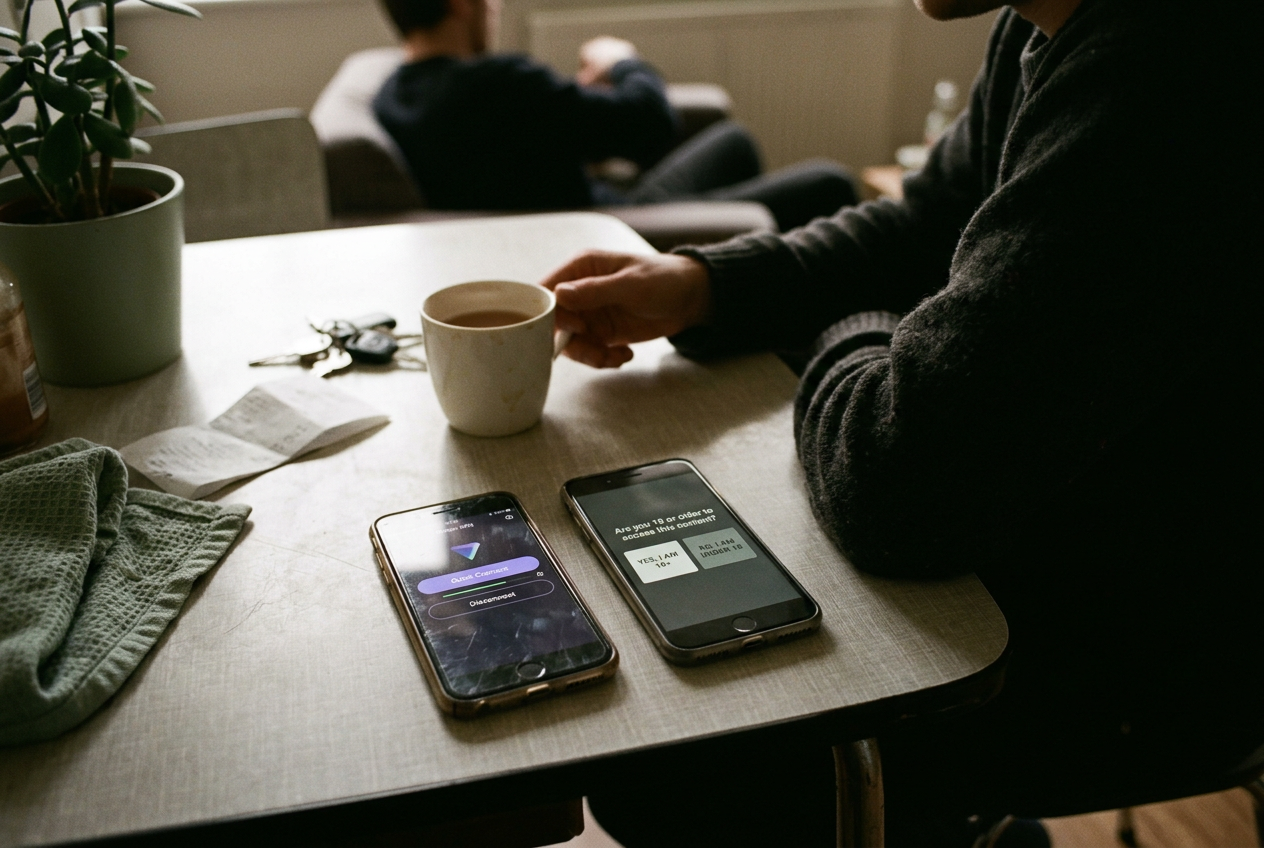
The awkward object at the center of the new social-media prohibition regime is the Quick Connect control in Proton VPN’s free iPhone app. Tap it and the phone routes its traffic through a remote server, which means a platform reading the connection’s internet protocol address, or IP address, sees the server’s approximate location instead of the phone’s.
That control does not turn a teenager into an elite operator. It does not forge a passport, change an Apple account’s recorded age or make the device anonymous. It does expose the central weakness in laws that promise to keep people off platforms according to age or geography: the law can declare a border, but somebody still has to make the phone recognize it.
The available somebody is usually a private company. Legislatures write the prohibition. Apple, Google, Meta, TikTok, identity vendors and internet providers get the implementation problem, along with the liability if a regulator decides their gate was too easy to open. The predictable result is a stack of checks that inconveniences ordinary users, catches some determined minors and generates a fresh market for proving that a person belongs on one side of a statutory line.
The ban is political theater only if one expects perfect exclusion. It can still change behavior, make access harder and give regulators leverage over major platforms. Yet its enforceable product is less glamorous than the podium language suggests. It is an identity and location system.
The app store can check the account, not the person
App stores offer the cleanest choke point because most phone users obtain software through Apple’s App Store or Google Play. A store can use the birth date attached to an account, family-management settings and an age-range signal, which tells an app that a user falls within a bracket without necessarily handing over the full date of birth. It can also refuse a download or require parental approval.
This works best when the account data is accurate and the platform controls software installation. Those conditions are common. They are not universal.
An old account may contain a convenient birthday entered years ago. A shared device can carry an adult’s store credentials. Some restricted services remain available through a web browser, where the app-store gate never appears. Android permits software installation outside Google Play, while Apple’s distribution rules vary by jurisdiction and continue to face legal and regulatory pressure.
A store-level block can remove the bright icon from the obvious shelf without removing the service from the internet.
The deeper problem is institutional. If Apple and Google become the preferred age authorities, lawmakers have handed two companies another regulatory function because they already control mobile distribution. That may reduce the number of documents each individual platform sees, especially when an app receives only an age bracket, but it concentrates the power to decide who may download what, and it makes access disputes part of the operating system.
The app store also cannot reliably determine where a person is merely from the country selected in a menu. Store regions may be tied to payment methods, account history or billing addresses, which makes casual switching harder than tapping Proton VPN’s Quick Connect control. Those signals still describe an account. They do not prove where its holder is sitting tonight.
Identity checks move the cost into the face
When account records are considered too weak, platforms can ask for stronger age assurance, the general term for methods that estimate or verify whether somebody meets an age threshold. The light version is self-declaration. The heavier versions include uploading government identification, submitting payment-card information, asking a third party to confirm an existing record or providing a face image for automated age estimation.
Each method fails differently. Self-declaration is cheap and easy to evade. Identification can establish a birth date, but children may use an adult’s document, and users without accepted documents face exclusion. Card checks establish access to a card more readily than they establish the identity of the person holding the phone.
Facial estimation produces a probability rather than a fact, with error rates that matter most near the legal threshold, where a young-looking adult or older-looking teenager becomes a compliance problem.
A verification vendor can issue a token, a signed digital statement that says the check passed without disclosing the underlying document to the social platform. That is better than sending a passport image to every feed with a Stories tab. It does not erase the collection. The vendor still receives sensitive material, the platform receives a persistent result and somebody must retain enough evidence to answer regulators, appeals and fraud complaints.
Here the statutory incentive becomes visible. A platform facing substantial penalties has little reason to design for the teenager wrongly admitted and every reason to document the adult it wrongly blocked. More checks create an audit trail. The audit trail becomes a database.
The database exists because a company needs to prove diligence after the law has failed to produce certainty.
This is why the ordinary adult ends up paying in time and privacy for a restriction nominally aimed at minors. The adult’s face, document or account history becomes evidence that the platform performed compliance. Verification companies get a larger market. Dominant platforms absorb the cost more easily than small forums, which may block an entire jurisdiction rather than buy an age-assurance system and staff an appeals process.
Location is a confidence score wearing a border uniform
IP geolocation maps a network address to an approximate place. It can often identify a country and may suggest a region or city, but it does not read the phone’s physical coordinates. Mobile carriers route traffic in ways that blur location. Corporate networks may send workers through centralized gateways.
Shared addresses can represent many households. Databases go stale.
Then there is the Quick Connect control.
A VPN, or virtual private network, creates an encrypted connection between the device and the VPN provider before traffic travels onward to the platform. If the chosen server is outside the restricted jurisdiction, a basic country-level block sees an allowed location. The user has not defeated the statute as a legal instrument. The user has defeated one technical signal.
Platforms can respond. They can identify addresses associated with commercial VPN servers, block data-center networks or demand another check when location signals conflict. Streaming services have spent years playing this game because licensing territories depend on it. The result is maintenance, not finality: VPN providers add servers, addresses change, false positives hit travelers and workplaces, and platforms decide how many legitimate users they are willing to lose for a cleaner compliance report.
A service can seek the phone’s GPS location, inspect the SIM country, compare the device locale, examine the store region or look at payment details. Combining signals makes casual evasion harder because one altered IP address no longer settles the issue. It also turns a social app into a border inspector with access to a much richer portrait of the device.
That is the trade. Weak location enforcement loses to a free VPN button. Stronger location enforcement demands more signals, more retention and more decisions about which mismatches look suspicious. People who travel, use privacy tools, share family devices or live near borders become anomalies to be resolved.
The law can impose friction, which is not the same as control
Australia’s social-media minimum-age framework and age-assurance measures emerging elsewhere place duties on services rather than treating every underage user as the primary enforcement target. That distinction matters. Regulators can investigate major companies, demand risk controls and impose consequences without sending police after children for lying about a birthday.
Yet company liability does not answer the engineering question. It changes the company’s appetite for risk.
A large platform can tighten account creation, challenge suspicious logins and remove accounts detected later. It can make evasion tiresome enough that some users give up. Friction has effects. Parents may gain support for household rules, and younger users may spend less time on the largest feeds if access becomes unreliable.
Others will move. They may use browsers, borrowed accounts, smaller services, private chats or platforms outside the regulator’s practical reach. Those destinations can have weaker moderation and fewer reporting tools. A law designed around a list of famous social networks also creates an incentive for services to argue that they belong in another legal category, because product taxonomy becomes the route around compliance.
The winners are easier to identify. Politicians get a legible prohibition. Large platforms get rules that smaller rivals struggle to afford. Apple and Google become infrastructure for identity policy.
Verification vendors sell the machinery. VPN companies acquire another reason for the Quick Connect control to remain on the home screen.
The person holding the phone gets a sequence of demands: confirm the birthday, prove the account, show the face, disclose the location. Access may decline at the margin. Data collection does not stay at the margin.
Questions people ask
Can a VPN bypass a social-media ban?
A VPN can bypass a restriction that relies mainly on an IP address to determine country or state. It cannot automatically change an account’s recorded age, app-store region, identity-verification result, SIM information or payment history, and platforms may block known VPN servers or request another form of proof.
Can
Apple or Google enforce an age limit by themselves?
They can restrict downloads, require family approval and pass an age-range signal to an app. That covers much ordinary mobile use, but browser access, inaccurate account birthdays, shared credentials and software obtained outside the main store leave gaps that app-store enforcement cannot close.
Do age checks require uploading identification?
Not always. Services can use account records, parental approval, payment checks, third-party confirmations or facial age estimation. Stronger methods tend to collect more sensitive information or create more persistent records, even when a vendor sends the platform only a pass-or-fail token.
Will these laws stop minors from using social media?
They can reduce convenient access and raise the time or technical effort needed to return. They cannot guarantee exclusion, and stricter enforcement may push users toward borrowed accounts, browsers or smaller services while requiring adults to surrender more evidence of age and location.
One update a day
Today's story, in your inbox
One story each morning — no hype, no filler, no algorithm deciding for you.