Campus Protest Rules in New Jersey Start With a Map
New Jersey colleges regulate protest through geography first: where sound carries, where tents touch grass and which doors require an ID. Discipline comes later.
August 21, 2026 · 7 min read
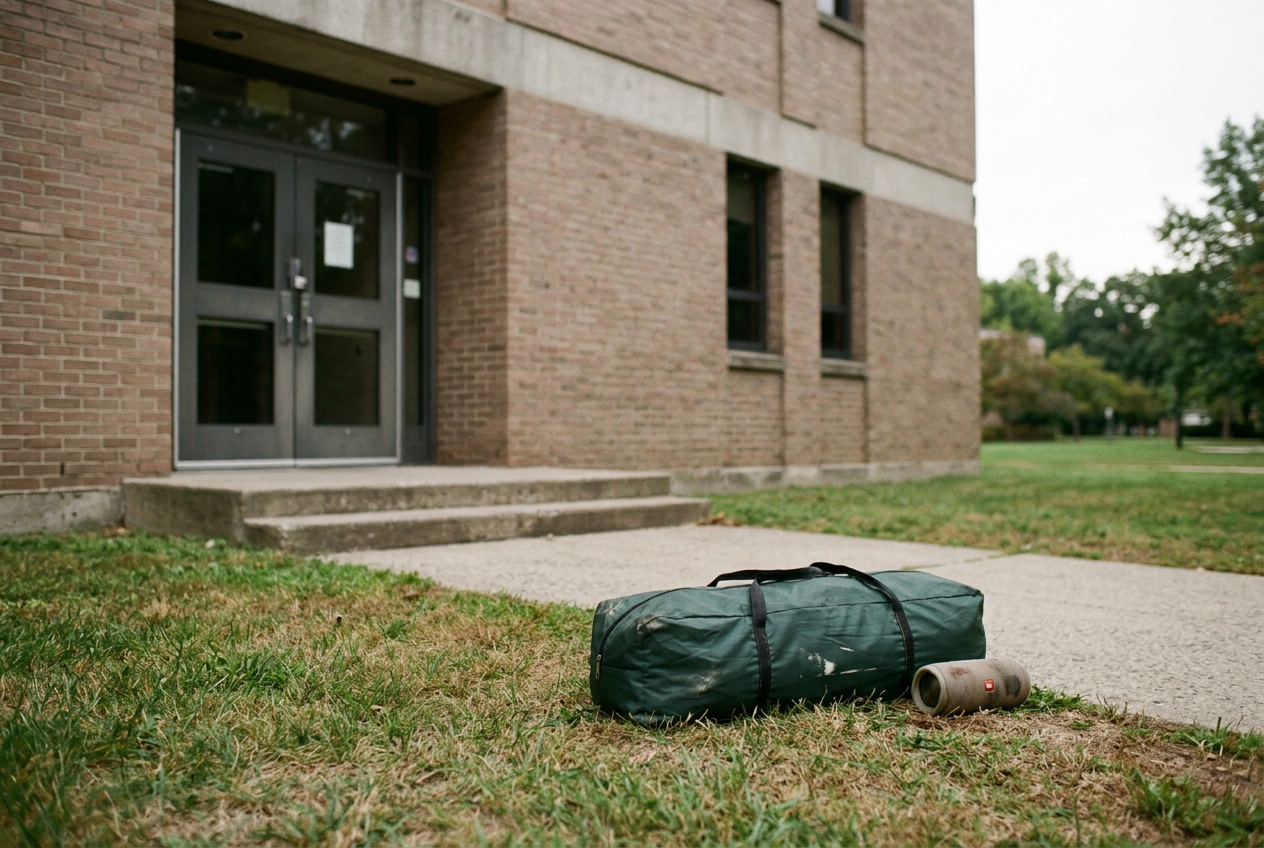
In spring 2024, a tent pole touching the grass at Princeton’s McCosh Courtyard carried more institutional weight than the slogans around it. Students attempting to establish an encampment were warned that tents violated university rules, and arrests followed after some continued setting them up, according to public reporting. The political message had not changed. Its classification had.
A rally can be protected expression. A tent can become an unauthorized structure, prohibited camping, a facilities problem or evidence that a gathering intends to remain after administrators want it gone. The pole crossing the courtyard was the hinge. Princeton did not need to adjudicate the argument about Gaza before acting on the hardware.
That distinction is the working center of campus protest policy across New Jersey. Published rules at Princeton, Rutgers, Montclair State and Rowan differ in language and legal posture, but they repeatedly regulate the same physical variables: amplified sound, temporary structures, access to buildings and the parcels of campus where organized expression may occur. Those variables look neutral when separated into web pages and facilities manuals. Put them back on a map and they describe how much protest an institution is willing to encounter.
The first moderation decision is spatial
Content moderation usually evokes a deleted post or suspended account. The campus version starts earlier. It controls distribution.
A demonstration beside a library entrance reaches students who did not seek it out. The same demonstration on a reservable lawn at the edge of pedestrian traffic reaches people who already know where to look. Both groups may retain the formal right to speak, yet only one occupies the institution’s daily field of vision. Geography decides whether protest interrupts campus life or becomes optional programming.
This is why designated spaces deserve more attention than their reassuring names. A university may call an area a public forum, expressive activity area or reservable event location. The designation can protect access by making clear that demonstrations belong there. It can also narrow practical reach when administrators treat the named locations as preferred containers, especially once scheduling systems, sound approvals and facilities staff enter the picture.
Montclair State’s published materials identify conditions for demonstrations and expressive activity, including operational rules around location, sound and interference. Rutgers routes organized use of many prominent spaces through facilities and event procedures while prohibiting obstruction and disruption. Rowan describes broad expressive rights in outdoor areas but retains authority over access, noise, structures and university operations. The wording changes.
The administrative incentive does not: preserve a version of protest that can be calendared, routed and ended.
A reservation requirement is a form of prior restraint, meaning speech must clear an administrative condition before it occurs. Courts often permit content-neutral time, place and manner restrictions, rules aimed at logistics rather than a viewpoint, if they are narrowly drawn and leave meaningful alternatives. On the ground, however, the difference between a reasonable rule and an effective suppression can be several hundred yards of empty lawn.
Sound draws the invisible boundary
Amplified sound rules reveal the real campus map because they define where a protest can be heard without physically blocking anything. Colleges commonly limit amplification during classes, near academic buildings or outside approved hours. The justification is obvious. A university must teach classes.
The discretion sits inside words such as “disrupt,” “interfere” and “unreasonable.” A portable speaker audible through one classroom window may trigger enforcement while a university-sponsored concert, construction project or athletics event operates through a separate approval channel. The sound itself is measurable. Institutional tolerance is not.
At Rutgers, a sprawling university whose New Brunswick operations cross multiple campuses and municipal streets, location changes the audience, the facilities authority and the likelihood that amplified speech will encounter a classroom. A gathering on Voorhees Mall occupies a historic pedestrian corridor beside academic buildings. Move it away from that corridor and the speech may continue at the same volume while reaching far fewer uncommitted listeners.
That is the bargain hidden in many sound policies. The institution does not have to ban the message. It can offer a quieter place.
Amplification rules also favor organizations with time and administrative fluency. A recognized student group can reserve equipment, identify a responsible contact and negotiate hours. A spontaneous coalition responding to an arrest, war or policy announcement arrives with a phone, a battery-powered speaker and no facilities liaison. Neutral procedure rewards whoever can predict the news.
The tent changes the category
Return to the tent pole at McCosh Courtyard. Princeton’s published rules prohibit camping and unauthorized structures, giving administrators a clear route from expressive activity to facilities enforcement. Once fabric and poles appear, officials can discuss fire access, overnight occupancy, sanitation and grounds protection rather than the political demand that produced the encampment.
Those concerns are not imaginary. Tents can obstruct routes, create safety problems and damage heavily used grounds. Yet a blanket ban also removes the feature that gives an encampment leverage: duration. A two-hour rally asks administrators to withstand noise.
An encampment asks them to wake up beside dissent.
Rutgers faced that distinction when pro-Palestinian protesters established encampments in New Brunswick and Newark during 2024. The New Brunswick encampment occupied Voorhees Mall, an area difficult to separate from the university’s public identity, until protesters and administrators reached an agreement and the site was cleared. Whatever one thinks of that agreement, the occupation’s location and persistence created the pressure. A petition could be routed.
A tent line on a central mall had to be managed.
The rules surrounding temporary structures let colleges determine whether protest may acquire that persistence. A canopy approved for a student fair belongs to event administration. The same canopy raised without permission during a demonstration becomes an unauthorized object, even if both occupy the same square of grass. Content neutrality survives on paper because the rule addresses structures.
Institutional context decides who gets a permit.
This is moderation through format. The slogan remains permitted while the delivery system is removed.
Doors complete the map
Building-access rules do even more work. Policies across the institutions reviewed here prohibit blocking entrances, occupying restricted rooms and interfering with normal operations. Many campus buildings also rely on card access, guest procedures or closing hours. These controls determine whether protesters can reach the people making the decision or must address the exterior wall.
An outdoor demonstration near an administrative building is visible. A sit-in inside it creates direct pressure, consumes staff time and interrupts the choreography of appointments, meetings and controlled entry. That is why building occupation receives a faster institutional response than an equally large gathering in an approved outdoor space. The issue is proximity to authority.
Access rules can be defensible while producing an unmistakable hierarchy. Senior administrators enter through controlled doors. Students are directed toward reservable lawns. The university then describes both sides as present on the same campus.
Princeton presents a particularly instructive case because it is private, yet New Jersey does not treat private-college speech as a matter of institutional grace alone. The state’s Leonard Law protects certain student speech rights at private colleges, building on a longer New Jersey tradition that includes litigation over expression at Princeton. Those protections still allow reasonable regulations. The fight therefore moves from whether speech exists to where, when and in what physical form the college must tolerate it.
The map becomes legally useful because it translates political conflict into property management.
A policy can be neutral and still know its audience
Universities have strong incentives to publish rules that avoid mentioning movements, ideologies or specific demands. Content-neutral language is easier to defend, easier to explain to trustees and less embarrassing when screenshots circulate. It also scales. A rule against unauthorized tents can be applied to climate activists, labor organizers or students protesting a war without rewriting the policy each semester.
That consistency does not make geography apolitical. Central lawns, ceremonial steps and administration buildings carry institutional value precisely because they are visible. Colleges sell prospective students images of crowded quads and shared public life, then discover during protest that the same architecture permits an audience to assemble without an invitation.
The most consequential enforcement choice may therefore happen before security officers arrive. Facilities staff decide whether a space can be reserved. Administrators determine whether amplification threatens instruction. Building managers lock doors.
Grounds rules turn the tent pole into a violation. Each decision is small enough to look procedural, while their combined effect determines whether protest can reach anyone beyond its participants.
A useful reading of any campus protest policy starts with four marks on the plan: the approved lawn, the nearest classroom, the locked administrative entrance and the place where a tent cannot stand. The disciplinary code explains what happens after a line is crossed. The map tells you where the institution drew it.
Questions people ask
Can a
New Jersey college require protesters to use a designated space?
Public colleges may impose content-neutral time, place and manner restrictions, while New Jersey law also protects certain speech rights at private colleges. A designated area becomes more contentious when officials treat it as the only practical venue or place it where the intended audience will not encounter the protest.
Why do campus tent bans matter so much?
A tent converts a short demonstration into an occupation with duration, overnight presence and material needs. Colleges can then invoke camping, safety, sanitation and facilities rules, allowing them to remove the structure without formally judging the protesters’ political message.
Are amplified sound restrictions the same at every college?
No. Published rules vary by campus, location, hour and approval process, but they commonly prohibit sound that disrupts teaching or university operations. The critical issue is who decides what counts as disruption and whether approved institutional events receive access to exceptions unavailable to spontaneous protests.
What should readers look for in a campus protest policy?
Look beyond the conduct code. Check maps of reservable spaces, facilities rules, amplification procedures, temporary-structure bans, building hours and guest-access systems. Together, those documents show where protest can remain visible and whether participants can reach the officials they are addressing.
One update a day
Today's story, in your inbox
One story each morning — no hype, no filler, no algorithm deciding for you.