Captain America Spends Its Ending Selling Marvel’s Next Team
Sam Wilson gets the shield, but his movie keeps clearing space for other heroes. Marvel has turned continuity into portfolio management, with the audience paying to watch the handoff.
August 11, 2026 · 8 min read
One post-credit scene is enough to demote an entire movie.
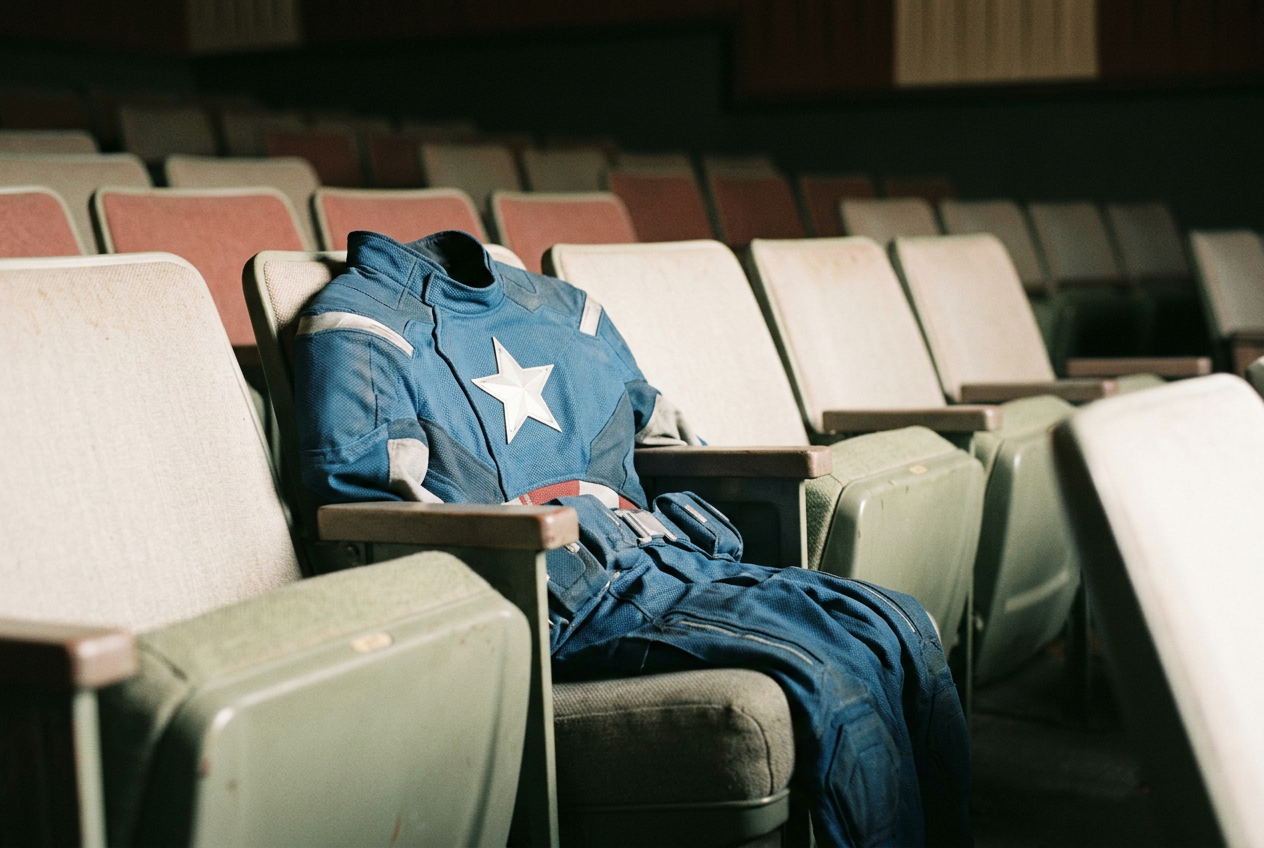
In Captain America: Brave New World, Sam Wilson has spent the film fighting for the right to inhabit a blue suit cut close through the torso, marked by a white chest star and attached to mechanical wings. It replaces the white Wakandan flight suit he wore in The Falcon and the Winter Soldier. The new uniform is less ceremonial and easier to read at speed. Captain America is no longer a borrowed title.
It fits him.
Then the movie leaves Sam behind.
After the main story ends, Samuel Sterns sits in prison and warns him about threats from other worlds. The scene provides no new understanding of Sterns, no consequence for Sam’s decisions and no emotional pressure on the relationship the film has spent its running time constructing between a Black Captain America and a United States government eager to use him. It points outward. Multiversal danger is approaching.
Keep the subscription. Remember the release calendar.
This is usually described as setup, a neutral word that makes an advertisement sound like carpentry. The more useful term is portfolio management. Marvel Studios controls a collection of characters, teams and story worlds whose value depends on continued circulation across movies, television series, licensing and merchandise. A franchise installment must earn money now while keeping several future combinations available.
Story becomes the interface through which those assets are moved.
The blue suit tells one story. The post-credit scene tells another.
A movie built from inherited obligations
Brave New World gives Sam a difficult assignment before the plot starts. He must follow Steve Rogers, close a television story, inherit material from The Incredible Hulk and reopen the Avengers file, all while carrying a film sold under his own name. Those obligations do not sit quietly in the background. They determine what can occupy the frame.
President Thaddeus Ross wants Sam to help reassemble the Avengers. Isaiah Bradley, whose history of imprisonment and medical exploitation gave The Falcon and the Winter Soldier its sharpest material, returns as a political liability after mind control turns him into an apparent assassin. Samuel Sterns returns from a film released long before the current shape of the Marvel Cinematic Universe had settled. Betty Ross reappears to complete her father’s emotional arc.
Bucky Barnes arrives briefly, carrying recognition from another branch of the franchise before departing toward his next assignment.
Each return creates an account the movie has to service. Sterns needs explanation. Ross needs transformation. Isaiah needs vindication.
Betty needs reconciliation. Bucky needs enough screen time to register but not enough to alter the plot. Sam, the supposed center, becomes the person who walks between these inherited claims and confirms that they still belong to the same corporate universe.
The cameos are not ruinous because audiences recognize them. Recognition can deepen a film when a returning face changes the present drama. The problem is allocation. Bucky’s appearance briefly activates a richer relationship than most of the movie has built, then withdraws it, because the character is being routed elsewhere.
Betty’s return gives Ross a reason to regain control after becoming Red Hulk, but her importance belongs mainly to his story. Isaiah’s ordeal should force the film to confront what Captain America represents when the state can still invade a Black veteran’s body. Instead, the conspiracy machinery swallows that argument.
Sam’s blue suit absorbs the damage. It is designed for direct action, with wings that function as propulsion, defense and weapon, yet the screenplay treats the man inside it as connective tissue. He can cross between Hulk continuity, presidential drama and Avengers planning because his job is to make unrelated holdings look like one story.
The loose thread is the product
A conventional unresolved subplot creates pressure within a film. It leaves a wound open or withholds an answer that changes how the completed story feels. Franchise suspension works differently. It preserves what financiers call option value, meaning the benefit of keeping a future choice available without committing to it now.
Brave New World accumulates that value aggressively. The discovery of adamantium around the Celestial Island can feed later stories involving global competition and, eventually, characters associated with the metal. Ross’s proposed Avengers revival remains available for another title. Sterns survives in custody.
The warning about other worlds opens a route toward whichever cross-dimensional threat Marvel chooses to prioritize. None of these routes must be followed immediately. Their usefulness lies in remaining usable.
That flexibility works for the studio. It hurts the movie because every preserved option competes with a present-tense consequence. Time spent making adamantium strategically important cannot deepen Sam’s public relationship with the country whose symbol he wears. A scene reserved for Bucky’s entrance cannot belong to Joaquin Torres, the new Falcon, whose partnership with Sam needs more than shared combat.
The post-credit warning cannot close the film’s argument about power because closure would reduce the number of doors left open.
This is why the deformation can be felt before the credits. Viewers trained by years of franchise scheduling stop reading a detail only for its dramatic meaning. A new metal is also a future casting announcement. A prison cell is storage.
A cameo is a routing notice. The film teaches you to inspect it as inventory, then asks for emotional investment in characters who have been arranged like inventory.
The mechanism is efficient. Marvel can advertise a future title inside a ticketed product, using actors and iconography that already command audience recognition. It can test enthusiasm without releasing a separate trailer. It can reassure shareholders and fans that dormant properties remain active, even when no complete story has been publicly committed.
The audience supplies both revenue and market research through box office, streaming behavior and online reaction.
Calling this fan service misses the transaction. Service implies the fan is the customer. Here, the fan also performs unpaid interpretive labor, matching symbols to announced projects, circulating screenshots and explaining how an unresolved beat could connect to another release. The studio receives promotion from the very incompleteness that weakens the film.
The replacement is already waiting
The ending becomes harsher when placed beside Thunderbolts*. That film turns its damaged group into the New Avengers, then uses a post-credit scene to introduce a Fantastic Four spacecraft and prepare another collision between properties. Sam’s possible Avengers team has barely become a proposition before a different team occupies the name and another franchise enters the sky.
This does not amount to an intricately planned world. It looks more like competing product lines being kept warm. The value comes from the promised convergence, so each movie must retain enough incompletion to make convergence necessary. A hero can win the immediate fight, but the franchise cannot permit him to settle the larger question.
Settled questions do not sell crossover events.
Brave New World’s final warning therefore functions less as an ending than as insurance against the film’s own dispensability. If audiences do not embrace this branch, the multiverse can redirect attention toward another. If they do, Sam can be folded into the next ensemble. Either result protects the portfolio.
Neither gives his film a reason to exist on its own terms.
The alternative is not complicated. End with Sam, Isaiah and Joaquin. Let the blue suit remain attached to the political problem it raises: who gets to represent a country that has exploited men like Isaiah while demanding patriotic performance from men like Sam. Marvel could still make another Avengers movie.
It would merely have to market that movie later, rather than making Brave New World carry the advertisement inside its closing minutes.
Instead, the suit completes its visual job and loses the argument. Sam has proven he can wear it, fly in it and survive a presidential monster in it. The studio remains more interested in where the costume can appear next.
Questions people ask
What does the
Captain America: Brave New World post-credit scene mean?
Samuel Sterns warns Sam Wilson that threats from other worlds are coming, pointing toward future multiverse stories rather than resolving this film’s conflict. The scene keeps several franchise routes open, but it adds little to Sam’s confrontation with Ross, Isaiah’s treatment or the political meaning of the Captain America title.
Why do
Marvel movies include so many unresolved subplots?
Loose plots preserve option value. Marvel can return to a character, object or conflict if another project needs it, while abandoning the thread if plans change. That flexibility protects the studio’s slate, but it shifts screen time away from consequences that would make the current movie feel complete.
Are post-credit scenes just trailers?
Some are jokes or codas, but scenes that introduce a new threat, team or property perform a trailer’s commercial job inside a paid movie. They direct attention toward the next release and recruit viewers to circulate clues, often before the present story has earned a proper ending.
Would removing the post-credit scene fix Brave New World?
No. The movie’s cameos and future-facing subplots already divide Sam’s story among several franchise obligations. Removing the Sterns scene would still improve the finish: the last image could belong to Sam’s blue suit and the country it represents, rather than another threat waiting outside the frame.
One update a day
Today's story, in your inbox
One story each morning — no hype, no filler, no algorithm deciding for you.