Club Sneaker Rules Let the Door Decide Who Looks Expensive
A black leather Samba can satisfy the written policy and still fail the person reading it. To test a dress code, you have to audit the door, not the website.
August 11, 2026 · 8 min read
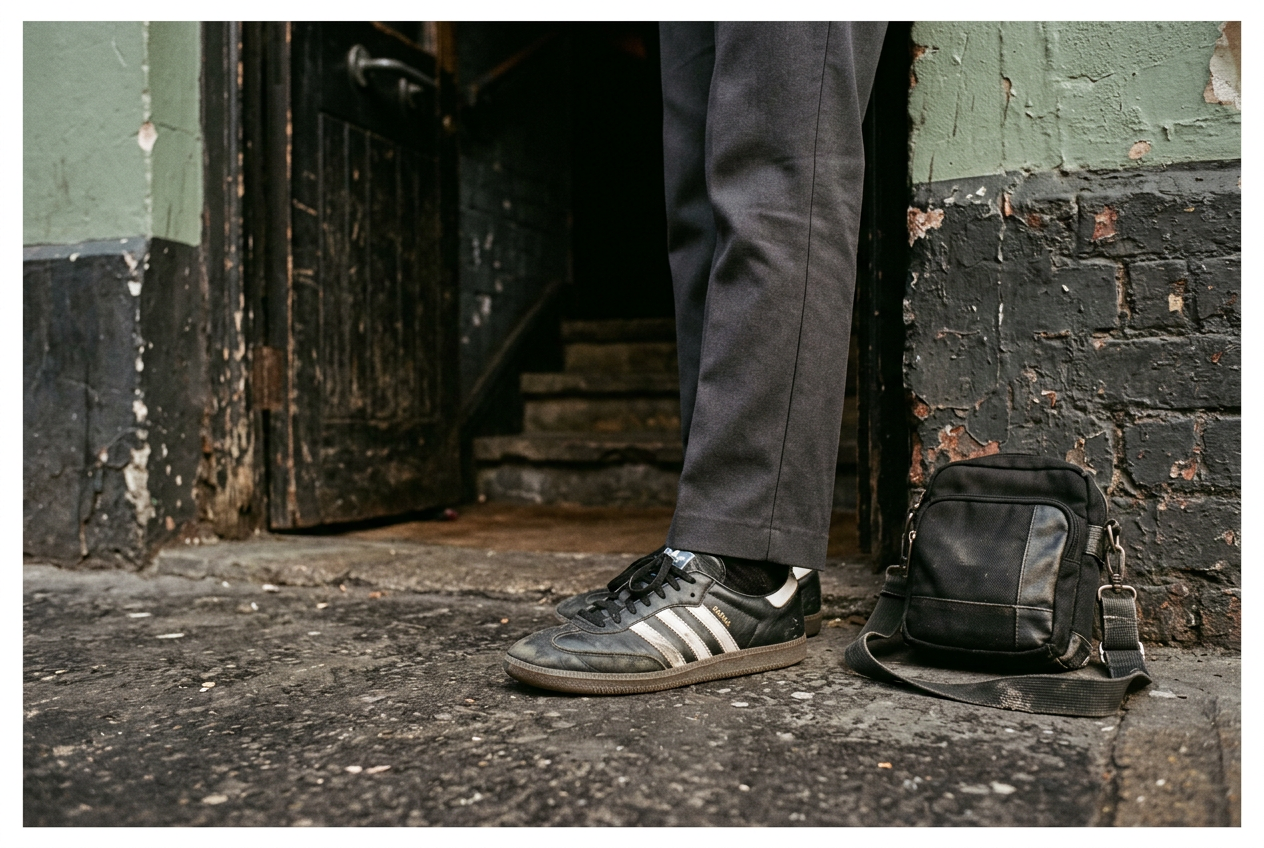
The test shoe is a black leather Adidas Samba OG with white stripes and a gum sole, worn under straight black trousers. It is clean. The leather upper is intact. Nothing flashes, lights up or exposes a toe.
In another setting, the shoe could pass for the safe choice made by someone who has read too many restaurant reservation emails.
At a club door, that certainty dissolves.
A rule against “athletic footwear” can catch the Samba because Adidas sells sportswear. A rule against “casual sneakers” can catch it because the gum sole reads casual to whoever controls the rope. A policy allowing “fashion sneakers” can admit the same shoe once the wearer’s coat, gender presentation, race, body, companions or perceived spending power changes how the entire outfit gets read.
This is the mechanism hidden inside nightlife’s most boring copy. The noun looks objective. The adjective keeps the power.
A proper field test would compare posted policies with repeated, time-stamped observations at several kinds of rooms across New York and New Jersey: a bottle-service club in Manhattan, a dance venue in Bushwick, a lounge in Jersey City, a Newark party space and a smaller bar where the person checking identification may also be managing the room. Without those observations, no responsible account can claim that a named venue rejected one guest and admitted another. The useful finding begins before the results: websites describe garments, while doors judge people.
The policy is written for deniability
Nightlife needs sorting. Capacity limits are real, intoxicated guests can endanger a room, and promoters often build parties around a musical or visual language that disappears if every evening becomes a generic walk-in crowd. None of that requires pretending a sneaker category can do the work.
Dress-code language gives a venue a legible reason for a decision that may have been made through several less legible impressions. “No athletic wear” sounds cleaner than “the room already has enough men who look like you.” “Upscale attire required” avoids naming the class performance being requested. “Management reserves all rights” closes the loop.
That last phrase matters. Door discretion is the authority staff retain to make admission decisions beyond the posted rule, often using demeanor, group composition, perceived intoxication, capacity or an undefined sense of fit. Some discretion protects the party. Broad discretion also lets a club turn bias into atmosphere and atmosphere into a defense.
The financial incentive is plain even when the door never mentions money. A venue does not maximize revenue by admitting guests in arrival order. It tries to construct a room that attracts higher-spending customers, keeps tables desirable, satisfies promoters and produces photographs that can market the next night. Clothes become a proxy for purchasing power because the door cannot inspect a bank account without ruining the fantasy.
The proxy is unstable. A pristine designer sneaker may be athletic by construction and “elevated” by price. A scuffed leather loafer may satisfy the letter of a no-sneakers rule while looking less formal than the Samba. The distinction is not material, function or cleanliness.
It is recognition. Staff must recognize the brand, recognize the styling and recognize the wearer as someone for whom bending the rule appears profitable.
Neutral wording helps because it moves the argument from discrimination to interpretation. The guest says the shoe is leather. The door says it is a sneaker. Both statements can be true, which means the venue owns the tie.
A real test needs matched entrances
One person wearing the black Samba once cannot establish much. The line changes with capacity, staff rotation, promoter, weather and the composition of the room at that moment. A rejection at midnight may reflect a crowded floor; admission twenty minutes later may reflect departing guests. Anecdotes flatten those variables, especially when the person telling the story already expects either racism or perfect fairness.
The stronger method is a matched-door audit, a test in which researchers hold clothing and timing as steady as possible while changing one visible characteristic at a time. The same Samba returns under the same trouser hem. The bag stays the same dimensions. Groups arrive within a narrow window, present valid identification and behave in the same calm way.
Each observation records the posted policy, the reason staff give, whether staff inspect the item closely and whether another guest wearing a comparable item enters.
That last comparison is difficult but essential. “No sneakers” means something different if every sneaker wearer is refused. It becomes discretionary when white leather Common Projects pass while a clean Nike Air Force 1 does not, or when a fashionable woman in a running shoe enters beside a man rejected for a lower-profile pair. Brand alone will not explain the result.
Styling, gender and racial coding arrive at the door together.
The audit must also separate safety rules from status rules. A prohibition on large backpacks can protect movement on a crowded floor and reduce the burden on security. A tiny crossbody bag rejected as “too casual” does not solve that problem. Bag size can be measured.
Casualness cannot.
Gender complicates the test further because many clubs enforce separate visual contracts without writing them down. A fitted top, bare leg or small handbag may signal compliance for one guest, while another is expected to wear a collared shirt, hard-soled shoe and trousers with no visible utility details. Nonbinary and gender-nonconforming guests can be penalized at the point where staff decide which unwritten contract applies.
The black Samba is useful here because it does not settle the question. It is low, leather and widely recognizable, with a gum outsole that preserves its sports origin. If the shoe passes on one body and fails on another, the material has not changed. The reading has.
The bag rule reveals the business model
Sneaker rules attract arguments because people care about shoes. Bag rules often show the venue’s machinery more clearly.
A specific size limit can connect to crowded-floor safety, coat-check capacity or security screening. The venue can publish dimensions, apply them to everyone and offer a workable check. Guests may dislike the inconvenience, but the rule has a physical object and a repeatable threshold.
“Backpacks discouraged” does something else. It lets staff admit the compact designer backpack, reject the commuter carrying a nylon daypack and treat both decisions as compliance. The practical burden lands on people arriving from work, traveling by public transit or carrying medication and other necessities. A guest with a car, hotel room or nearby apartment can stage a nightlife outfit around the door.
Someone crossing the Hudson with everything needed for the evening wears the commute on the body.
That is why the New York and New Jersey comparison matters. A dress code does not begin at the rope. It begins with the trip, the storage options and the cost of replacing a functional bag with one that looks ornamental enough to disappear into the room. The policy rewards people who can separate work, travel and nightlife into different containers.
Coat check can soften that burden, though only when it is open, affordable and willing to accept the item. Otherwise the guest pays for a ride home, abandons the night or negotiates with a worker who may have no authority to alter the rule. The venue keeps the language loose because loose language avoids promising a service.
“Fashion sneaker” is a price filter with plausible exceptions
Marketers have spent years carving sneakers into lifestyle categories that materials cannot support. Performance, luxury, streetwear and fashion sound like separate species until two rubber-soled leather shoes reach the same door.
The “fashion sneaker” exemption asks staff to recognize status quickly. Price helps, but price is not the entire signal. Scarcity, currentness, condition and the rest of the outfit can all change the verdict. A shoe becomes acceptable when it demonstrates that the wearer knew a sneaker might be risky and chose one expected to win the argument.
That favors cultural fluency. It also favors guests whose bodies are already read as belonging in the room. The expensive item does not purchase admission on its own; it gives the door a respectable explanation for admission.
For the venue, this ambiguity is useful. A strict no-sneakers policy would turn away guests wearing costly pairs and frustrate promoters trying to fill tables. A permissive policy would weaken the door’s ability to shape the crowd. “No casual sneakers” preserves both options.
The club can invoke the category when it wants exclusion and ignore it when admission is more valuable.
The Samba returns here as a control object. Clean it, photograph it before each attempt and keep the trouser break identical. If the explanations shift from “athletic” to “too casual” to “not tonight,” the changing vocabulary is part of the finding. The shoe has exhausted the rule.
The door has moved to taste.
Publish the exceptions or admit the policy is casting
A fairer dress code does not need to abolish judgment. It needs to distinguish safety, operations and aesthetic casting.
Venues can publish measurable bag dimensions, identify footwear barred for physical reasons and state whether coat check accepts oversized items. If a party requires a specific style, the promoter can name that style without laundering it through “upscale.” Visual examples would expose contradictions faster than another paragraph of luxury adjectives.
Enforcement records would help management see patterns it might otherwise deny. Staff could log the stated reason for refusal through a short internal form, then compare those reasons across shifts and promoters. That creates administrative work, and nightlife operators rarely volunteer for paperwork that could document inconsistency. The cost is part of the point.
Discretion feels efficient because rejected guests absorb the error.
A field audit should therefore publish uncertainty rather than force every refusal into one accusation. Capacity may explain a night. Intoxication may explain a guest. Repeated mismatches between policy and admission, especially when the same item receives different treatment across perceived gender or race, reveal the structure that a cleanly written dress code conceals.
The black leather Samba cannot prove intent. It can show when footwear stops being an explanation.
Questions people ask
Can a nightclub legally enforce a dress code?
Nightclubs generally may set dress and admission policies, but neutral wording does not excuse unlawful discrimination. The legal question depends on jurisdiction and facts beyond a single refusal. This analysis is about how to document enforcement patterns, not how an individual guest should pursue a claim.
Why do clubs ban sneakers if expensive sneakers are allowed?
The exception helps venues preserve discretion. Staff can reject a shoe as casual when they want to limit admission, then recognize another sneaker as fashionable when the wearer, brand or group appears valuable to the room. The category works because it has no stable material threshold.
How can dress-code enforcement be tested fairly?
Use repeated matched visits, keep clothing and arrival conditions consistent, record the posted rule and note the reason given at the door. Comparable guests and comparable items matter more than one dramatic rejection, because capacity, staffing and promoter changes can distort a single night.
Are bag restrictions always discriminatory?
No. Measured size limits can address crowd movement, screening and storage. Trouble begins when vague labels such as “casual” or “inappropriate” replace dimensions, especially if staff admit ornamental bags while rejecting functional ones of similar size.
One update a day
Today's story, in your inbox
One story each morning — no hype, no filler, no algorithm deciding for you.