Dolby Atmos Keeps the Boom While Your TV Buries the Dialogue
The theatrical mix is only half the problem. A controlled test with Dune: Part Two shows how TV defaults, downmixing and thin speakers turn cinematic range into subtitle duty.
August 11, 2026 · 8 min read
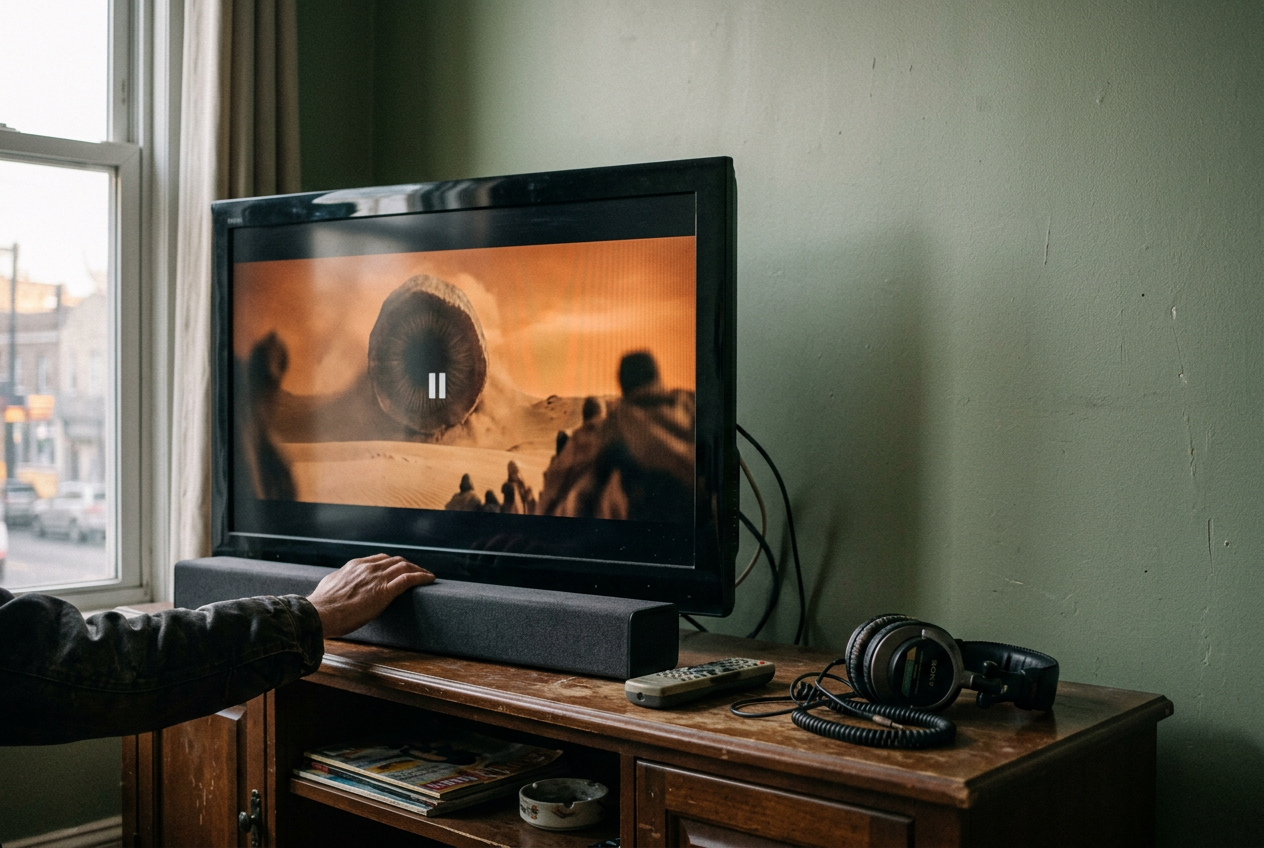
The sandworm ride in Dune: Part Two is useful because it makes every part of a home setup declare its loyalties. The scene has wind, machinery, a vast low-frequency rumble and shouted instructions that need to remain intelligible without sounding detached from the environment. It is designed to overwhelm Paul. It should not defeat the person holding the remote.
I used that sequence as the anchor for three passes: television speakers, a soundbar with a dedicated center channel and closed-back headphones. Civil War supplied a second check because its sudden gunfire and quieter exchanges expose dynamic-range problems quickly. The point was not to crown a product category. It was to separate information missing from the mix from information mangled after the stream reached the room.
That distinction matters. Dolby Atmos gets blamed whenever dialogue disappears, but Atmos is a delivery format, not a single house style. It lets mixers place sounds in a three-dimensional field using channels and audio objects, which are sounds packaged with instructions about where they should appear. Speech may still sit mainly in the center channel.
The trouble starts when a television must translate that larger sound field into two small drivers firing downward or toward a wall.
The mix survives better than the room
A theatrical mix can hold quiet dialogue far below its loudest effects because a cinema has calibrated speakers, controlled acoustics and enough amplifier headroom to reproduce a sudden peak without flattening everything around it. Dynamic range is that distance between the quietest and loudest useful sounds. Filmmakers use it as form: scale arrives through contrast, not permanent volume.
Streaming services generally want to retain that contrast, especially when an Atmos badge helps present a title as premium. They typically deliver Atmos in a compressed Dolby Digital Plus stream, while discs can carry it through higher-bandwidth formats. Either route may preserve the dramatic relationships in the mix. Neither can guarantee what the television does next.
On the TV pass, the Dune: Part Two sandworm scene kept its broad shape. The low end thinned out because the speakers could not move enough air, yet the effects still triggered aggressive processing and occupied much of the available output. Dialogue became the fragile layer. Raising the volume helped the words, then made the next impact excessive.
That familiar remote-control loop is dynamic range meeting inadequate playback, not proof that the dialogue track vanished.
A television also performs a downmix, meaning it combines a multichannel soundtrack into fewer speakers. Done well, center-channel speech remains stable. Done poorly, or followed by spatial processing that tries to make two speakers sound wider, the voice can lose level and clarity while effects spread impressively across the cabinet. The demo sounds expansive.
The sentence does not.
Run the test without changing the evidence
Use one version of the film and replay the same short sequence. Do not compare a disc on the soundbar with a browser stream on headphones, because different apps and devices may request different audio tracks. Confirm that each pass is receiving the same language track and note whether the service labels it Atmos, 5.1 or stereo.
Turn off sound presets first. Modes called cinema, immersive or virtual surround often alter frequency balance and width, which makes them part of the test rather than neutral ground. Disable volume leveling, night mode and dialogue enhancement for the initial pass. Set a comfortable level during ordinary speech, then leave the remote alone through the loud section.
Listen for two separate failures. If speech is present but masked whenever music, wind or effects rise, the playback system may lack headroom or be reproducing the mix badly. If particular lines remain recessed across the TV, soundbar and headphones at sensible levels, the problem points back toward creative choices in recording or mixing. Some performances are murmured.
Some production sound is rough. Atmos does not sneak onto set and lower an actor’s chin.
A center channel changes the argument
The soundbar pass made the sandworm ride easier to follow without shrinking it into background television. The important feature was not the upward-firing Atmos drivers. It was the center channel, a physical speaker path assigned largely to dialogue in conventional screen mixes.
That separation gives speech somewhere to live when the rest of the soundtrack becomes dense. A soundbar still performs processing, and a narrow unit cannot reproduce a cinema, whatever its packaging suggests, but it does not have to force the same pair of tiny drivers to carry voices, bass and spatial effects at once. In Civil War, the distance between conversation and gunfire remained abrupt while the spoken material held together more reliably.
This is also where settings can expose the difference between a bad default and a bad mix. A modest center-channel lift can improve intelligibility without compressing the whole soundtrack. Dialogue enhancement is broader and less predictable: some implementations identify vocal frequencies and raise them, which can also emphasize hiss, room tone and brittle consonants. Useful, sometimes.
Invisible, rarely.
Headphones remove the room, not the decisions
The headphone pass was the cleanest diagnostic because it removed reflected sound, speaker placement and the television cabinet. Atmos over headphones is usually rendered binaurally, meaning the multichannel scene is translated into two ear signals that simulate direction. Even ordinary stereo playback can reveal whether a line exists clearly in the source.
Dune: Part Two remained forceful, but the words no longer had to compete with room acoustics or drivers aimed at furniture. That does not make headphones the authoritative version. The bass reaches the ears rather than the body, and spatial scale becomes an interpretation. They are still the fastest way to check the central complaint.
If a line becomes clear immediately on headphones, the home playback chain deserves more suspicion than the mixer.
If it stays buried, do not let the Atmos logo take the entire charge. Dialogue can be recorded softly, performed with little projection or deliberately placed inside noise. Directors and mixers sometimes prefer environmental realism over effortless comprehension. That is a choice open to criticism.
The format merely preserves and transports it.
Fix the defaults before buying another box
Start by selecting the best-supported output rather than the fanciest label. A TV feeding its own speakers may behave more predictably with a stereo track than with an Atmos stream it must fold down. If the app offers a plain 5.1 or stereo option, compare it during the sandworm ride.
Clearer dialogue in stereo is evidence that the downmix or spatial processing was hurting the center information.
Next, disable virtual surround and automatic sound modes. Try night mode afterward. Night mode applies dynamic-range compression, reducing the distance between quieter speech and loud peaks, so it sacrifices some impact to make the film usable at domestic volume. That trade is more honest than repeatedly raising and lowering the master level.
For a soundbar, verify the connection and output setting. HDMI eARC, an enhanced audio-return connection, can carry higher-bandwidth formats from a television to compatible audio equipment. A mismatched passthrough setting may cause the TV to decode or convert the stream before the bar receives it. The exact menu language changes by manufacturer, naturally, because consumer audio needed another small administrative burden.
Do not buy rear speakers to solve a center-channel problem. Do not buy an Atmos badge to solve weak dialogue. A soundbar with a real center channel can be worthwhile; headphones may already provide the diagnostic clarity required. The cheapest successful intervention is often changing the track, turning off fake width or accepting night mode’s reduced theatrical punch.
The industry’s incentive is to keep the premium master and the premium badge moving through the pipeline. There is less glory in making every television negotiate that master sensibly through bargain speakers in a reflective room. Cinematic dynamic range survives the trip home because it helps sell fidelity. Intelligibility becomes your settings problem.
Return to the sandworm ride after each change. If the rumble still has scale and the instructions remain legible without a hand on the remote, the system is doing its job. Stop there.
Questions people ask
Does Dolby Atmos make dialogue quieter?
Not by itself. Atmos can carry a mix with wide dynamic range, while your television’s downmixing, spatial processing and limited speakers can leave center-focused speech less intelligible than effects. A line that clears up on headphones or a dedicated center channel usually points toward playback rather than missing dialogue information.
Should I turn off Dolby Atmos on my TV?
Compare the Atmos track with 5.1 or stereo during the same scene. If stereo produces clearer speech through the television’s own speakers, use it there; the simpler track may suit that hardware better. Keep Atmos when an external system can decode and reproduce it without compromising the center.
Why does night mode make speech easier to hear?
Night mode compresses dynamic range, bringing quiet material and loud peaks closer together. That means dialogue needs less volume to remain audible, while explosions lose some force. It changes the intended contrast, but it is often a sensible domestic compromise rather than a technical failure.
Will a soundbar fix every badly mixed film?
No. A soundbar with a dedicated center channel can improve separation and reduce damage from a television’s tiny speakers, but it cannot repair dialogue that was recorded poorly or deliberately buried. Test headphones first. If the same line remains unclear there, more hardware may only reproduce the choice more expensively.
One update a day
Today's story, in your inbox
One story each morning — no hype, no filler, no algorithm deciding for you.