New Jersey Buys the Police Drone Before Writing the Rules
Municipal purchase records describe powerful drone systems in exact detail. The public policies governing where they fly, what they keep and who gets the footage are often thinner or later.
August 11, 2026 · 8 min read
The revealing document is not the police drone policy. It is the purchase order.
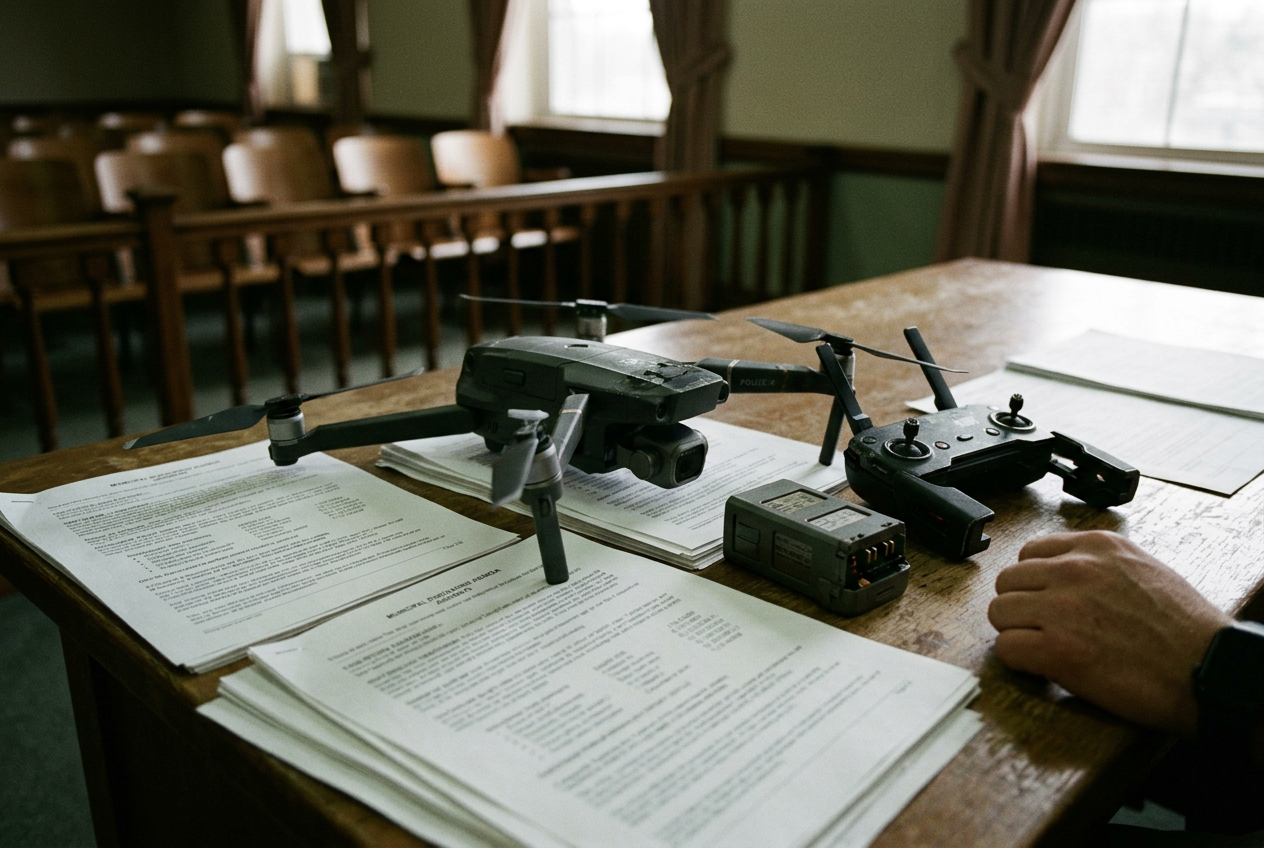
In municipal purchasing materials from New Jersey, a drone can appear as a compact block of administrative prose: airframe, controller, batteries, camera payload, training and support. A DJI Matrice 300 RTK package, the kind of commercial system that appears in public-safety procurement records, is not described there as a debate about persistent observation. It is equipment. Someone has checked the budget line, the vendor has described the payload, and the governing body is being asked to approve the expense.
That line item is the anchor because it tells the truth more efficiently than the eventual policy. The aircraft can carry zoom and thermal-imaging cameras. Extra batteries extend operating time. The controller lets an officer watch from somewhere other than the scene.
Training turns a boxed product into an institutional capability. None of this determines how the drone must be used, but it establishes what the department can do before residents have secured enforceable limits on where it flies, how long footage survives or which other agencies receive it.
New Jersey’s fragmented municipal system makes that sequence easy. Police departments identify operational needs, vendors package equipment around those needs, purchasing staff route the transaction through ordinary approval channels, and councils encounter the drone as a procurement matter rather than a constitutional choice. Public comment may technically be available. Meaningful argument is harder when the relevant item sits between vehicle maintenance and another professional-services contract.
The public gets a spending decision. The department gets an aerial sensor.
Procurement is the first surveillance policy
Procurement records tend to be exact where public rules are vague. They identify hardware, accessories, maintenance and training because those details affect price and contract performance. A policy may say that a drone will support public safety, document incidents or help locate missing people, phrases broad enough to cover the sympathetic cases everyone imagines and many less sympathetic ones they do not.
The asymmetry matters. A thermal camera detects heat differences rather than producing an ordinary color image, allowing an operator to find a person in darkness or scan terrain that officers cannot easily reach. A zoom camera can observe from farther away. Neither feature is inherently abusive.
Both expand the distance between the person being watched and the institution doing the watching, which reduces the practical warning that surveillance is occurring.
Once the Matrice package is purchased, the burden changes sides. Before acquisition, officials could be required to explain the proposed missions, estimate recurring costs, publish a use policy and obtain legislative approval for both. After acquisition, restrictions can be characterized as obstacles to using equipment taxpayers already bought. The sunk cost becomes an argument for deployment.
This is why the familiar council presentation about emergencies is incomplete. Search and rescue, hazardous scenes and crash documentation are functions with obvious public value. They also sell the purchase. The harder decisions concern routine patrol, protests, backyards visible from public airspace, automated dispatch and repeated flights over the same blocks.
Those questions rarely fit inside a vendor quote, so the quote advances while the argument waits.
A drone does not need artificial intelligence or facial recognition to alter police power. Cheap repeatability is enough. A helicopter requires specialized crews, fuel and substantial operating expense. A commercial quadcopter can be launched by trained department personnel, and each successful deployment supplies an institutional reason to buy another battery, train another operator or place another aircraft closer to anticipated calls.
The purchase order is therefore more than evidence that a municipality owns a device. It is the first policy choice, made in the language of inventory.
The gaps are where the program lives
A useful drone policy should answer several narrow questions. It should specify which incidents permit launch, who authorizes flight, whether a warrant is required for targeted surveillance, how bystanders are minimized, how footage is logged, when it is deleted and which outside agencies can obtain it. It should also state whether the department may connect the aircraft to automated dispatch or launch it routinely as a first responder.
Drone as First Responder, usually shortened to DFR, means dispatching an aircraft to a call before or alongside officers on the ground. The model can give police an earlier view of a scene. It can also convert emergency dispatch into a remote aerial-observation system, particularly when drones are stationed for rapid launch rather than carried to exceptional incidents.
Publicly available New Jersey policies do not always match the specificity of the equipment records. Some departments publish general unmanned-aircraft rules. Others place drones inside broader directives covering photography, evidence or specialized equipment. Records obtained through the New Jersey Open Public Records Act can reveal additional manuals, but a resident should not need a records request and a working knowledge of police-policy numbering to learn whether an aircraft may hover over the block.
Retention is where bland wording does serious work. A policy may distinguish evidentiary footage from material with no apparent value, then permit retention under separate evidence schedules once an officer classifies a recording as relevant. That classification matters more than a headline deletion period. It decides whether an incidental flight becomes a durable police record.
Storage location matters too. Footage may remain on removable media, move to a department server or enter a digital-evidence platform supplied by a contractor. Each transfer creates another set of permissions and audit questions. A rule saying that the department owns the footage does not explain which vendor personnel can maintain the system, whether another agency can receive an export or how investigators document access.
Sharing can be equally elastic. Mutual-aid relationships, county prosecutors and task forces are ordinary parts of New Jersey policing. A policy that permits disclosure for law-enforcement purposes may therefore authorize a wider circulation network than residents infer from the phrase. The drone belongs to one municipality.
Its images need not stay there.
The Matrice line item says what camera was bought. A thin policy may never say how many institutions can watch what it records.
The incentive is to postpone the limits
Police departments have a rational reason to seek flexible language. Officials cannot predict every emergency, and a policy with narrow permitted uses may require amendments as missions change. Vendors have a parallel incentive: sell a platform capable of expansion, then offer software, support, replacement aircraft and integrations after the agency has trained personnel around it.
Residents have the opposite problem. The moment when they possess the most leverage is before the contract, when officials can still condition approval on public rules, reporting and deletion requirements. Municipal procedure often separates those matters. Purchasing goes through budget resolutions and contract approvals; operational policy remains inside the department, subject to legal review and the chain of command.
One process has a scheduled vote. The other can arrive later.
That division lets elected officials claim a narrow role. Council members approved equipment, not tactics. Police administrators set tactics, not budgets. The vendor supplied technology, not policy.
Each statement can be formally defensible while the surveillance system emerges from the gaps between them.
Courts do not repair this structure. Constitutional rules can restrain targeted searches, particularly where police intrude on protected spaces or use technology in ways that expose details unavailable through ordinary observation. They do not provide a complete municipal operating manual. A lawsuit also arrives after a deployment, requires a person with standing to challenge it and addresses a legal violation rather than every bad public-policy choice.
Procurement oversight works earlier. A municipality can require a surveillance impact report before purchase, meaning a public document that describes the proposed uses, data flows, costs and civil-liberties risks. It can make council approval contingent on a published policy, prohibit secondary uses without another vote and require annual reports listing flights, purposes, complaints, sharing and retention. Those are governance choices, not technical obstacles.
They impose costs. Officers and municipal lawyers must write rules before the hardware arrives. Councils must hold hearings longer than a routine consent-agenda item. Departments lose some discretion, and vendors face questions that may slow a sale.
That inconvenience is the point. Surveillance becomes easy when every institution involved is allowed to treat its own decision as too small to count.
Buying capacity changes the next debate
After purchase, even an unused drone affects policy. The department has trained pilots. Supervisors know the camera’s reach. Emergency managers can request access.
Neighboring agencies know the aircraft exists. A later proposal to expand deployment no longer sounds like the creation of a surveillance program; it sounds like fuller use of an existing asset.
This is the institutional trick hidden inside the sequence. Capability accumulates through ordinary transactions, while restraint must arrive as an exceptional political act. The municipality does not announce that it has altered the balance between police visibility and public anonymity. It approves a device, then develops practices, then writes down some portion of those practices after officers and budgets have adjusted around them.
New Jersey municipalities do not need to ban police drones to reverse that order. They need to treat the line item as the beginning of the argument rather than proof that the argument is over. No funds should move until residents can compare the proposed camera package with rules governing deployment, retention and sharing on the same agenda.
Otherwise, the Matrice purchase order will remain the clearest document in the file. It describes the power precisely. The policy describes the promises.
Questions people ask
Can
New Jersey police fly a drone without a warrant?
It depends on the mission, location and degree of targeted observation. Constitutional search rules and aviation regulations set some boundaries, but they do not answer every operational question. A strong local policy should identify when officers must obtain a warrant rather than relying on a broad claim that every flight will comply with existing law.
How long can police keep drone footage?
Retention depends on the department’s written rules, evidence schedules and how an officer classifies the recording. Footage treated as evidence may remain far longer than routine material. Residents should look beyond a stated deletion period and ask where files move, who changes their classification and whether every access or export is logged.
Can one police department share drone video with another?
Often, policies allow sharing for law-enforcement, prosecutorial or mutual-aid purposes, though the wording and approval requirements vary. The meaningful safeguards are narrow purposes, documented requests, access logs and deletion rules for the receiving agency. A promise that footage will not be released publicly says little about circulation inside government.
What should happen before a municipality buys a police drone?
Officials should publish the proposed hardware, full cost, intended missions, retention rules, sharing terms and vendor data arrangements before a public vote. The use policy should take effect with the purchase, and later expansions such as routine first-response flights should require another vote rather than an internal change in police practice.
One update a day
Today's story, in your inbox
One story each morning — no hype, no filler, no algorithm deciding for you.