New Jersey Schools Buy AI Detectors. Students Get the Risk.
Districts buy Turnitin and similar tools as ordinary software, then let probabilistic scores migrate into misconduct cases. The contract rarely says how much evidence a percentage should become.
August 11, 2026 · 7 min read
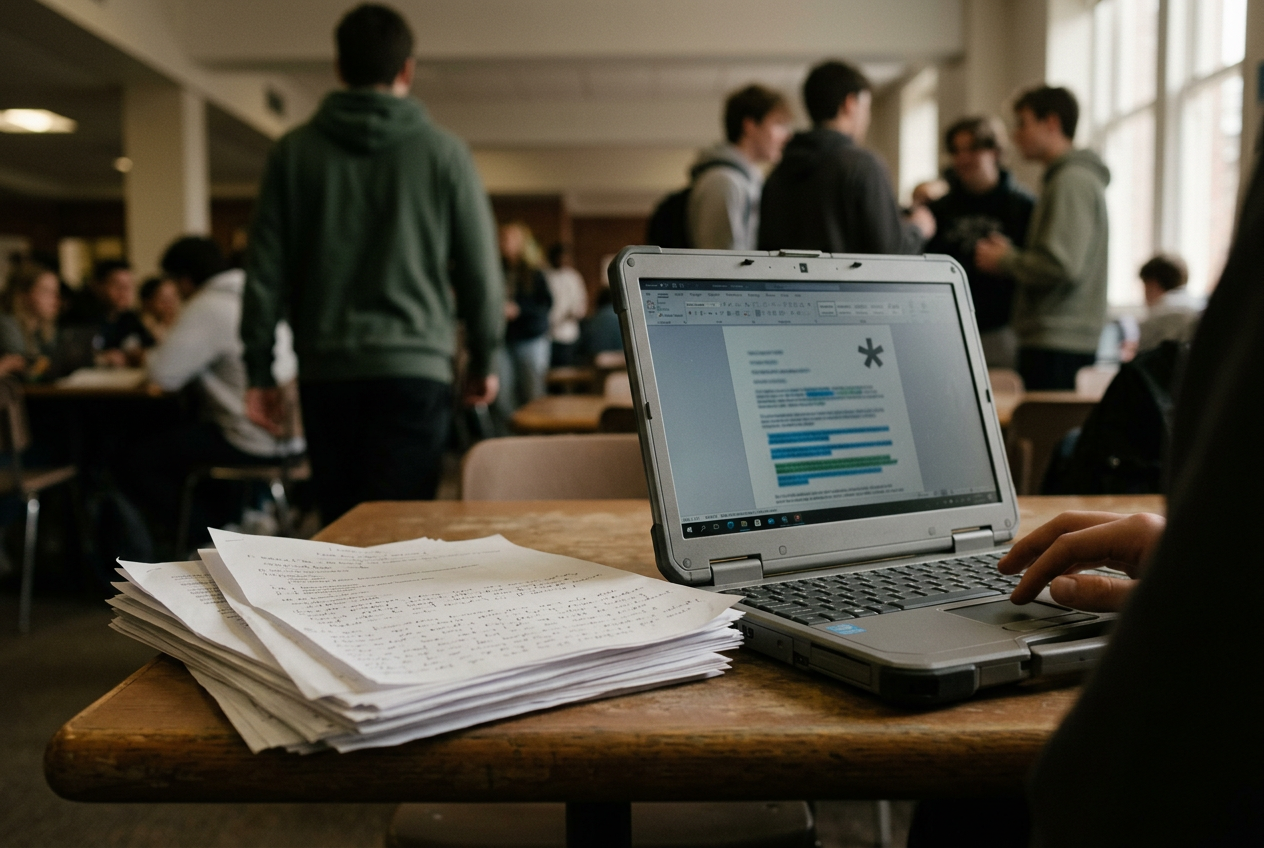
Start with the asterisk.
Turnitin’s AI-writing report can replace a precise score below 20 percent with an asterisk, a design choice the company explains by noting that results in this range carry a higher incidence of false positives. The familiar similarity report is different: it marks text that overlaps with material in Turnitin’s databases and assigns a percentage, which can reflect quotations, references, boilerplate or copied prose. Neither number decides plagiarism by itself. Turnitin’s own documentation tells educators to apply judgment and gather more information.
Yet the software reaches a New Jersey classroom through a purchasing system built to answer another set of questions. A district approves a subscription. The bill list names a vendor. An account code places the expense among instructional technology, curriculum or software.
Administrators provision accounts, connect the product to a learning-management system, and make the report available beside the student’s submission.
The distance between invoice and accusation is short. The evidentiary rule governing that trip is often nowhere near the purchase order.
The purchase becomes infrastructure
Public New Jersey board packets, bill lists and district materials show how plagiarism services become ordinary school machinery. Turnitin appears as a subscription or instructional platform rather than as an investigative instrument, while other districts advertise access to products that market AI detection alongside authorship analysis, originality checking or automated feedback. The procurement record can establish who was paid and sometimes which department paid them. It rarely explains what happens when the product points at a child.
That omission matters because buying software changes the default. A teacher who once had to notice a suspicious shift in style, search for a matching source and speak with the student can now receive a colored report automatically. The system has already framed the paper as an object requiring inspection. Its output arrives with percentages, highlighted passages and interface polish, all the visual grammar of measurement.
Districts are not purchasing a finding of guilt. They are purchasing a workflow that makes suspicion cheaper to produce.
The vendor benefits from scale: one contract can place its product across subjects and grade levels without requiring a fresh purchasing decision for every assignment. The district gets a manageable response to faculty anxiety about ChatGPT and copied work. Teachers get something that looks faster than reconstructing how an essay was written. Students supply the text, and depending on district settings and product terms, submissions may also enter a repository used for later comparison.
The incentive is plain. Schools have more writing to assess than staff time to assess its provenance, while vendors sell an answer that converts uncertainty into a dashboard. The dashboard does not need to be conclusive to earn its renewal. It needs to feel operational.
A percentage enters the discipline system
A similarity score measures matching text. An AI-writing score estimates whether passages resemble text generated by a model, using patterns learned from examples rather than identifying a hidden signature left by ChatGPT. These are separate claims, although a rushed disciplinary process can flatten both into the same allegation: the student did not write this.
Once a report is generated, the teacher may compare it with earlier work, ask for drafts, inspect document history or hold a conference. That is the careful version. The less careful version treats the number as a test result and asks the student to disprove it, even though the student cannot inspect the detector’s model, training data or internal weighting.
New Jersey school discipline remains heavily local. District codes commonly prohibit plagiarism, cheating and unauthorized assistance, but a rule written for copied passages does not automatically settle what counts as impermissible AI use. A student might use a grammar tool, an approved translation aid, autocomplete, a chatbot-generated outline or an entire generated draft. The policy has to distinguish those acts before the detector can contribute anything useful.
Procurement does not force that distinction. A board can approve the software without adopting a public evidentiary standard for its reports, defining who may view them, or specifying what corroboration a teacher must obtain before lowering a grade or referring a case. The contract buys access. The student handbook supplies the penalty.
Institutional habit bridges the gap.
This is where the asterisk returns. Turnitin withholds a precise low-range AI percentage because precision there would overstate reliability, but the symbol can still preserve suspicion. A teacher sees that the detector found something. A student sees an accusation that cannot be reproduced outside a proprietary system.
The caution changes the display without removing the power relationship.
The vendor warning does not follow the score
Vendor documentation generally presents detection as one input into a broader review. That caveat is sensible and commercially useful. It limits the claim while allowing the product to remain embedded in high-stakes decisions.
Inside a classroom, however, the percentage travels better than the warning. It fits into an email, a grade comment or a referral form. The qualification requires more work: reading technical documentation, understanding which kinds of prose the model supports, noting the product version, and checking whether the text met the conditions under which the vendor says its detector should operate.
Independent researchers and public reporting have repeatedly found that AI-text detectors can misclassify human writing and can be evaded by edited machine output. The risk is not evenly distributed. Formulaic academic prose can resemble model output, while writers using English as an additional language may produce the predictable syntax detectors associate with generated text. A polished false negative and a plainspoken false positive can therefore pass each other in the hallway.
No detector can recover a writing process from the final document alone. It can classify surface patterns. That difference becomes crucial when punishment depends on authorship, intent and the rules in force when the assignment was set.
The strongest evidence usually sits elsewhere: version history showing a document develop, research notes, saved drafts, source trails, or a student’s ability to explain a choice in the paper. None is perfect. Together they examine conduct rather than asking a probability score to impersonate a witness.
They also cost staff time. That is the hidden economy of the purchase. Automated suspicion is inexpensive once the district has paid for seats; a fair investigation requires a teacher or administrator to read, compare, meet and document. The software works for the institution because it compresses that labor, then leaves the student to demand that it be restored.
Procurement asks the wrong questions
School software review tends to focus on price, privacy terms, cybersecurity, accessibility and compatibility. Those checks matter, especially when student writing moves to an outside company’s systems. They do not answer how much evidentiary weight a report should carry.
A district evaluating a detector should have to connect the contract to a written use policy. That policy should identify the product and the output being used, prohibit discipline based on a detector alone, preserve the report and relevant drafts for an appeal, and tell students which forms of AI assistance an assignment permits. If the vendor changes its model or scoring display, the district should review the rule rather than pretending the subscription stayed the same because the logo did.
Public records can expose part of this chain. Board agendas and bill lists identify purchases. Contracts, statements of work and data-protection agreements can show what the district bought, how long data may be retained, whether student submissions enter a comparison repository, and which subcontractors handle them. Handbooks and academic-integrity policies reveal whether anyone wrote rules for using the output after it arrived.
The missing document is often the most important one: the standard that says when a highlighted report becomes enough to punish a student.
Without that standard, human review becomes ceremonial. An administrator can say a person made the final decision while leaving the proprietary score to set the accusation, define the scope of the meeting and shift the burden onto the student. A human being somewhere in the chain does not cure automation bias, the tendency to defer to a computerized output because it appears objective.
The alternative is less sleek. Teachers can design staged assignments, require notes or drafts, discuss sources, and assess whether students can account for their own decisions. Schools can reserve detector reports for prompts to investigate, never findings to adopt. That approach costs time, which is precisely why the subscription looked attractive.
The procurement line remains useful evidence, just not evidence against the student. It shows where the district placed its money and trust. Beside it sits the asterisk, warning that even the seller knows the number can say more than the system knows.
Questions people ask
Can Turnitin prove that a student used AI?
No. Its AI-writing output estimates whether qualifying prose resembles machine-generated writing. Turnitin tells educators not to use the score as the sole basis for adverse action, so a school should examine drafts, document history, sources and the student’s explanation before reaching a conclusion.
Is a high similarity score proof of plagiarism?
No. A similarity score reports text that matches material in Turnitin’s databases. Correctly quoted passages, references, assignment language and common phrasing can raise it, while plagiarism that does not match indexed material may escape it. A person must inspect the highlighted sources and apply the assignment’s rules.
What should a student receive during an AI-cheating inquiry?
At minimum, the student should be shown the report being relied upon, the applicable academic-integrity rule and the other evidence supporting the allegation. A usable appeal also requires enough information to challenge mistakes, including which tool produced the result and whether the decision relied on drafts or document history.
What do procurement records reveal about school writing detectors?
They can identify the vendor, subscription, paying department and contract documents, including data terms when those records are public. They usually do not reveal how teachers interpret scores or how often reports lead to punishment, which is why purchase records must be read beside handbooks, classroom policies and appeal procedures.
One update a day
Today's story, in your inbox
One story each morning — no hype, no filler, no algorithm deciding for you.