New Jersey Streams Its Meetings, Then Loses the Record
An audit of five municipal archives found a familiar bargain: residents can watch government live, but finding the same discussion later may require platform archaeology.
August 17, 2026 · 8 min read

The small blue Video link on Newark Municipal Council’s Legistar calendar looks like public access reduced to its most useful form. Pick a meeting. Open the agenda. Watch the record.
No ceremonial trip to City Hall, no request to a clerk, no need to know which department owns the answer.
That link is also where the trouble begins. A meeting archive only works when the agenda, minutes, video and captions remain connected after the livestream ends. Break those connections and the public record still exists in the technical sense, scattered between a municipal calendar, a vendor player, a PDF repository and perhaps YouTube. The resident gets a scavenger hunt.
NoAlgo reviewed the public-facing meeting archives of Newark, Jersey City, Trenton, Paterson and Elizabeth, New Jersey’s five largest municipalities, checking how an ordinary user could locate an older meeting, search its agenda, follow a durable video link, use captions and learn how long the material would remain online. This was a usability audit, not a legal compliance ruling, and archive features can change without notice. That last part is one of the findings.
The cities do not all fail in the same way. Some provide structured calendars with meeting-level pages. Others lean more heavily on video channels or document folders. Captions may appear because a platform generated them, while agendas often live elsewhere as PDFs.
Plain-language retention promises were difficult to find on the archive surfaces reviewed. The shared mechanism is fragmentation: each contractor or department completes its assigned task, yet nobody is clearly responsible for making the whole meeting retrievable five years later.
The livestream is the easy purchase
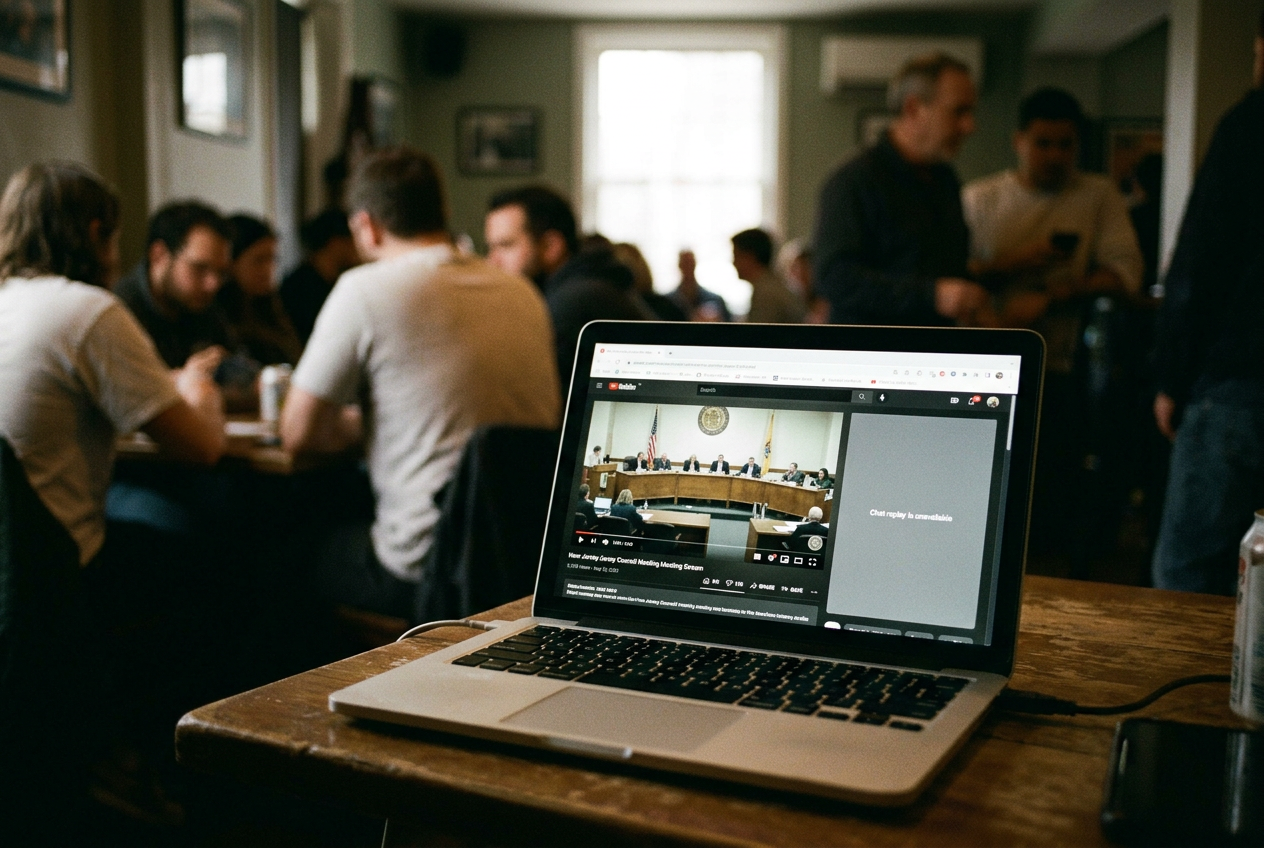
Municipal streaming solves an obvious political problem. Officials can say the meeting was public, residents can watch from home, and a vendor can sell a familiar package containing a player, calendar and archive. The stream also produces an immediate artifact for social media, where a clipped exchange can circulate before the minutes are approved.
Archiving asks more of the institution. Someone has to preserve the file, keep its URL working, attach it to the correct agenda and expose enough text for a search engine to understand what happened. Captions need correction or at least preservation. Old pages need migration when the city replaces a vendor.
None of this creates the visible satisfaction of a red LIVE badge.
The incentive follows the procurement. A streaming contract can be evaluated through uptime and picture quality, while archival usefulness requires standards that survive the contract itself: exportable files, persistent identifiers and searchable text owned or controlled by the municipality. A persistent identifier is a stable reference that should still point to the same record after a website redesign. If the request for proposals does not demand one, the vendor has little reason to build municipal memory on the city’s behalf.
This is how visibility becomes a performance metric while retrieval becomes the resident’s unpaid labor.
Five cities, one fractured record
Newark’s Legistar calendar offers the clearest version of the blue-link model. Legistar, a legislative records system sold by Granicus, can place agendas, minutes and video references on a meeting entry rather than dumping every artifact into a general media page. That structure matters. A resident searching by meeting date can move between records without first learning the city’s internal filing habits.
Yet even a well-labeled Video field cannot answer the larger questions by itself. The useful record depends on the linked player remaining available, the calendar retaining its old entries and the city preserving the relationship between them during the next migration. The blue link is access today. It is not, by its color or existence, a retention policy.
Across Jersey City, Trenton, Paterson and Elizabeth, the public paths varied, but the same weak points recurred. Meeting videos and legislative documents often occupied different interfaces. Finding the video did not guarantee finding the agenda beside it. Finding an agenda did not mean its contents were searchable.
A channel search could surface titles and descriptions while missing the words spoken inside the meeting, particularly when captions were absent, inaccurate or unavailable to outside search engines.
This distinction is easy to miss because a video channel feels searchable. Type the mayor’s name and something appears. Type the name of a redevelopment entity, a street affected by a zoning change or the contracted service buried under a generic agenda heading, and the limits become clearer. Platform search ranks what it has indexed, using rules the municipality neither controls nor explains.
A resident should not have to know whether a council calls its event a regular meeting, legislative session or public conference before the archive will admit that the event exists. Naming conventions are administrative choices. Search systems turn them into access barriers.
Captions are infrastructure, not decoration
Automatic captions make a long meeting more usable for Deaf and hard-of-hearing residents, people watching without sound and anyone trying to locate a specific exchange. They are also the nearest thing many municipalities have to a transcript. When captions are generated and held by YouTube or another player, however, the city has delegated part of its public record to a platform feature.
Automatic speech recognition, software that converts audio into text, struggles with names, overlapping speakers, room acoustics and local terminology. Those errors matter most where precision matters: parcel numbers, company names, vote language and addresses. A caption file that exists but cannot be downloaded, searched outside the player or carried into a replacement archive offers access on the platform’s terms.
Federal accessibility rules now give this issue more force. The Justice Department’s 2024 rule under Title II of the Americans with Disabilities Act requires state and local government web content and mobile apps to meet WCAG 2.1 Level AA, a technical accessibility standard, on deadlines that vary by population. The rule contains exceptions and details that matter, but the direction is plain.
Municipal video cannot be treated as an optional media flourish once government chooses to publish it as a route into civic participation.
Compliance alone will not create a searchable historical record. A caption track can satisfy a viewing need while remaining poorly indexed, detached during migration or riddled with uncorrected civic nouns. Accessibility and accountability overlap here, but neither can be reduced to the presence of a CC icon.
The PDF is where search goes to die
Agendas should supply the vocabulary that video lacks. They identify ordinances, resolutions, contracts and public hearings, giving residents something more precise than a two-hour recording titled with a date. In the reviewed archives, the most useful meeting pages were those that kept these documents near the video and exposed them through a structured calendar.
The weakest records relied on PDFs that behaved like pictures or sat inside folders with little surrounding text. Optical character recognition, software that turns an image of text into machine-readable words, can rescue a scanned document, but only if it is applied and checked. Without it, a person can read the agenda on screen while the site’s own search box cannot.
Even searchable PDFs impose another cost. Search engines may index them unevenly, amended versions can sit beside originals, and links can break when staff reorganize a directory. HTML agendas, meaning ordinary web pages with structured text, are easier to search, quote and preserve. They also let a city connect an individual agenda item to the relevant video timestamp.
That is more work. It is also what an archive is for.
Return to Newark’s blue Video link. Its value comes from context. Remove the meeting page around it and the recording becomes another long municipal video with a date in the title. Remove the agenda text and a resident must scrub through hours of proceedings to locate a vote that government already cataloged for itself.
Retention without a promise
New Jersey’s Open Public Meetings Act centers notice, public attendance and meeting minutes. Livestream video does not replace the official minutes. The state’s public-records and retention framework may also govern recordings a municipality creates or keeps, depending on the record and applicable schedule. That legal machinery is different from a usable online archive.
A record can remain obtainable through a formal request after disappearing from the website. This arrangement shifts the cost downstream. The resident must know the recording exists, identify the custodian, describe it well enough to retrieve and wait for a response. Reporters, defense attorneys, organizers and residents tracking a development application lose the ability to search independently across time.
The archive pages reviewed did not consistently put a clear, durable retention statement where a user would need it. A channel containing years of videos can look permanent without promising permanence. A vendor calendar can look official while its continued operation depends on a contract, an account setting and a future migration plan the public cannot see.
That ambiguity works for institutions. A deleted record attracts attention. A record that becomes difficult to locate after a redesign can vanish without producing a deletion event, a responsible actor or even a moment when someone knows to object.
A public archive needs an owner
The fix is less glamorous than another camera. Municipalities can require stable meeting pages, downloadable caption files, searchable HTML agendas and public retention language in streaming contracts. They can also export video and metadata into storage they control, then test old links after every redesign. None of those measures requires inventing a new civic platform.
The harder requirement is organizational. One office must own retrieval across the full record rather than assuming the clerk owns minutes, information technology owns the website and a vendor owns playback. Fragmented responsibility produced the fractured archives in the first place.
A useful audit should begin with an old meeting, not last night’s stream. Search for an agenda item without knowing its date. Open the video from the meeting page. Search or download the captions.
Copy the link and verify that it resolves without a social-media account. Find a posted retention rule. If staff cannot complete that route, residents will fare worse.
The blue Video link remains a good idea. It should still be blue, clickable and attached to the same public record after the vendor logo changes.
Questions people ask
Are
New Jersey towns required to livestream public meetings?
New Jersey’s Open Public Meetings Act generally requires advance notice, public access and minutes, but it does not make a livestream the universal substitute for an open meeting. Remote participation rules and emergency practices can affect particular meetings. Once a city publishes video, separate public-records, retention and accessibility obligations may apply.
Why can’t
Google find words spoken during a council meeting?
Search engines need accessible text. Spoken words may exist only inside audio, while automatic captions can be inaccurate, blocked from indexing or held inside a vendor player. A searchable agenda and preserved caption file give the recording terms that municipal and external search tools can retrieve.
Does a
YouTube archive count as permanent public access?
No platform channel guarantees permanent municipal access by itself. Videos can be removed, accounts can change, captions can disappear and links can break during migration. A city needs its own retention rules, exportable copies and stable meeting pages that do not depend on one platform remaining convenient.
What should residents look for in a meeting archive?
Start with an older meeting. Check whether one page connects the agenda, minutes, video and captions; whether the agenda text is searchable; and whether the city explains retention. A current livestream proves that a camera worked. An older, searchable link proves that someone planned for memory.
One update a day
Today's story, in your inbox
One story each morning — no hype, no filler, no algorithm deciding for you.