Ring Killed a Police Request Button. The Footage Is Still in Play
The Neighbors app no longer gives police a broadcast tool for soliciting recordings. Consent, warrants and emergency disclosures remain available.
August 23, 2026 · 8 min read
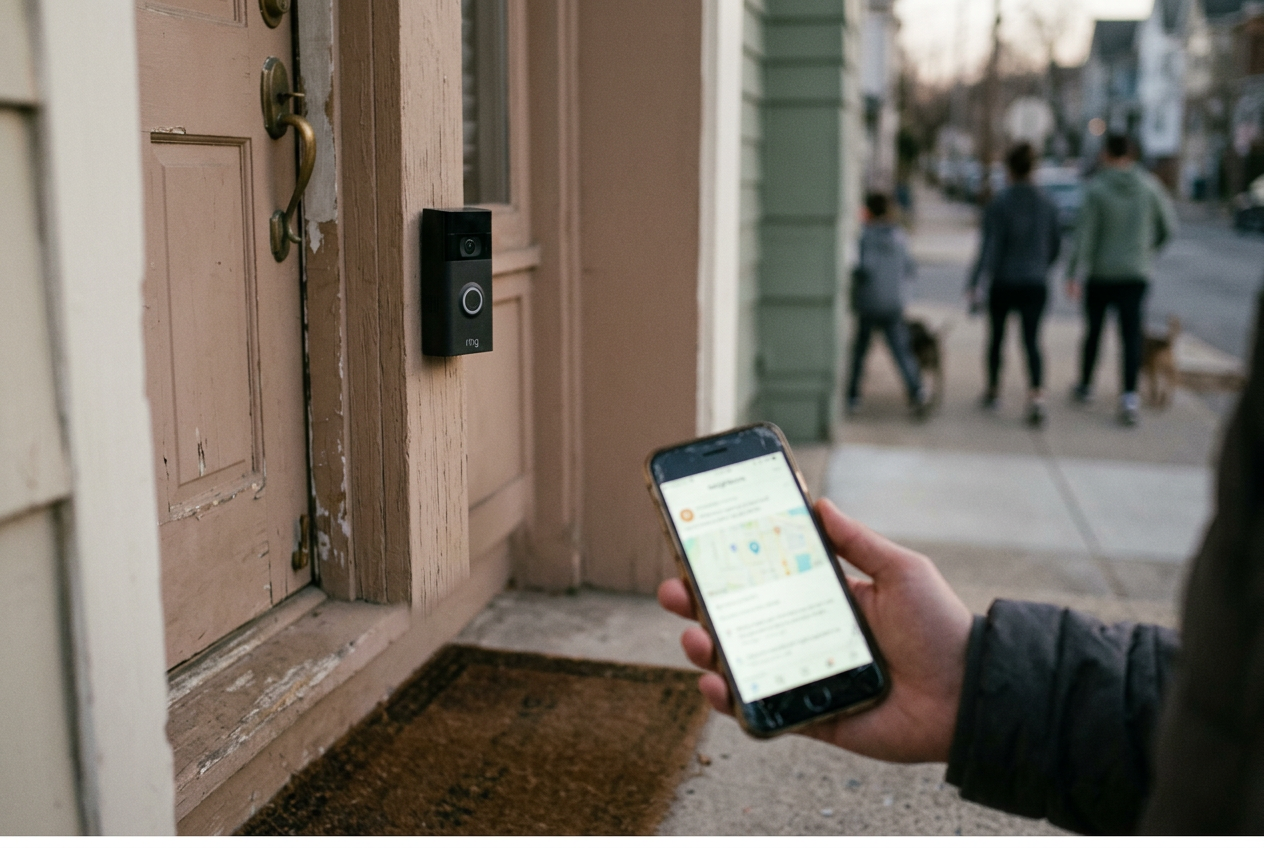
In January 2024, Ring announced that public-safety agencies would lose access to Request for Assistance, a feature inside its Neighbors app. The tool let an approved agency publish a geographically targeted post asking users to submit recordings from a specified place and period. Sharing was voluntary. The request arrived, however, inside the same company-controlled interface where owners watched clips, received alerts and discussed whatever had moved near the hydrangeas.
That Request for Assistance post is the concrete thing Ring ended. It was a one-to-many solicitation system, built into the product and furnished with a neighborhood audience. Its disappearance matters because it removes a cheap way for police to find cameras, reach owners and collect files without first visiting each address.
It did not switch off police access to Ring video.
The distinction was easy to lose in headlines announcing that Ring would no longer let police request footage. Ring stopped offering one request channel. It did not prevent an officer from asking an owner directly, and it did not place stored recordings beyond warrants, other valid legal demands or Amazon’s emergency-disclosure policy. The surveillance relationship became less visible in the app.
It did not end.
The button compressed a police canvass
Before its removal, Request for Assistance turned an old investigative practice into platform infrastructure. Police have always knocked on doors after an incident, looking for witnesses and cameras. Ring’s tool compressed that canvass into a post: define an area, state the relevant period, publish the request and wait for owners to volunteer clips.
The tool did not give an officer unrestricted entry to every camera in that zone. Ring said agencies could not privately demand footage through the app, and owners decided whether to respond. Still, platform design does more than formal authority. A request delivered through the app that operates your doorbell camera feels like part of the product, not a cold approach from the state, while Ring’s presence lends the solicitation a layer of corporate legitimacy.
Removing the Request for Assistance post adds friction. Investigators must identify likely cameras, contact owners through some other channel or establish grounds for legal process. Fewer people may see the request. The agency loses a ready-made distribution system.
Ring also stops placing police solicitations directly among neighborhood posts, where crime reports, package anxieties and motion alerts already encourage users to treat ordinary streets as evidence feeds.
Friction is not prohibition. It is a higher cost in staff time, paperwork and uncertainty, which may reduce broad fishing but will matter less when investigators already know which camera recorded the event.
The owner remains the shortest route
The simplest remaining path runs through the person who controls the account. An officer can knock, call or otherwise ask an owner to open the Ring app and show a recording. The owner can download the clip and send it, just as someone could hand over video from another camera system or a phone.
That exchange does not require the discontinued Neighbors feature. It happens outside the Request for Assistance tile, and once the owner supplies a copy, the police possess that copy independently of Ring. Deleting the original from an account does not recall a file already shared, placed in an investigative system or passed to prosecutors.
Consent sounds clean in a settings menu. In person, it is shaped by authority, urgency and a homeowner’s incomplete sense of what the recording contains. A clip offered to help with a package theft may capture a neighbor, a visitor or a worker who never agreed to become part of an evidence collection. The account holder controls the camera.
Everyone crossing its field of view lives with that decision.
Owners can refuse a voluntary request, though circumstances differ and the later arrival of legal process changes the position. Ring’s product announcement altered how police could reach many users at once. It did nothing to prevent an individual officer from asking an individual owner, which is why the missing button should not be confused with a privacy wall.
Amazon can still receive legal demands
When police seek data held by Ring rather than asking the owner, federal privacy law and the form of the demand become central. The Stored Communications Act, a federal law governing when service providers may disclose stored communications and account records, draws distinctions between video content and non-content information.
Amazon’s published law-enforcement guidance says it requires valid legal process and reviews demands before responding. A search warrant, which a judge issues after finding probable cause, is generally the route for obtaining stored video content from a provider. A subpoena, a compulsory demand that does not carry the same probable-cause standard, may reach narrower non-content records such as subscriber details, while court orders can apply to other account information depending on the law and the requested material.
Those categories matter. Knowing who registered an account, which email address is attached or when a service was used is different from receiving the recording itself, even though metadata, meaning information about an account or communication rather than its contents, can still expose a household’s habits and associations.
A legal demand also cannot produce a recording that does not exist. Availability depends on whether the camera recorded the event, whether the account had cloud recording enabled, whether the clip remained within the applicable storage period and what data Amazon still held when it received the demand. A warrant is legal authority, not a time machine.
Scope matters too. Providers can reject, challenge or seek to narrow demands they consider defective or overbroad, while courts may impose additional limits. None of this gives police a universal Ring dashboard. It does preserve a formal route to particular accounts and recordings, backed by law rather than an app feature.
The Request for Assistance tile sat before this stage. It helped police locate footage and secure voluntary delivery without having to establish probable cause. A warrant reaches the company through a different mechanism. Ring eliminated the first convenience while continuing to comply with the second.
Emergency disclosure sits outside the announcement
Federal law also permits a provider to disclose customer information voluntarily when it believes in good faith that an emergency involving danger of death or serious physical injury requires disclosure without delay. Police can submit an emergency request, but the label alone does not compel production. Amazon decides whether the circumstances satisfy its policy and the legal exception.
This route receives less attention because it is exceptional by design and evaluated case by case. It is still part of the access map. An emergency disclosure does not depend on the Neighbors app, an owner answering the door or a warrant arriving first. That makes oversight important: the provider is making a consequential judgment under pressure, with the affected user absent from the exchange.
The existence of an emergency channel does not mean every urgent police request succeeds. It means Ring’s announcement about a public solicitation tool never covered all warrantless disclosures. The company changed a product workflow. Federal law continued to supply an exception.
Ring removed the most embarrassing interface
Amazon had several reasons to retire Request for Assistance. The feature attracted sustained criticism from civil-liberties groups and lawmakers, turned Ring’s police relationships into a recurring reputational problem and made the company look less like a seller of consumer security hardware than an operator of neighborhood surveillance infrastructure.
Ending the tool reduced that exposure without forcing Amazon to abandon the cloud service at the center of Ring’s model or promise resistance to valid legal orders. Customers could keep recording. Police could keep canvassing. Amazon could describe a privacy change that was real, bounded and favorable to the company.
The incentive sits in that boundary. A dedicated police button makes the corporate role unmistakable because Ring designs the route, approves agency participation and delivers the audience. Owner consent can be framed as the customer’s choice. A warrant belongs to the courts.
An emergency request belongs to a statutory exception. Removing the button pushes responsibility outward while leaving the underlying archive available through established channels.
That is still an improvement over embedding police solicitation in a household product. The app no longer converts every participating user in an area into the instant recipient of an official footage request. Yet the camera remains pointed outward, the recording may remain on Amazon’s systems and the person on the sidewalk still has no account setting to change.
The Request for Assistance tile is gone. The doorbell beside the door is still collecting the material that made the tile useful.
Questions people ask
Can police still get
Ring footage without the owner’s permission?
Yes. Police can seek stored video from Amazon with appropriate legal process, generally a search warrant for content. Amazon may also disclose information during a qualifying emergency involving danger of death or serious physical injury, after evaluating whether the request meets the legal standard and company policy.
Can police ask a Ring owner directly for a video?
Yes. An officer can contact an owner and request that the person view, download or share a clip. The owner may decline a voluntary request, but police can later pursue legal process where justified. Once a recording has been shared, Ring’s removal of the original request tool does not control that copy.
Did
Ring give police live access to every nearby camera?
Request for Assistance did not provide unrestricted live access. It let approved agencies publish targeted requests to Neighbors users, who chose whether to submit recordings. Ending the feature removed that broadcast channel, not every route by which investigators can identify a camera or obtain video.
What changed for people recorded by a neighbor’s Ring camera?
They are less likely to have footage solicited through a police post embedded in Neighbors, but they still do not control the account holder’s consent or Amazon’s response to valid process. Their practical exposure depends on where the camera points, what it records, how long the clip remains stored and whether someone seeks it.
One update a day
Today's story, in your inbox
One story each morning — no hype, no filler, no algorithm deciding for you.