The Gun-Detection Camera Is Only as Good as the Lockdown Plan
Schools buy AI gun detection as a fast technical fix. The consequential machinery begins after the software draws a box and someone decides whether to call police.
August 11, 2026 · 8 min read
At Rancocas Valley Regional High School in New Jersey, the artifact worth watching is a cropped camera image with a colored box around something shaped like a gun. The district became an early public-school customer of ZeroEyes, a Philadelphia-area company founded after the Parkland shooting. Its software plugs into existing surveillance-camera networks and looks for visible firearms.
That box is what gets sold. It is legible to a school board, useful on television and easy to place in a grant application. A computer saw the gun. The institution acted.
Between those two sentences sits the real product: remote human review, local dispatch procedures, camera maps, escalation rules and a police response whose consequences will be carried by whoever happens to be standing inside the frame.
School districts tend to describe these systems as another layer of security. The phrase sounds modest. The procurement is not. Once a district connects an automated detector to its cameras, it changes what those cameras are for and creates a new reason to interpret an ambiguous image as an emergency before anyone at the school has established what happened.
The contract buys a chain of judgment
ZeroEyes does not publicly present its system as autonomous. The software analyzes camera feeds for an object resembling a firearm, then sends a still image to the company’s operations center, where reviewers with military or law-enforcement backgrounds decide whether the image shows a plausible gun. A verified alert can then reach school personnel, security staff or emergency dispatchers, depending on the customer’s plan.
Human verification is the company’s answer to a basic computer-vision problem. Computer vision, software that extracts patterns from images, does not understand a hallway in the way a teacher standing there does. It compares shapes and visual features. A handgun partly covered by a sleeve may disappear from its attention, while a phone, tool or prop held at the right angle may resemble the training examples closely enough to produce a candidate alert.
The reviewer is meant to stop that candidate from becoming a police call. This matters. It also relocates the question rather than settling it.
A reviewer sees the image selected by the model, from the camera angle available, under whatever lighting the school installed years earlier. The person may receive location data and adjacent frames, but not the accumulated knowledge of the building: the student rehearsing a play, the maintenance worker carrying equipment, the security officer authorized to have a weapon, the classroom exercise that nobody entered into the vendor’s workflow.
Rancocas Valley’s boxed image therefore has at least four authors. The camera chooses the angle. The model chooses the object. A remote reviewer chooses whether it looks dangerous.
The district chooses what danger requires. Procurement presentations compress those judgments into an alert speed because seconds are easy to measure and institutional discretion is awkward to put on a slide.
Existing cameras are not a neutral input
The promise that gun-detection software can use cameras a district already owns helps the sale. It avoids the optics and expense of airport-style screening at every entrance, while allowing administrators to say they have upgraded security without rebuilding the campus.
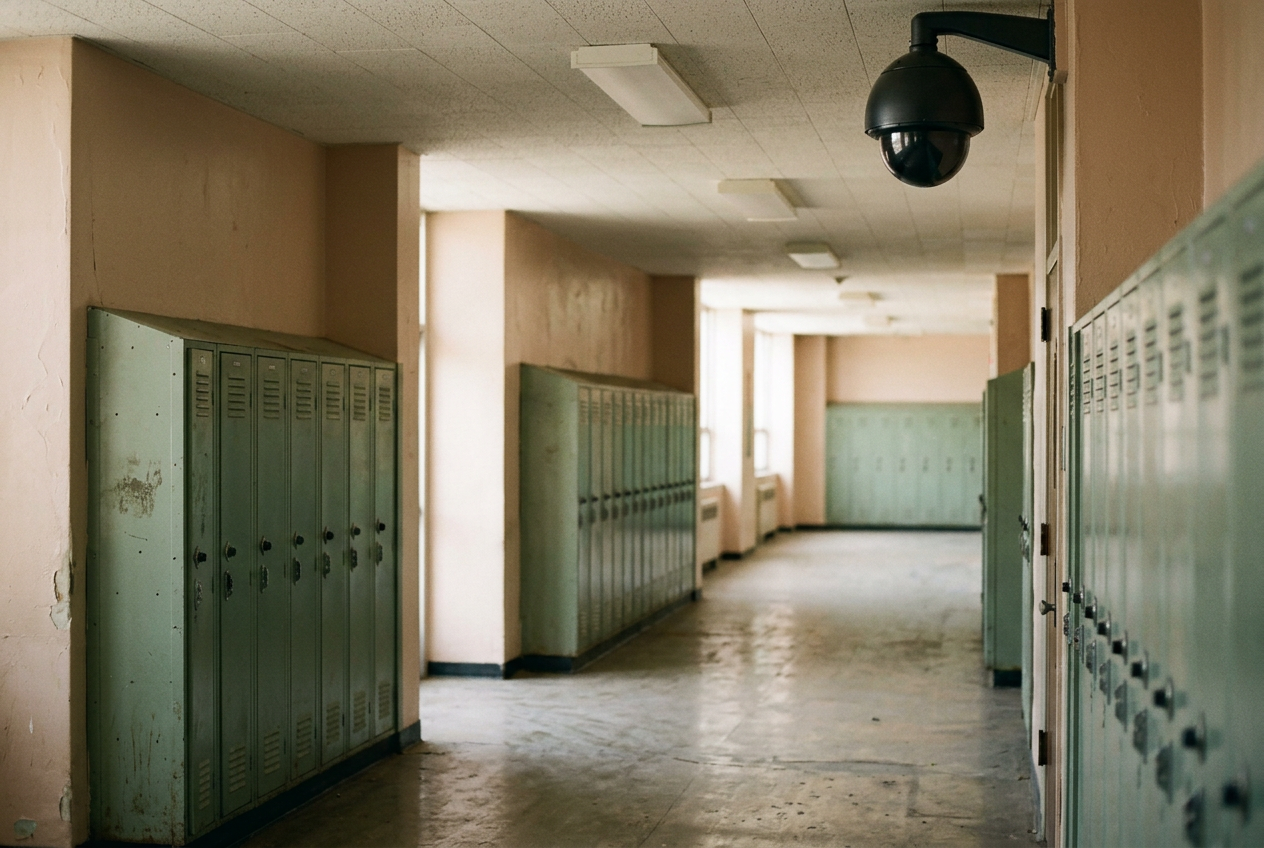
Existing infrastructure carries its own limits. A hallway camera may be mounted high enough to watch movement rather than identify an object in a hand. Compression can erase detail. Bodies block one another between classes.
A visible firearm can remain below the frame, inside clothing or behind a backpack. The software cannot identify what the camera never captures.
This produces an unhelpful asymmetry. The system is most capable when a weapon is clearly displayed in view of a connected camera, a point at which several people nearby may also be able to see it. It is weakest during concealed carry, rapid movement or partial obstruction, which are precisely the conditions under which administrators want machine vision to supply knowledge unavailable to humans.
None of that makes detection worthless. An alert from an empty corridor, parking area or distant entrance could give staff information they would otherwise lack. The problem begins when a district purchases a narrow visual capability and speaks about it as if it were a general answer to school shootings.
The boxed object at Rancocas Valley cannot tell administrators whether the person holding it intends violence. It cannot say whether a firearm is loaded or whether another weapon has passed outside the camera’s view. The box answers one limited question: did these pixels resemble the system’s examples strongly enough to reach a reviewer?
False alarms do not end at the review desk
Vendors often distinguish between a software detection and a verified alert. That distinction is reasonable, but it can also make false-positive claims slippery. If the model flags a harmless object and a reviewer rejects it, the company may count the event as a successful screening rather than a false alarm delivered to the customer.
For a district evaluating performance, both numbers matter. Administrators need to know how often the model generates candidates, how many reviewers reject, how many remain uncertain and how many verified alerts later prove harmless. They also need the denominator: the amount of camera footage analyzed and the number of staged or real visible guns the system missed. A percentage without that operating history is decoration.
Even a human-approved alert may be wrong in the way that matters locally. A reviewer can reasonably conclude that an object resembles a gun while lacking enough context to know that it is a replica. Once the alert reaches the district, policy takes over. Staff may lock doors, announce a lockdown or call law enforcement.
Officers arrive prepared for an armed person in a school, not for an interesting conversation about classifier confidence.
That escalation imposes costs whether or not anyone is injured. Instruction stops. Students receive frightened messages from relatives. A child associated with the image may encounter armed officers before an administrator verifies the object at close range.
In districts where police contact already falls unevenly across race and disability, automated suspicion enters an institution with an existing distribution system.
A serious false-alarm policy should specify who has authority to escalate, whether school staff can inspect contextual footage, how authorized weapons and drills are handled, and when parents are notified. It should also require an after-action record for rejected and dispatched alerts, stripped of unnecessary student identifiers but detailed enough for public oversight.
Districts frequently resist releasing operational detail on security grounds. Some secrecy is defensible; publishing camera blind spots would be foolish. But withholding performance standards, audit totals and the division of authority between vendor, school and police does not secure a building. It secures the contract from evaluation.
The buyer wants reassurance, the vendor wants renewal
School-security procurement occurs under a brutal incentive. After a shooting, administrators are expected to prove that they acted. Prevention programs centered on staffing, building maintenance, threat assessment or student support take time and produce diffuse results. Software arrives with a dashboard.
Federal and state safety grants can make surveillance easier to fund than recurring personnel, because a technology purchase looks finite even when subscriptions, camera upgrades and training continue. The vendor gets paid for monitoring and service. The district gets a visible precaution. Board members get a record showing they approved something marketed as faster detection.
Nobody in that arrangement needs to promise perfection. They need only argue that an additional layer might save time. The claim is difficult to oppose in public because the imagined downside of refusing the product is catastrophic, while the costs of accepting it are spread across budgets, staff attention and students subjected to alerts.
That is why the post-box rules deserve more scrutiny than the demo. A district should negotiate access to its own alert history, demand separate counts for machine candidates and human-verified alerts, test cameras under ordinary crowded conditions, and publish who can summon police. It should set a renewal threshold before the first invoice, rather than deciding later that any alert proves usefulness and every miss requires more cameras.
At Rancocas Valley, as in any school using this model, the colored box remains only a claim. The institution gives it force. If the district has not written a public, reviewable answer for what happens after the box appears, it has purchased detection theater with an armed response attached.
Questions people ask
How does AI weapon detection work in a school?
Software scans connected camera feeds for visual patterns associated with firearms. A product such as ZeroEyes sends candidate images to remote human reviewers, who can reject them or forward an alert with location information. The district’s own protocol then determines whether staff investigate, lock down the building or contact police.
Can school gun-detection cameras produce false alarms?
Yes. Harmless objects can resemble weapons because of angle, lighting, image compression or partial obstruction, and human reviewers can still lack local context. Districts should count model-generated candidates, reviewer-approved alerts and incidents later found harmless separately; combining them allows ordinary errors to disappear inside a vendor’s verification process.
Do these systems use facial recognition?
Gun-detection vendors including ZeroEyes say their core product detects visible firearms rather than identifying faces. That does not remove the surveillance issue. The software still processes school camera feeds, creates alert images and can trigger action against a person whose identity becomes obvious to administrators or police through location, clothing and ordinary school records.
Who decides whether an alert brings police to school?
The contract and district response plan assign that authority. A vendor reviewer may verify the image, but local officials decide which recipients get the alert and whether verification triggers dispatch automatically or requires another check. That decision should be public even if camera locations and tactical instructions remain confidential.
One update a day
Today's story, in your inbox
One story each morning — no hype, no filler, no algorithm deciding for you.