TSA Facial Recognition Is Optional Until You Have to Say No
TSA says travelers may decline facial recognition without losing their place in line. The catch is built into the checkpoint: opting out requires identifying yourself to the officer controlling it.
August 15, 2026 · 7 min read
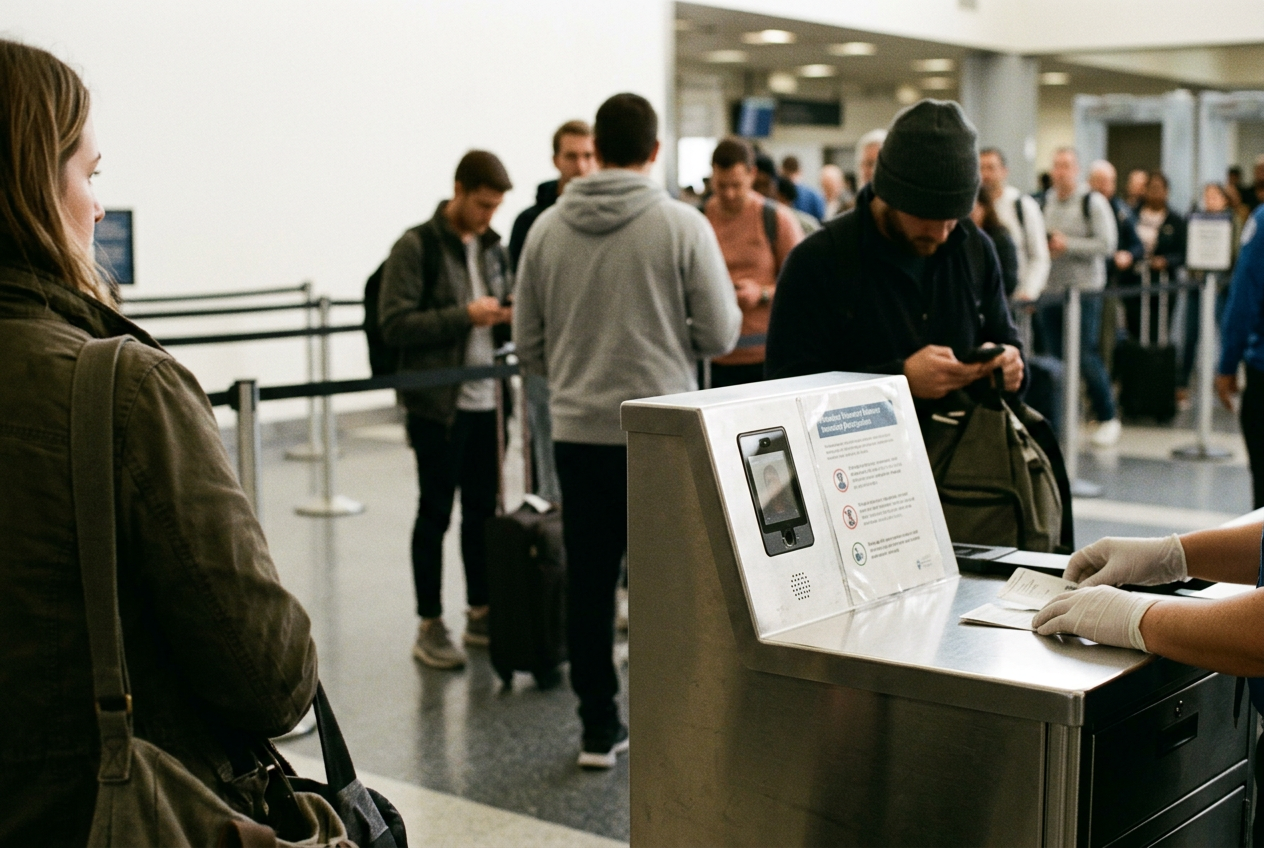
The crucial line in TSA’s facial-recognition instructions is not the assurance that participation is voluntary. It is the instruction to notify an officer if you do not want your photo taken.
That sentence moves the entire burden of consent onto the traveler. The agency supplies the camera, arranges the line, trains the officer and decides where the notice appears. You supply the objection, out loud, while holding up everyone behind you.
This matters at Newark Liberty International Airport and at the larger airports serving travelers around New Jersey because facial-recognition equipment does not arrive as a separate attraction with a registration desk and a waiver. It appears at the document-checking position passengers already must pass. Deployment can vary by terminal and lane, but the institutional arrangement remains the same wherever the equipment is operating: required identity screening and optional face capture occupy the same few feet of floor.
The sign is the concrete object to watch. It may tell travelers that photography is voluntary and that declining will not cost them their place in line, yet the operational instruction still points toward the uniformed officer. Return to that sign after watching the lane for a minute. Its promise concerns formal eligibility.
It says less about the social and physical conditions under which a person must exercise the choice.
The camera inherits the authority of the checkpoint
TSA uses facial matching at some checkpoints through credential authentication technology, equipment that checks an identity document and can compare its photograph with a live image of the traveler. The comparison is automated. A camera captures the face at the podium, software estimates whether it matches the image associated with the presented credential, and the officer receives the result.
TSA describes participation in facial recognition as voluntary. Its public materials say a traveler can decline, present identification and proceed through the standard identity-verification method without losing a place in line. That distinction is important: identity screening is generally part of entering the secure area, while submitting to the facial comparison is not required merely because the camera is sitting there.
Architecture blurs the distinction. A traveler approaches the same podium, hands over the same identification and responds to the same officer, often without knowing whether the next instruction belongs to mandatory screening or an optional technology test. Once the camera has been placed inside the official sequence, its presence borrows legitimacy from everything surrounding it. Bins, barriers, uniforms and the queue all say proceed.
Consent delivered under those conditions may satisfy an agency policy while failing a more ordinary test: did the person understand that there was a choice before the machinery was ready to take the image?
The sign is supposed to do that work. But disclosure is not measured only by whether words exist somewhere near the lane. Position matters. Type size matters.
So does whether a passenger can read the notice before reaching the officer, rather than while juggling identification and listening for commands. A notice discovered at the point of capture functions less like advance consent than an emergency brake.
Saying no is part of the product design
The official opt-out method is short. Tell the officer you do not want facial recognition and request the standard identity check.
Short is not frictionless.
Checkpoint lines train passengers to comply quickly. Shoes, electronics and liquids have accumulated their own instructions over the years, some varying by equipment or lane, and the practical reward for mastering the choreography is avoiding attention. Facial recognition enters that setting as one more gesture to perform. Declining requires breaking the rhythm and asking the authority figure at the narrowest point in the line to change the procedure.
The cost may amount only to discomfort and a few seconds. That is enough to shape behavior at scale, especially for travelers who already expect extra scrutiny, people with limited English, passengers unfamiliar with the technology and anyone who has learned that an airport checkpoint is a poor venue for testing how much discretion an officer possesses.
This is the mechanism beneath the voluntary label. The agency does not need to forbid refusal when line design can make acceptance the default and turn refusal into a visible exception. Software companies call this friction when a screen adds an extra click. Government adds a uniform, a queue and the possibility of missing a flight.
A usable choice would not rely on confidence. It would appear before the traveler enters the final identity-check line, distinguish the optional photograph from the required document check and offer a lane or clearly marked path that does not require a spoken declaration. The existing instruction instead treats self-advocacy as an adequate interface.
That arrangement works for TSA. Officers can process travelers through equipment already installed at the podium, while the agency can accurately state that no one is compelled to participate. The institution receives the operational benefit of a default without having to defend an explicit mandate.
The incentive is a normalized biometric checkpoint
TSA presents facial matching as an identity-verification and security tool. Automation also promises a standardized transaction: compare the person with the credential, return a result and move the line. The agency has an incentive to expand systems that can be incorporated into ordinary checkpoint operations without requiring passengers to enroll before arriving.
The stakes extend beyond whether one airport photo is retained. TSA says its handling and deletion practices depend on the system and testing context, and its public materials describe limits on routine image retention. Those policies matter, but they do not settle the institutional question. A system can delete an image and still normalize the capture of faces as the expected way to pass through public infrastructure.
Biometric data means measurements derived from a person’s physical characteristics, such as a facial image used for automated matching. Unlike a boarding pass, a face cannot be canceled and replaced after a breach. The immediate checkpoint comparison may be narrow, yet the equipment, contracts and procedural habits built around it can support broader uses later if policy changes.
That is why the sign deserves more scrutiny than a privacy-policy summary. It marks the place where TSA translates a contested surveillance system into a routine customer interaction. The agency’s policy says choice. The lane says next.
For airports serving the New Jersey region, a meaningful evaluation should therefore test more than whether a notice can be found after someone knows to search for it. The relevant questions are concrete: whether the notice appears before the camera, whether the optional step is identified in plain language, whether the officer mentions the choice without prompting, and whether declining changes the traveler’s treatment or position in line.
Those observations must be gathered at specific terminals and lanes because equipment and operations can differ. They should not be inferred from TSA’s national instructions, and this draft does not invent them. The absence of supplied field notes leaves the local performance of the policy unverified. It does not erase the design problem visible in the policy itself.
A right that depends on nerve
The strongest version of TSA’s case is straightforward. Travelers remain free to refuse the facial comparison, officers retain another way to verify identity, and posted language gives notice of the option. No facial-recognition mandate is required to use the checkpoint.
The weakness is just as plain. Formal permission to refuse does not guarantee that refusal is legible, private or easy to exercise. An opt-out built around confronting the officer asks the passenger to supply the clarity that the institution declined to build into the lane.
Return once more to the sign. Its most revealing feature is not the word voluntary. It is the direction to notify someone. The camera can sit passively at the default position because dissent has been assigned an action, while acceptance requires little more than facing forward.
A better system would reverse that burden. The facial comparison would begin only after an affirmative choice, separate from presenting identification, and the non-biometric route would be visible without negotiation. That would likely reduce participation. It would also reveal how many travelers wanted the technology, rather than how many kept moving when the officer called them forward.
Until then, the opt-out remains real in the limited bureaucratic sense and compromised in the practical one. TSA can point to the notice. The traveler still has to stop the line.
Questions people ask
Can I opt out of TSA facial recognition?
TSA says facial recognition at its checkpoints is voluntary. A traveler may tell the officer they decline the photograph and ask for the standard identity-verification method instead; TSA’s public instructions say doing so should not cost the traveler a place in line.
Do
I still have to show identification if I decline?
Declining facial recognition does not eliminate identity screening. The distinction concerns how TSA compares you with your credential: you can refuse the live facial image while still presenting the identification and boarding documents required for the checkpoint procedure that applies to you.
Why does the opt-out feel harder than the policy sounds?
The camera sits inside a compulsory checkpoint, while refusal requires a spoken interruption directed at the officer controlling passage. That design makes acceptance passive and refusal visible, so the practical burden falls most heavily on travelers who are rushed, uncertain about the rules or wary of additional scrutiny.
What should airport reporting test about the notices?
A field test should record whether travelers can see and understand the notice before reaching the camera, whether officers explain the option without prompting, and what happens after someone declines. Those details must be observed at named terminals and lanes rather than assumed from national TSA policy.
One update a day
Today's story, in your inbox
One story each morning — no hype, no filler, no algorithm deciding for you.