Your Rotating Concert Ticket Is Also an Attendance Record
Ticketmaster’s moving barcode blocks copied screenshots by binding entry to a live account. The same machinery can record who presented a ticket, when, where and whether the gate refused it.
August 27, 2026 · 7 min read

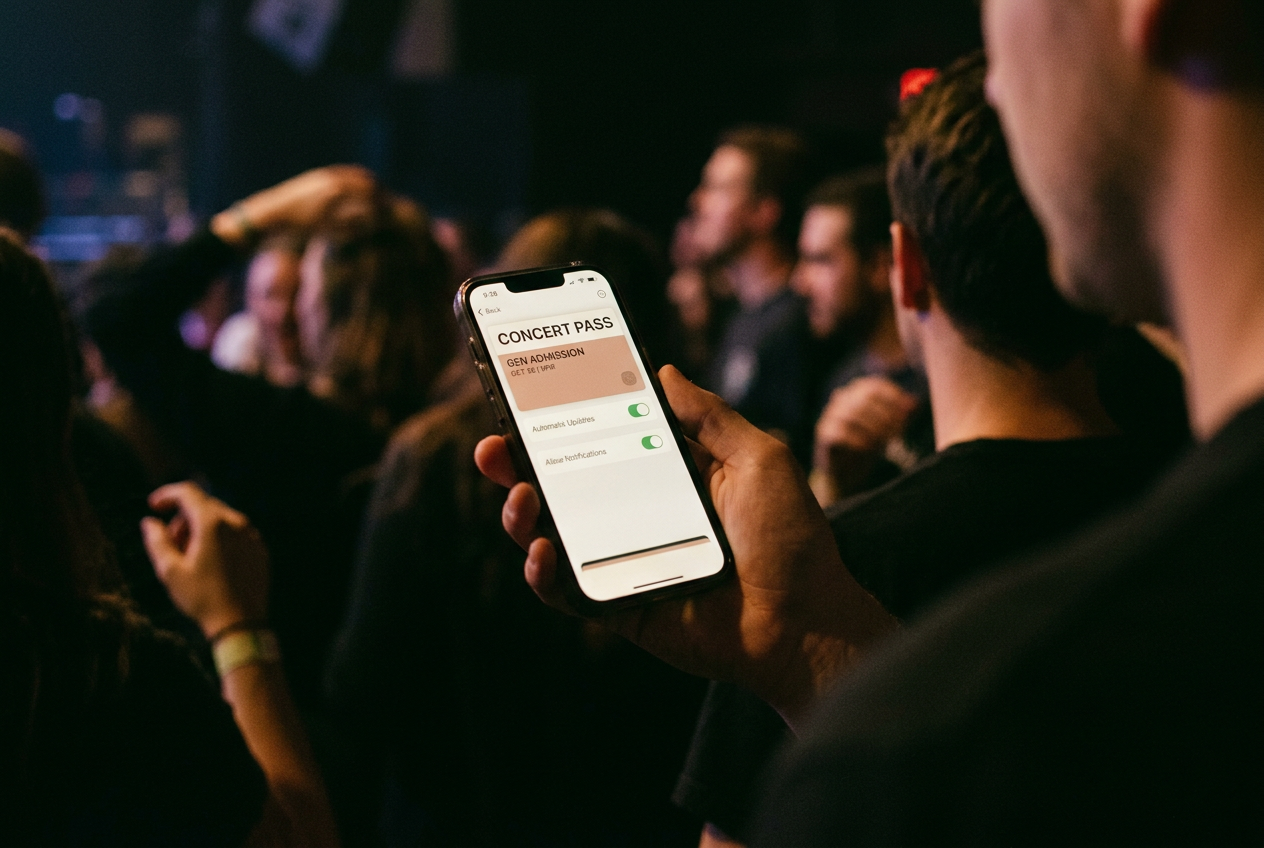
Put one ordinary Ticketmaster SafeTix ticket on the screen. The seat details sit above a barcode crossed by a moving blue bar, a small visual warning that a screenshot will not get someone else through the door. At the scanner, the code resolves to a ticket record. The light turns green or it does not.
That exchange looks anonymous because the usher never asks your name. It is not.
The scanner does not need a government ID to identify the credential. SafeTix, Ticketmaster’s account-based mobile ticket system, ties the ticket to a digital account and replaces the old static barcode with a rotating barcode, meaning the valid token changes on a short cycle. The gate can check whether the token is current, whether the ticket has already been used and whether the platform still recognizes the person presenting it as the holder.
Fraud prevention is the advertised purpose. Attendance infrastructure is the result.
The barcode has a history before the gate
A paper ticket carried most of its useful information on its face. A static digital ticket did much the same thing in pixels, which made it easy to duplicate and easy to sell several times. The venue learned that someone presented barcode 123 at an entrance. It could not always know which copy would arrive first.
SafeTix changes the balance. When the blue-bar ticket loads inside the Ticketmaster app, the app must obtain or generate a currently valid credential linked to the ticket record. Ticketmaster’s consumer documentation emphasizes the practical consequence: screenshots do not work, and the ticket should be opened in the app or added to a supported mobile wallet before arrival.
That load can produce ordinary platform telemetry, the technical records created when software and servers communicate. Depending on the app’s configuration and permissions, those records may include an account identifier, ticket identifier, device or app information, IP address, request time and whether the credential loaded successfully. Ticketmaster’s privacy notices describe collecting information about account activity, ticket use, devices, network information and interactions with its services. The public documents do not publish a field-by-field SafeTix event log, so they do not establish that every possible field is attached to every barcode refresh.
The distinction matters. It would be careless to claim that opening the ticket always tells Ticketmaster your exact physical location. An IP address can suggest a rough area, and a phone may supply more precise location only where permissions and product features allow it. Still, the platform does not need continuous GPS to infer attendance.
A valid scan at a named venue, entrance and time is already a strong location record.
The blue bar is therefore doing two jobs. It tells you that the credential is alive, while the service behind it decides whether that credential remains eligible for entry. The phone screen is only the visible edge.
A transfer changes the recognized holder
Ticket transfer makes the identity layer clearer.
If the original buyer sends a ticket through Ticketmaster’s transfer system, the recipient accepts it through an account. Ticketmaster’s help documentation says the sender’s ticket is no longer valid after acceptance, while the recipient receives a new barcode. The platform can retain the relationship between the order, the sender, the recipient and the replacement credential because that relationship is what prevents both accounts from presenting the same right of entry.
The recipient’s legal identity may remain uncertain. An account name can be inaccurate, a shared email address can belong to a household, and one person can carry another person’s phone. Account-linked does not mean verified beyond dispute. It means the system has a durable platform identity to which it can attach the ticket’s movements.
This is why the absence of an ID check offers less privacy than it appears to. The person at the door does not need to compare your face with a license because the platform has already converted the ticket from a bearer instrument, which belongs to whoever possesses it, into an account-controlled credential. The account supplies continuity. The rotating token supplies freshness.
Informal sharing breaks that continuity in revealing ways. If someone hands over an unlocked phone, the scan may still be attributed to the account that controls the ticket rather than the body that crossed the threshold. If a ticket is transferred through the official channel, the recipient becomes visible to the platform. Fraud controls improve the record without making it a perfect record of human identity.
That imperfection does not erase the surveillance consequence. Most commercial databases do not require courtroom certainty. They require enough confidence to segment customers, resolve disputes, investigate chargebacks, measure turnout or decide which account should receive the next promotion.
The scanner writes more than yes or no
Return to the blue-bar ticket at the gate. A scan request needs enough context to answer a basic set of operational questions: which credential was presented, at which access point, at what time, against which event, and with what result. If the answer is no, the system also needs a reason that staff can act on, such as already used, invalid, transferred away or unreadable.
Ticketmaster markets Presence, its venue access-control platform, around real-time entry management and information about fans entering events. Its brand materials present digital tickets and access data as tools for controlling fraud, monitoring entry and understanding attendance. That is useful to a venue trying to open doors on time. It also means a rejection is data, not an absence of data.
A copied screenshot can leave a failed-scan record. So can an old barcode displayed after a transfer, a ticket presented at the wrong entrance or a credential already redeemed elsewhere. Multiple attempts may reveal movement between gates and the interval between them, provided the access system retains gate identifiers and timestamps. Public-facing documentation does not disclose the full retention period or every party able to query those logs.
The green scan has greater commercial value. Purchase data says someone intended to attend. Entry data says a credential associated with an account arrived. The difference is useful to promoters measuring no-shows, venues staffing entrances, support teams handling disputes and platforms refining customer profiles.
It can distinguish the person who bought four tickets from the accounts that accepted the other three, although it still cannot prove which human body used each phone.
The money sits inside that distinction. Ticketmaster sells infrastructure to event organizers while operating the consumer accounts, ticket transfers and resale channels around it. Better fraud controls protect inventory and reduce duplicate-ticket confrontations. Better attendance data makes the infrastructure more valuable to clients and gives the platform a clearer view of behavior after purchase, where an older ticketing system might have seen only an order and a detached barcode.
Ticketmaster’s broader privacy notices allow information to be used for service operation, security, analytics, personalization and marketing, subject to the notice, jurisdiction and user choices. They also describe sharing in categories that include affiliated companies, event partners and service providers. Those categories are broader than the usher holding the scanner. The marquee rarely explains that difference.
Fraud prevention does not dictate indefinite memory
Rotating credentials solve a real problem. A static screenshot can be copied without leaving the original buyer’s possession, and the first copy scanned may invalidate every other one. Venues need a way to reject duplication without turning the entrance into a desk where every guest presents identification.
The privacy cost is not technically unavoidable in its current form. A system can retain the minimum scan record needed for access and disputes, delete detailed gate logs after a defined period, separate security data from marketing profiles, and give event partners aggregated attendance totals rather than account-level histories. A cryptographically signed credential, meaning one whose authenticity can be checked mathematically, can prove that a ticket is valid without exposing every account detail to each scanner operator.
Some records would remain. Redemption must be marked to stop reuse, and a transfer system must know which credential it canceled. The policy choice concerns how long those events persist, how readily they join other customer data and whether a person can attend a concert without creating a durable interest signal for an advertising system.
Brand documentation is much clearer about preventing screenshot fraud than about those boundaries. Consumer help pages explain how to load the ticket, transfer it and make the blue bar appear. Privacy notices cover large families of data and purposes across the company. Neither gives the person at the gate a compact answer to the practical questions that matter there: the precise scan fields, the retention schedule, the event partner’s access and whether attendance can shape later marketing.
The ticket works. That is the point at which most people stop inspecting it.
Questions people ask
Can
Ticketmaster tell that I entered a concert?
A successful scan can link the redeemed ticket to an event, time and access point, while the ticket itself is associated with an account or transfer recipient. That supports a strong attendance inference, although it does not prove that the named account holder was the person carrying the phone.
Does opening a rotating barcode reveal my location?
Opening the ticket creates a service interaction that can include time, account, device and network information. Exact location depends on app permissions and configuration, but the eventual venue scan supplies a concrete location signal without requiring GPS because the scanner belongs to a known event and entrance.
What happens when a concert ticket is rejected?
The access system can record the attempted credential, scanner, time and rejection result so staff can diagnose the problem and prevent reuse. Ticketmaster’s public consumer materials do not provide a complete schema or universal retention period for failed-scan records, leaving the eventual life of that attempt unclear.
Does adding the ticket to a mobile wallet prevent tracking?
No. A wallet can reduce the need to reopen the ticketing app at the venue, but the credential still has to be validated and redeemed. The scan can still update the ticketing or access-control system with an entry result tied to the ticket record.
One update a day
Today's story, in your inbox
One story each morning — no hype, no filler, no algorithm deciding for you.