The Club’s ID Scanner Can Turn Your License Into a Visit Log
The same machine that confirms your age can create a searchable record of where you went, when you arrived, and whether another venue banned you.
August 24, 2026 · 8 min read
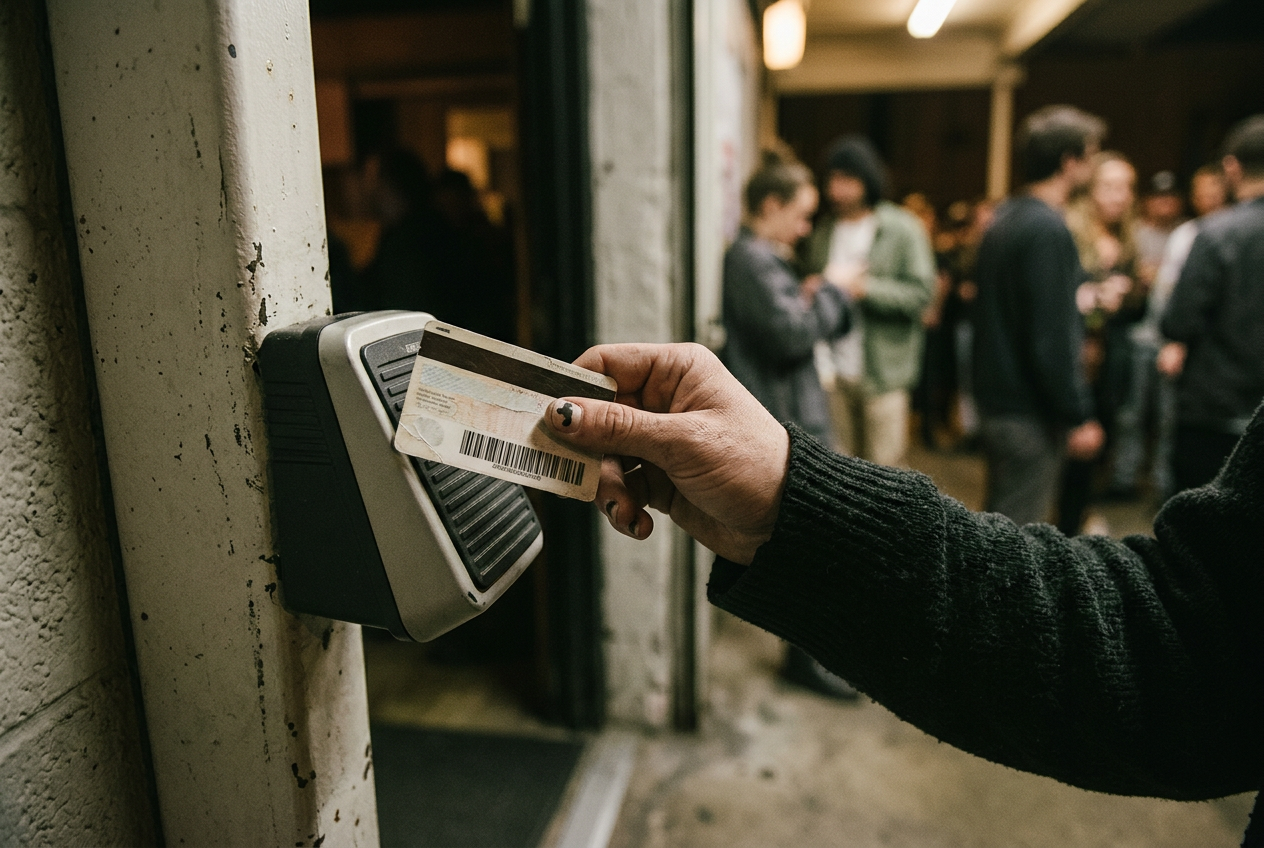
The important part of your driver’s license may be the black-and-white block on the back. In the United States, that is usually a PDF417 barcode, a machine-readable format that can encode fields including your name, birth date, address, license number, and physical descriptors.
You carry it pressed against old receipts in a wallet. At the club door, it gets handed over barcode-side up. The scanner chirps, the screen changes color, and the line moves. This looks like a faster version of the flashlight test.
It can be much more.
A scanner can check whether the barcode is formatted correctly, compare the encoded birth date with the legal drinking age, and identify signs that a document has been altered. Depending on the hardware and service, it may also inspect security features or compare information on the front and back. None of that requires the venue to build a durable history of your night.
Yet many venue systems are sold as management platforms rather than disposable age calculators. Vendor materials from companies including PatronScan and IDScan.net describe functions for recording admissions, identifying returning patrons, documenting incidents, and flagging banned people. Once the scan populates a profile, the black-and-white block on your license has done more than prove you are old enough to order a drink.
It has made you searchable.
Authentication became customer management
The distinction is easy to blur because both operations happen during the same wrist movement.
Authentication asks whether the document appears valid and whether its holder meets an age threshold. Logging asks who entered, at which location, at what time, and what staff later attached to that identity. A venue may have legitimate reasons to do either, but the second operation creates an asset with a longer life and a wider set of possible users.
That asset works for the venue. An electronic log may help staff demonstrate that they checked IDs, investigate an incident, recognize someone previously removed, or coordinate a ban across properties. It also works for the vendor, whose product becomes harder to replace once a customer depends on accumulated records, staff notes, and access to a larger exclusion network.
The sales logic is familiar. Age verification is the narrow task that gets the box onto the counter. Risk management, analytics, and networked identification make the subscription sticky.
PatronScan’s public product materials have promoted incident reporting and banned-patron tools alongside ID authentication. IDScan.net presents scanning as part of broader venue and visitor management, with records that authorized users can search or flag. Features and defaults vary by product, contract, venue, and jurisdiction, which is precisely why the generic reassurance that a scanner merely checks age tells patrons almost nothing.
A door worker may see only a green approval screen. A manager may have access to names, prior visits, and staff-entered notes. A corporate operator may administer several locations. The vendor may host the system.
Calling all of these actors “the club” hides who controls the record and who can retrieve it after the music stops.
Retention is where the promise changes
Vendor privacy materials often distinguish ordinary scan data from records tied to an incident or ban. Some systems advertise configurable retention controls. Others describe deletion windows for routine records while allowing flagged profiles, incident reports, or exclusion entries to remain available longer.
The headline retention period is therefore not enough. A company can say routine scans expire while preserving the category most likely to affect a patron later. A person removed after an argument may discover that the night was converted into a durable risk label, even though the underlying event was never tested by a court, reviewed by an independent body, or explained beyond a hurried note entered by staff.
This is where the barcode returns. The information printed on the front of a license was already visible to the doorman, and much of the barcode may repeat it. Machine readability changes the economics. Copying a name and birth date by hand takes time, creates errors, and looks invasive.
A scanner can ingest standardized fields in seconds, tie them to a timestamp, and make thousands of visits searchable without adding another employee.
The privacy problem does not depend on facial recognition or a secret government database. It begins with ordinary administrative convenience. A database can reveal attendance patterns at a gay bar, political event, strip club, music venue, or recovery-community fundraiser even if nobody designed the system to infer sexuality, beliefs, employment, or health. The venue category supplies the context.
The visit log supplies the identity.
Law-enforcement access adds another layer. Stored records may be sought through legal process, voluntarily disclosed under a company’s policies, or exposed during an investigation involving the venue. The exact rules depend on jurisdiction and circumstance. The practical point is plainer: data that was never retained cannot become a convenient historical attendance sheet.
Nor must a company sell the information for it to create risk. Employee misuse, weak account controls, an overbroad search permission, a vendor breach, or a shared login can turn a safety tool into a directory of people and places. The incentive at installation is to collect enough information to make the product useful. The costs arrive later and usually belong to patrons.
Ban lists privatize due process
A paper “do not admit” list once had natural limits. It stayed behind one door, depended on staff memory, and became stale. A networked ban list can travel between venues and present a staff judgment as a neutral database result.
That may keep a person accused of serious violence from walking into another participating room the same night. It can also spread mistakes, biased descriptions, identity mismatches, and punishment without a workable appeal. The scanner’s authority comes partly from presentation. A flag on a screen looks settled, even when it began as a subjective account entered during a chaotic closing shift.
Public scrutiny of venue-scanning systems has repeatedly centered on proportionality, meaning whether the amount and duration of data collection match the stated safety purpose. Canadian privacy regulators, among others, have examined nightclub ID scanning and pushed operators toward narrower collection and shorter retention. The recurring dispute is not whether venues may check age. It is whether checking age justifies keeping a named attendance record for later uses.
Vendors and operators can separate those functions. A system can return an age-verification result without retaining identity fields. It can delete routine scans quickly, restrict incident access, log staff searches, and keep bans local unless a serious, defined event warrants sharing. Those choices may reduce the product’s value as a customer-management database.
That is the point.
The realistic conversation at the door
The person holding the scanner may not know the retention policy. They may work for contracted security, lack access to administrative settings, and have a line of impatient people behind you. Privacy law has not repealed social pressure.
A patron can still ask whether the scan is stored or used only to verify age, whether the venue participates in a shared ban system, and where its privacy notice can be read. The most useful question concerns the operator: who holds the record and handles access or deletion requests. A confident answer should identify a company or venue policy, not merely insist that the system is secure.
Ask before surrendering the card, not after the chirp. If the venue allows manual inspection, the tradeoff is a few more seconds under a flashlight and perhaps closer scrutiny of the document. Some venues will refuse entry without a scan. In practice, consent at a crowded door often means accepting the database or abandoning the night, which is legally and ethically thinner than the word suggests.
People with an outdated address, changed name, nonmatching gender marker, immigration concern, or prior venue dispute bear more of that pressure. A blanket assurance that law-abiding customers have nothing to fear ignores the mundane ways records become wrong and the unequal consequences of having to correct them.
For a venue, the better policy is visible before the bouncer reaches for the black-and-white barcode: state what gets collected, separate verification from retention, publish the deletion period, name any sharing network, and provide a route to challenge a ban. None of this prevents checking age. It prevents a safety claim from quietly becoming permission to remember everyone.
Questions people ask
Do club ID scanners save your information?
Some do. The scanner may only return an age or validity result, but venue-management systems can also create records containing identity fields, entry times, visit histories, incident notes, and ban flags. The venue’s configuration and the vendor’s retention policy determine what remains after the check.
Can a club scan an ID without keeping a copy?
Yes. Authentication and retention are separate technical choices, even when the same device performs both. A system can read the barcode, return a result, and discard the identifying fields, though patrons should not assume that is how a particular venue configured it.
Can one venue’s ban follow you to another club?
It can if venues use a shared system or belong to the same operator network. The important details are who can add a ban, which locations can see it, how long it lasts, and whether the person identified has any route to contest an error.
What should you ask before handing over your license?
Ask whether the venue stores the scan, how long routine and flagged records remain, whether information or bans are shared, and who handles privacy requests. Also ask whether staff can inspect the physical license manually instead, while recognizing that the venue may make scanning a condition of entry.
One update a day
Today's story, in your inbox
One story each morning — no hype, no filler, no algorithm deciding for you.