That Rotating Concert Barcode Is an Ownership Rule
A changing barcode blocks copied tickets. It also lets ticketing companies and event organizers control lending, transfer and resale long after your card clears.
August 26, 2026 · 8 min read
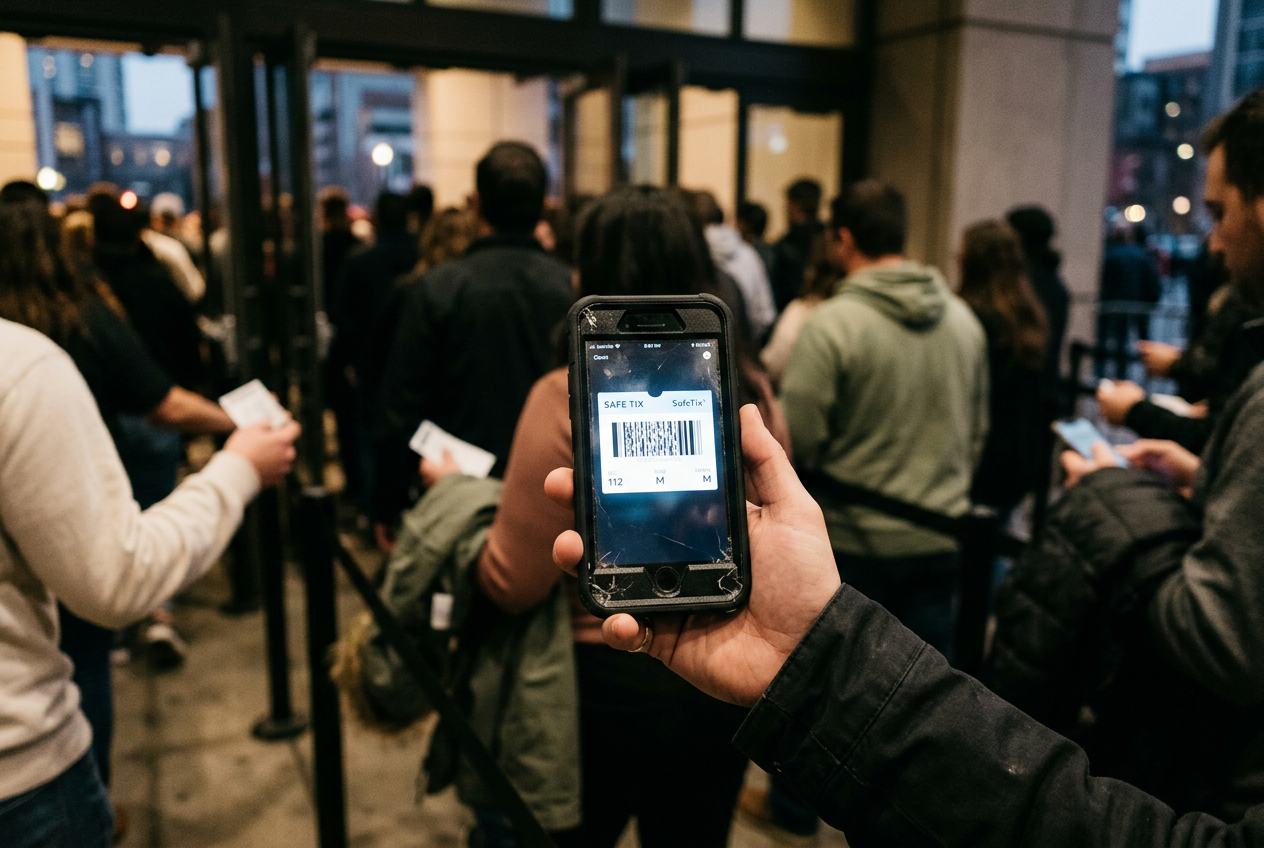
Take one ordinary object: a Ticketmaster SafeTix ticket glowing on a phone in a cracked black case outside an arena. The barcode shifts while an animated line moves across it. A screenshot will fail. The person holding the phone may have paid months ago, but the ticket still needs Ticketmaster’s software, account system and current permission to behave like a ticket.
That last dependency is the real product.
SafeTix uses a dynamic barcode, a code that changes repeatedly so an older image cannot be redeemed. Ticketmaster’s consumer documentation presents this as fraud prevention, and the security case is straightforward. A static PDF can be copied and sold to several people; whichever copy reaches the scanner first may work, leaving everyone else to discover the scam at the gate. A changing code makes that crude duplication much harder.
It also changes what purchase means. Paper tickets and static PDFs could circulate as objects. You could lend one to a friend, sell it through whatever channel you trusted, give it away without creating another account or attend without placing a platform-managed identity between yourself and the door. The SafeTix ticket remains a service administered after payment.
It is less like a thing in your pocket than a permission the issuer keeps refreshing.
The ticket that refuses to become a picture
The moving barcode on that cracked phone case works because the app generates a current credential and the venue scanner checks whether it is valid. Ticketmaster says screenshots will not grant entry. That instruction sounds like a minor technical precaution, but it removes the simplest form of possession: having a faithful copy of something you bought.
A static ticket separates issuance from use. Once delivered, the seller does not need to participate every time the buyer shows it, forwards it or prints it. A dynamic ticket keeps the issuer in the loop, which means the company can fight duplicates but can also enforce whatever other rules have been attached to the credential. Security and control arrive in the same package because they use the same switch.
Ticketmaster’s Purchase Policy describes a ticket as a revocable license rather than ordinary property. That legal framing predates the moving barcode, but app-only entry gives it machinery. The distinction no longer sits quietly in terms few buyers read. It appears as a grayed-out transfer button, an unavailable resale option or a screenshot that turns into expensive wallpaper at the scanner.
The phone adds its own admission tax. It must have power, the ticket must be loaded or placed in a supported digital wallet, and the buyer has to recover an account if a password or device fails. Ticketmaster advises customers to charge their phones and access tickets before arriving. None of this is ruinous for most people.
It is still labor transferred from the venue and issuer to the attendee, performed while a security line moves behind them.
Transfer happens by permission
Suppose the owner of the SafeTix ticket cannot attend and wants a sibling to use it. With paper, the handoff ends when the paper changes hands. In Ticketmaster’s system, the sender initiates a transfer, the recipient receives an invitation, and the recipient accepts through a Ticketmaster account. Once accepted, the recipient gets a new barcode and the sender’s barcode stops working.
That is a sound way to prevent both people from presenting the same credential. It also means lending has been converted into an account-mediated transaction. The platform does not merely verify the ticket at the venue; it supervises the handoff before either person reaches the door.
Ticketmaster says event organizers can decide whether transfer is available, and some tickets may remain ineligible or locked until closer to the event. The person who paid therefore possesses no universal power to nominate another user. They possess whatever transfer function the organizer has enabled at that moment. If the button is unavailable, the practical alternatives narrow to attending together with the buyer’s phone, surrendering account access or asking support for relief.
Each is clumsier than handing someone a ticket.
Return to the cracked black case. If its owner bought two seats and arrives with both guests, one phone can usually present the group’s tickets. If a guest arrives separately, the software’s transfer policy suddenly matters. A private arrangement among friends now depends on a commercial platform’s account state, interface and organizer settings.
The fraud tool has become a rule about association: who may enter with whom, under whose account and through which approved handoff.
The account becomes part of the credential
Anonymous attendance was never absolute. Card purchases leave records, venues use cameras, and online ticket orders have long required personal details. App-only entry tightens the connection because the usable credential lives inside an authenticated account, while a transferred ticket asks the next holder to enter the same system.
Ticketmaster’s Privacy Policy describes collection that can include account and contact information, purchase activity, device information and interactions with its services. A barcode scan also has to mark a credential as redeemed so it cannot be reused. Together, those functions give the platform and relevant event businesses a durable account of issuance, transfer and entry that paper bought with cash did not automatically create.
The important point is structural, not conspiratorial. Ticketmaster does not need to infer a grand secret from one arena show for the arrangement to matter. Mandatory identification makes attendance legible to the companies running the system, and it removes the buyer’s ability to decide that a particular night out should remain detached from a permanent platform account. That can carry more weight at a political fundraiser, a controversial performance or an event attended by someone whose family, employer or community monitors their movements.
Privacy policies tend to describe broad categories and permitted uses, while the person in the security line faces a binary choice. Present the account-bound ticket or stay outside. Consent has done some heroic rebranding by that point.
Fraud control has a business model
The platform’s continuing role creates commercial leverage. Ticketmaster’s resale documentation says resale availability depends on the event and that fees may apply. When official resale is enabled, the platform can host the secondary transaction, set the permitted workflow and collect money from activity that once happened beyond the primary seller’s system. Certain events use face-value exchange or other restrictions; others allow different resale terms.
The common feature is jurisdiction.
Transfer locks also steer buyers away from informal markets because a listing is less useful when the seller cannot deliver the credential. Some restrictions come from artists or event organizers rather than Ticketmaster acting alone, a distinction worth preserving without pretending it changes the attendee’s experience. The platform supplies the enforcement layer. The organizer chooses among controls.
The buyer meets the result at the button.
This arrangement helps explain why anti-fraud language receives so much institutional enthusiasm. Fraud is real, copied barcodes cause real losses, and dynamic credentials can reduce both. Yet the design also keeps transactions observable and channels resale toward approved rails, where rules can be changed and fees can be charged. A security measure that ended at duplicate prevention would not require organizers to retain broad discretion over legitimate transfer between willing people.
The incentive is continuing control after the primary sale. Ticketing companies remain relevant to the ticket’s movement, while organizers retain tools for managing resale, access and customer data. Buyers receive protection against a familiar scam, then pay for it with reduced autonomy over an item they reasonably understand themselves to have purchased.
A less controlling ticket is possible
A venue does not have to return to easily copied PDFs to give buyers more control. A digital credential can resist duplication while guaranteeing transfer, allowing privacy-preserving guest tickets or offering a staffed process that does not require the recipient to join the same commercial account system. Organizers could publish transfer windows before purchase and separate fraud checks from rules governing price or resale channel.
Those choices would reduce platform discretion, which is why they should be treated as governance rather than interface polish. The relevant standard is whether the issuer blocks duplicate use or keeps authority over every later use. Those aims overlap, but they are not identical.
At the arena door, the SafeTix barcode in the cracked black case will probably do exactly what its owner needs. It will update, scan and turn green. The quiet condition is that the company remains present for the ticket’s entire life, including the moment it disappears into the scanner.
Questions people ask
Why does my Ticketmaster barcode keep changing?
Ticketmaster SafeTix uses a dynamic barcode that refreshes so a saved image cannot function as a reusable ticket. The current code lets the venue reject screenshots and duplicated older codes, reducing a common form of ticket fraud while keeping validation tied to Ticketmaster’s system.
Can
I lend a mobile concert ticket to someone else?
Usually you must use the platform’s transfer feature rather than send a screenshot. The recipient may need a Ticketmaster account and receives a replacement barcode after accepting. Event organizers can disable transfer or delay its availability, so paying for the ticket does not guarantee that you can lend it whenever you choose.
Does an app-only ticket make concert attendance less private?
It can. The usable ticket is connected to an account, purchase record and device interaction, while transfers bring recipients into the platform’s account system. Ticketmaster’s privacy documentation describes collecting account, transaction and device data. That creates a more legible attendance trail than an unregistered paper ticket handed between people.
Can an event organizer stop me from reselling my ticket?
The organizer can limit whether Ticketmaster transfer or resale tools are available, subject to applicable rules and the event’s terms. Official resale may also impose pricing conditions or fees. A changing barcode makes those restrictions enforceable because an unauthorized copy cannot replace the platform-approved credential.
One update a day
Today's story, in your inbox
One story each morning — no hype, no filler, no algorithm deciding for you.