Your STI Test's Plain Mailer Is the Least Private Part
Discreet packaging hides the test from a roommate. It does not hide the order from payment processors, carriers, lab portals or the vendors behind the website.
August 18, 2026 · 8 min read

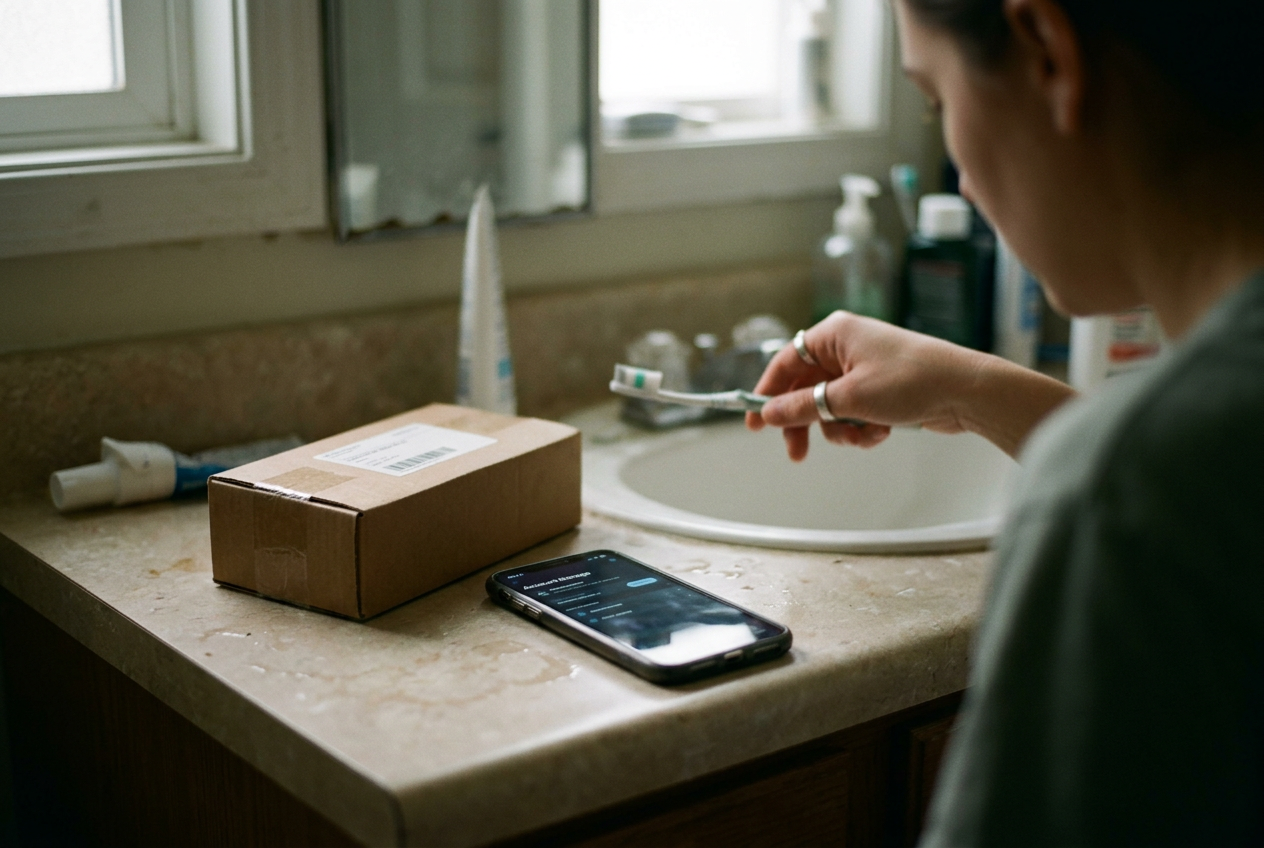
Picture one ordinary object: an Everlywell STI test mailer addressed to a shared apartment. The company markets discreet packaging, which solves a real problem. The box does not announce gonorrhea, HIV or syphilis to whoever brings in the mail.
That mailer is still carrying a name and address. A carrier has scanned it. A payment processor has handled the purchase. The customer has probably passed through an account, a kit-registration page and a laboratory portal, while confirmation emails or texts may now sit on a lock screen.
The plain box is the most visible part of the transaction and, in many cases, the least revealing.
This is the basic privacy problem with direct-to-consumer STI testing. Companies sell discretion as a property of the package, but the service runs through a chain of storefronts, clinicians, laboratories, software vendors and delivery systems. Each participant may need some data to do its job. Several also collect data that has little to do with processing a specimen.
This is reporting based on public brand documentation, not medical or legal advice. Policies, service partners and state requirements change, so check the current documents before relying on any single promise.
The order creates a record before the test does
Major services do not all sell the same thing, even when their home pages make the kits look interchangeable.
Everlywell and myLAB Box operate recognizable consumer storefronts: choose a test, pay, receive a kit, register it and return a specimen for laboratory processing. LetsGetChecked also links a shipped kit to an account and collection workflow, with clinical review around testing and results. Nurx sits closer to telehealth. Its STI services can begin with a medical intake and move through licensed providers, testing partners and follow-up care, which creates a broader clinical record than a bare retail order.
Those structures determine what gets collected. A storefront needs payment and delivery information. A laboratory needs enough information to match a specimen to the right person and produce a valid report. A clinician may need medical history, symptoms, medications, sex assigned at birth, anatomy or sexual-exposure details to decide which tests are appropriate.
State rules can also require demographic or identity information.
Identity verification does not always mean uploading a government ID. It can mean matching a legal name, date of birth, address, phone number and kit code across several systems. Telehealth services may ask for more because the company is arranging medical care rather than selling a box alone. The distinction matters if an ID image, insurance card or facial photograph would create risk on a shared device or family account.
The privacy cost begins at checkout. Abandoning the cart later does not necessarily erase browsing events, an email address already entered or cookies placed by the site.
Four services, four versions of discretion
Brand documents show a common route, with different amounts of friction and different numbers of entities in the middle.
| Service | Ordering and identity | Results route | Privacy pressure point | |---|---|---|---| | Everlywell | Consumer account, payment, shipping details and kit registration | Account-based results after laboratory processing and clinician review where applicable | The retail site, registered kit and clinical testing layer may operate under different privacy terms | | LetsGetChecked | Online order followed by account-linked kit activation and personal health information | Results through its digital service, with clinical contact available as described for the test | Account messages, health questionnaires and communications add records beyond the parcel | | myLAB Box | Storefront purchase, delivery information and kit registration | Digital access after a partner laboratory processes the sample | Its privacy policy and the laboratory or physician documentation must be read together | | Nurx | Telehealth intake may collect contact, identity, medical and insurance information | Provider-mediated service with testing and follow-up through associated systems | A fuller medical workflow improves continuity but leaves more data in provider, lab and billing systems |
This table is a route map, not a permanent ranking. A company can switch laboratories, analytics tools, fulfillment vendors or portal software without changing the basic product name. Read the notice attached to the service you are using, not a review of it from two years ago.
The Everlywell mailer returns here. Its outside can be discreet while the order inside belongs to several legal contexts. Health Insurance Portability and Accountability Act protection, usually shortened to HIPAA, applies to covered health care entities and their business associates rather than every company that touches something health-related. A laboratory or clinician may handle protected health information under HIPAA while browsing behavior, storefront activity or marketing data sits under a general consumer privacy policy.
A HIPAA badge should not be read as an invisibility cloak. It does not mean no one processes the data, no record exists or every click on the retail site becomes a medical record.
The lab portal is a second account, even when it looks like one
Kit activation is the hinge. Before activation, the company has an order and an address. After activation, a barcode or kit identifier connects that purchase to a person and, eventually, a specimen.
Some services present ordering, registration and results inside one branded interface. Behind it, the laboratory, clinician network or portal vendor may remain a separate organization with its own retention duties. Laboratory records are not ordinary shopping history; providers may have legal or clinical reasons to retain them even after a consumer deletes the retail account.
Deletion language deserves a slow read. Look for qualifications such as records the company must keep, data already disclosed to service providers, deidentified information or backups retained for security and compliance. Deidentified means direct identifiers have been removed or altered, though the usefulness of that protection depends on the remaining data and the rules governing reuse.
Results can also leak through convenience features. An email saying results are ready may reveal nothing to the mail provider about the diagnosis, but the sender name and subject can expose the testing relationship. Text reminders appear on shared phone plans and lock screens. Password managers, browser history and autofill can preserve the name of the portal.
Downloaded PDF reports may sync to a family cloud account.
None of this makes online testing inherently unsafe. It means privacy is an operational task, not a shipping aesthetic.
Data sharing hides in categories and verbs
Privacy policies rarely provide a clean list of every company receiving data. They describe categories: payment processors, laboratories, clinicians, cloud hosts, customer-support tools, analytics providers, advertising partners and government authorities where disclosure is required.
The verbs matter. “Process” can describe a vendor handling information under contract. “Share” and “sell” may carry specific meanings under state privacy laws that differ from ordinary speech. A policy saying the company does not sell medical information does not automatically answer whether the retail website sends device identifiers or page activity to advertising technology.
That split works for the business. Online testing companies compete for customers through search, social platforms and referral marketing, all of which reward measurement. The company wants to know which advertisement produced an order; the customer wants the fact of seeking an STI test treated as sensitive before checkout. Those interests collide well before a laboratory sees a tube.
Look for sections covering cookies, targeted advertising, cross-context behavioral advertising, mobile analytics and consumer privacy choices. A Global Privacy Control is a browser signal that asks participating sites to treat the user as opting out of certain sales or sharing. It can reduce some tracking where recognized, but it does not block the operational disclosures needed to fulfill an order or run a test.
A practical privacy check before ordering
Start with your threat model, meaning the person or system you need privacy from. A roommate, parent, abusive partner, employer, insurer and advertising platform require different precautions. No single “discreet” claim covers all of them.
- Open the privacy notice before creating an account. Search within it for “laboratory,” “advertising,” “retention,” “delete,” “service provider” and “consumer request.” Save a copy or screenshot because the language can change.
- Check whether the medical and retail layers have separate notices. Read the laboratory, clinician or telehealth privacy document linked during consent. The storefront policy is rarely the whole route.
- Inspect the communication settings. Choose email or text based on who can see the device, then turn off lock-screen previews. Use an email account that is not shared with family, work or school.
- Treat insurance as a separate disclosure choice. Using insurance can create claims records and an explanation of benefits, a statement describing care and cost that may go to the policyholder. Ask the service and insurer about the route before submitting coverage details.
- Ask what appears on both labels. Discreet outer packaging does not guarantee that the sender, return facility or carrier dashboard will be neutral. Consider a secure pickup location if home delivery creates danger, provided the service and carrier allow it.
- Use a private device where possible. Turn off browser syncing, avoid saving the portal password on a shared profile and remove downloaded reports from shared folders. Private-browsing mode limits local history; it does not hide traffic from the site, carrier or internet provider.
- Check deletion and opt-out tools after results arrive. Close unused retail accounts, request deletion where available and opt out of targeted advertising. Expect medical or laboratory records to follow different retention rules.
If home delivery, digital records or payment traces create an immediate safety risk, a local sexual-health clinic may offer a more controllable route. Ask how it handles identification, billing, patient portals, reporting and confidential communications before providing details. Public-health reporting for certain infections can still apply; confidentiality is not the same as anonymity.
The Everlywell mailer on the apartment table can remain plain. The useful question is who saw the order before it arrived and which records remain after the cardboard is gone.
Questions people ask
Can I order an online STI test anonymously?
Usually not in the strict sense. Shipping, payment, specimen matching and laboratory reporting generally require identifying information. A service may keep the contents off the package, but discreet delivery does not erase the name, address, account, transaction or laboratory record attached to the order.
Does
HIPAA cover everything I enter on an STI testing website?
No. HIPAA may cover information handled by a participating clinician, laboratory or other covered entity, while retail browsing, advertising data and some account activity fall under a general privacy policy or state consumer law. Read both the consumer notice and any clinical privacy notice presented during registration.
Will the test name appear on the shipping label or bank statement?
Packaging claims usually address the parcel, not every trace. The label still needs delivery information, while the card statement may show a company or payment descriptor. Check the service's current shipping and billing documentation, and do not assume the return label or carrier notification uses the same wording.
Is a clinic more private than an online testing company?
A clinic may avoid home shipping and retail ad tracking, but it can still create identification, billing, portal and public-health records. The safer option depends on who you need privacy from. Ask about confidential communications, insurance billing, portal access and reporting before testing.
One update a day
Today's story, in your inbox
One story each morning — no hype, no filler, no algorithm deciding for you.