YouTube’s AI Label Often Appears After You Press Play
YouTube asks creators to flag realistic synthetic media, then keeps the standard disclosure away from the surfaces where most viewing decisions happen.
August 26, 2026 · 7 min read
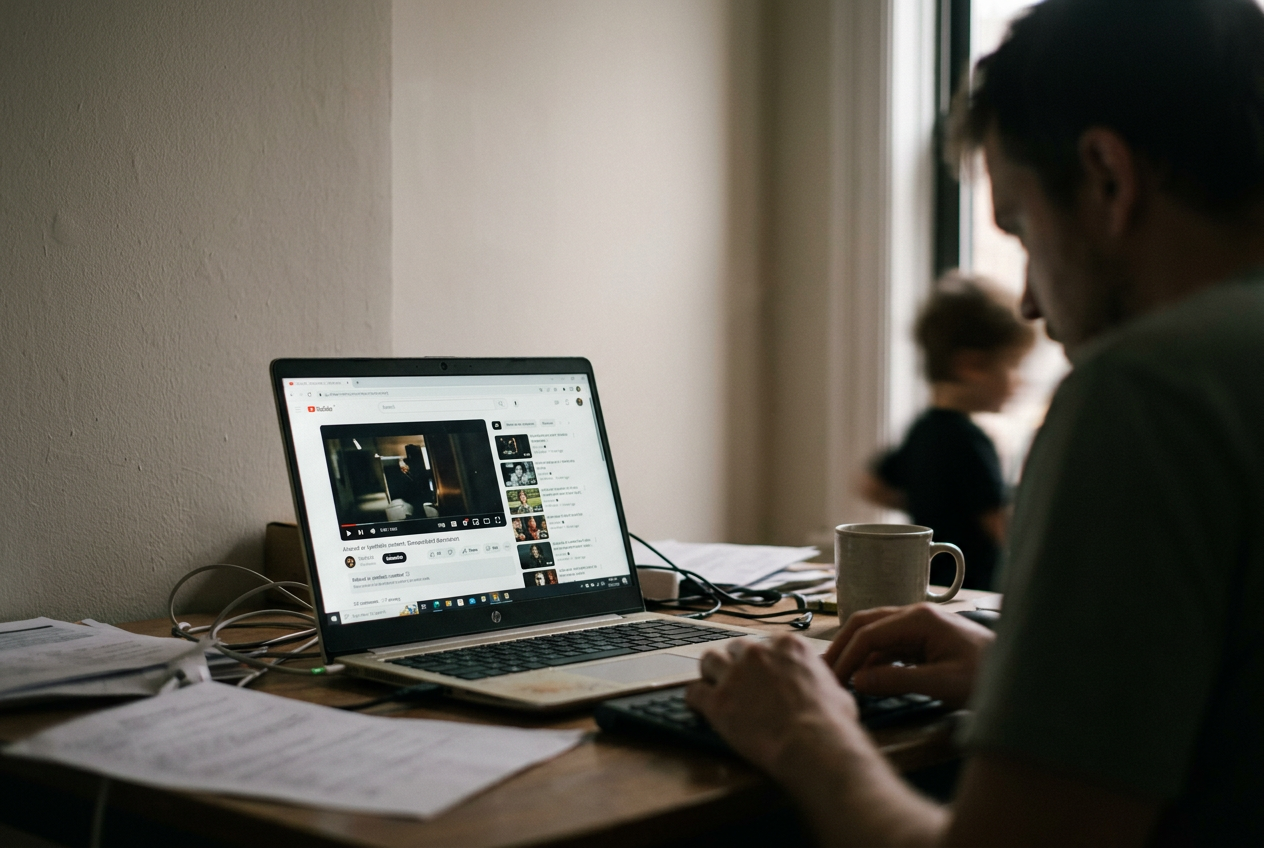
The object to keep watching is a small gray row under a YouTube video’s expanded description. It reads “Altered or synthetic content,” followed by explanatory copy and a link to learn more. You have already clicked the thumbnail, supplied the view and entered the watch page before the standard version of this warning becomes visible.
That placement is the policy.
YouTube introduced its creator disclosure system in 2024 for realistic material that has been meaningfully altered or synthetically generated. During upload, a creator answers an “Altered content” question in YouTube Studio. A yes can produce that gray row. For sensitive subjects such as elections, conflicts, public health and finance, YouTube says it may put a more prominent label inside the video player.
The distinction matters because most videos are encountered somewhere else first. Search results, home recommendations, Up Next panels and links embedded in other sites are decision surfaces: the places where a thumbnail and title compete for attention. YouTube’s standard disclosure is documented primarily as watch-page information. It is context delivered after distribution has done its work.
Follow the label
Run the gray row through YouTube’s main surfaces and its limits become plain.
On a standard watch page, the disclosure sits in the expanded description. The viewer may need to open that description, especially on a phone, where the interface gives the video, title and engagement controls more immediate space. The label is available. It is not necessarily presented at the moment the claim lands.
Search is different. YouTube’s public documentation does not promise that the standard altered-content label will appear on the result card beside the thumbnail and title. The same is true of ordinary recommendation cards on Home and Up Next. A disclosed synthetic clip can therefore compete in ranking systems without its disclosure traveling with the package that earns the click.
An embed strips the context down further. The standard embedded player does not reproduce the full watch-page description around the video, and YouTube’s documentation does not guarantee that the ordinary description label will survive wherever a third-party site places the player. A prominent in-player warning for a sensitive topic has a better chance of reaching the viewer because it belongs to the player rather than the surrounding page, but that is an escalation chosen by YouTube, not the default treatment of every disclosed upload.
The gray row has not failed at its assigned job. Its job is narrower than the public language around “AI labels” suggests. It records a piece of provenance, meaning information about how media was made or changed, after someone has supplied that information or YouTube has another basis for adding it. It does not function as a warning attached to every impression.
That works well for YouTube. The platform can say viewers receive context without placing friction on the thumbnails that feed watch time, ad inventory and creator revenue. YouTube also says making the required disclosure does not by itself reduce a video’s audience or monetization eligibility. The system asks for honesty while promising that honesty will not be punished by distribution.
That is sensible. It also leaves the most commercially important surface untouched.
What creators must disclose
YouTube’s test is not whether artificial intelligence touched a file. It asks whether content is realistic and meaningfully altered or synthetic.
Its documentation points to cases such as making a real person appear to say or do something they did not, altering footage of a real event or place, generating a realistic event that never happened, cloning someone else’s voice, or producing synthetic music. The policy focuses on material a viewer could mistake for reality, especially where the manipulation changes the substance of what appears to have occurred.
Plenty of machine-assisted work falls outside that requirement. YouTube says creators generally do not need to disclose production assistance used for scripts, ideas, captions or thumbnails. Minor aesthetic edits, color adjustments, lighting filters, beauty effects and other changes that do not mislead a viewer about a real event also sit outside the mandatory category. Unrealistic fantasy scenes are treated differently from convincing fabrications.
This is where the word “altered” does more work than the label can show. The gray row does not tell you which second of a video was generated, whether the voice was cloned, whether a face was replaced, or whether the entire upload came from a text prompt. It compresses distinct production histories into one notice. A creator who repaired a realistic scene and a channel publishing fully synthetic footage may receive the same visible treatment.
That compression protects the label from becoming a technical ledger. It also limits its use as evidence. The disclosure says that qualifying alteration occurred. It does not measure the alteration, identify the tool or explain who authorized the use of a person’s likeness.
The voluntary middle
The upload toggle is a self-reporting mechanism. YouTube can require creators to use it, threaten penalties for repeated noncompliance and apply a label itself in some cases, but those powers do not turn the system into universal detection.
Content made with certain YouTube generative tools can receive disclosure automatically. YouTube may also add a label when a creator mentions synthetic production in the title or description, and it can read supported Content Credentials, tamper-evident metadata that records parts of a file’s origin and editing history. Those routes reduce reliance on the uploader without eliminating it. Metadata can disappear when files move through unsupported software or are re-exported, while external tools do not all provide a compatible record.
Everything in the middle still depends heavily on the person uploading the video. A realistic voice clone made with an outside service, a subtle face replacement and footage altered to move an event to a different location all qualify under YouTube’s examples, yet the platform’s public documentation does not claim that it can reliably detect every such edit before publication.
YouTube reserves the right to label content itself and says repeated failures to disclose may lead to removal or suspension from the YouTube Partner Program, the system through which eligible channels receive platform revenue. Enforcement remains downstream. The video must be noticed, detected or reported, then assessed against a standard that turns on realism and significance. Neither term has a clean technical boundary.
The financial incentive is uneven. Honest disclosure carries no stated automatic ranking penalty, which removes one reason to hide an edit. A deceptive uploader still benefits if an unlabeled thumbnail wins the click before enforcement arrives, particularly when the upload is tied to a fast news cycle and its useful life is measured in hours. The gray row cannot recover the attention already sold around a false premise.
A disclosure is not authentication
The most dangerous reading of YouTube’s system is the inverse one: labeled means synthetic, so unlabeled means real.
YouTube does not make that promise. An absent label can mean the video did not require disclosure, the creator decided the edit was minor, the uploader ignored the rule, compatible metadata was unavailable, or enforcement had not caught up. The viewer sees the same absence in each case.
Nor does a label settle whether a video violates another policy. Synthetic content can remain on YouTube when it follows the platform’s rules, while manipulated media may be removed if it breaches policies covering misinformation, impersonation, privacy or other harms. Disclosure and moderation are separate controls. One adds context.
The other can restrict or remove material.
There is a better interface available in plain sight. YouTube could carry the disclosure onto search results and recommendation cards, then let viewers open a concise record stating whether the uploader self-disclosed, YouTube added the notice, or supported credentials supplied it. That would not solve detection. It would move known information to the point where people choose what to watch.
For now, the gray row remains under the expanded description. It is useful when present, weak when hidden and meaningless when absent. On an embedded clip, the most relevant fact about its construction may sit back on a watch page the viewer never visits.
Questions people ask
Where does YouTube show the altered-content label?
The standard label appears in a video’s expanded description on the watch page. YouTube may use a more prominent notice in the player for sensitive subjects, but its documentation does not promise the ordinary label on every search result, recommendation card or third-party embed.
Does an unlabeled
YouTube video contain no AI-generated material?
No. Some uses of AI, including production assistance and minor aesthetic edits, do not require disclosure. Qualifying realistic manipulation may also go unlabeled when an uploader fails to report it, metadata is unavailable or YouTube has not detected the problem.
Does
YouTube punish creators for using the disclosure?
YouTube says disclosure itself does not limit monetization eligibility or audience reach. Repeated failure to disclose qualifying content can lead to penalties, including removal or suspension from the YouTube Partner Program, while the underlying video remains subject to the platform’s other content policies.
Can
YouTube add an AI label without the uploader’s permission?
Yes. YouTube can apply a label itself, including when supported metadata or information supplied elsewhere indicates synthetic production. Certain YouTube creation tools disclose automatically, but outside tools and missing metadata leave much of the system dependent on creator reporting.
One update a day
Today's story, in your inbox
One story each morning — no hype, no filler, no algorithm deciding for you.