A Protest Zone Can Delete a Crowd Without Banning a Word
At Indiana University, a lawn long associated with public assembly became the test case for a quieter form of control: keep the speech, regulate its location, timing and audience.
August 25, 2026 · 8 min read
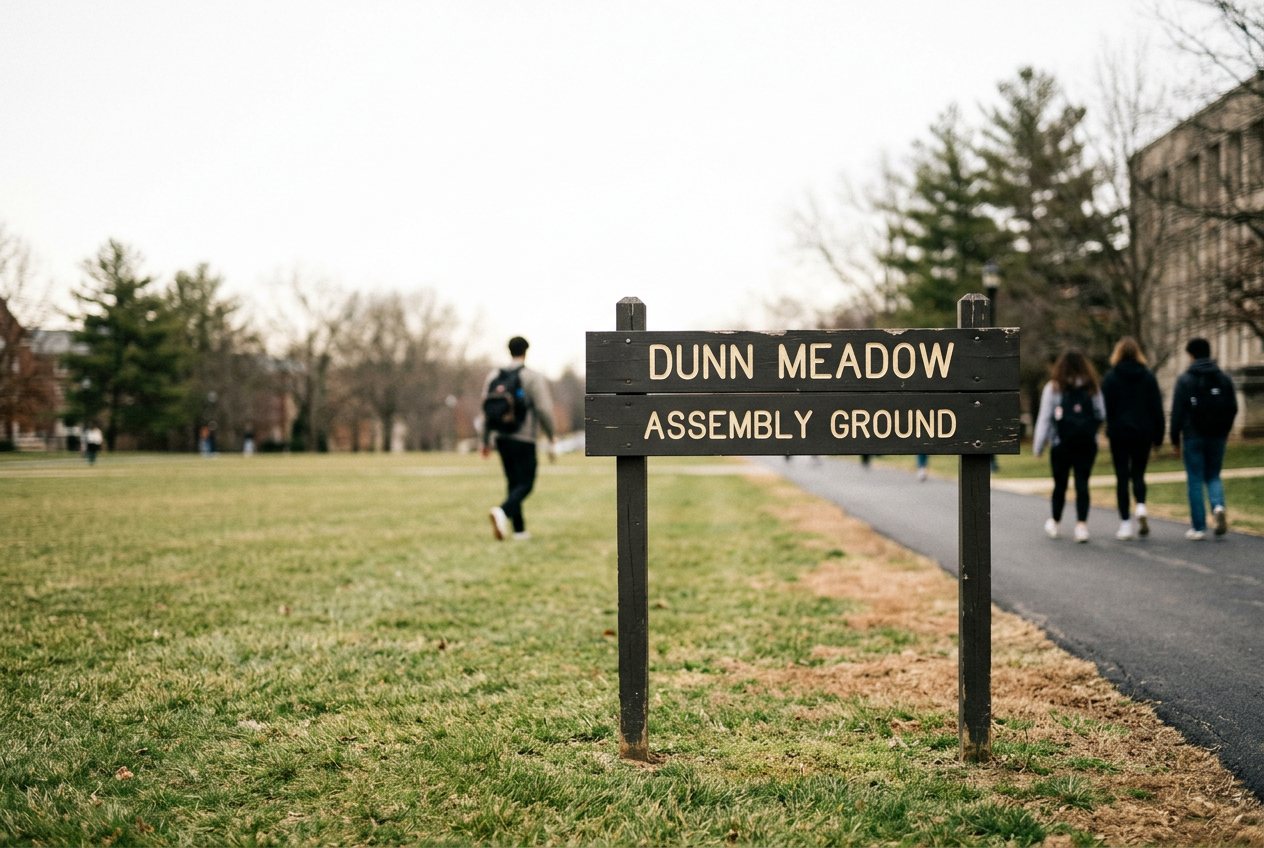
Dunn Meadow is a patch of grass beside the Indiana Memorial Union, identified by Indiana University for decades as an assembly ground. That designation sounds like a promise. In April 2024, it behaved more like a settings menu.
As students prepared a Gaza solidarity encampment, university administrators revised the meadow’s rules, adding restrictions on temporary structures and overnight activity. Police cleared tents and made arrests after protesters proceeded. The university had not prohibited criticism of Israel, support for Palestinians or demands aimed at its investments. It had regulated the material conditions that allowed those messages to remain visible.
The distinction mattered legally. It mattered even more operationally.
A sign can stay up for an afternoon. An encampment persists through shift changes, classes, meals and the dead hours when administrators would prefer the issue to become tomorrow’s email. Tents extend a protest’s duration, while duration supplies an audience that no organizer could book in advance: commuters taking the same path each morning, workers leaving late, prospective students touring with their parents. Remove the tents and the message survives.
The public around it thins out.
This is the campus protest map as a moderation system. The institution does not always delete the post. It changes who can encounter it.
The lawn became a permission layer
Universities describe protest rules through the familiar language of safety, access and orderly operations. Public universities also rely on time, place and manner restrictions, meaning rules that can regulate when, where and how expression occurs if they remain content-neutral, serve a significant institutional interest and leave adequate alternatives for communication.
That framework can protect a campus from a blocked hospital entrance or amplified sound outside an exam room. It can also produce a substantial administrative apparatus whose individual rules appear neutral while their combined effect makes collective speech brief, distant and easy to ignore.
Dunn Meadow exposes the mechanism because the place already carried institutional meaning. Indiana University’s assembly-ground designation was not an accidental folk custom. It gave students a known location where political activity could gather an audience without first manufacturing one from scratch. When administrators altered the conditions governing structures and nighttime use as an encampment approached, the physical lawn stayed exactly where it was.
Its political function changed.
This is what platform users would recognize as a distribution decision. A social network can permit a post while declining to recommend it, excluding it from search or limiting its circulation. Universities can permit an opinion while moving it away from pedestrian traffic, confining it to hours when few people pass, denying amplification or requiring organizers to navigate a reservation system built for club fairs and catered panels.
No censor needs to inspect every slogan. Architecture does the first pass.
The portal decides what counts as normal
A reservation portal looks dull enough to escape scrutiny. It asks for an organizer, location, date, expected attendance, equipment and institutional affiliation. Each field can have a reasonable administrative purpose. Together, they convert spontaneous assembly into an event application.
That conversion changes the default. Speech that was allowed unless it caused a concrete problem becomes pending until an office approves it. Organizers must identify themselves before they know whether permission will arrive, estimate the size of a crowd that may not yet exist and fit political urgency into a scheduling workflow designed around predictable campus programming. A protest responding to breaking news starts with paperwork.
The portal also creates metadata, information about the event rather than its message. Administrators can see who is organizing, which groups collaborate, how frequently they apply and what spaces they seek. The university gains a legible record of dissent before the dissent becomes public. Students receive no equivalent view into how officials classify requests, whose application gets expedited or which vaguely worded safety concern becomes decisive.
That asymmetry is useful. It lowers the institution’s information costs while raising the organizer’s coordination costs, measured in volunteer hours, delayed announcements and the risk that a mobilized crowd arrives after the relevant meeting, trustee visit or recruitment event has ended.
The approved time window performs the same work. A noon demonstration can technically proceed while remaining incompatible with hourly workers, commuters and students in required classes. A ban on overnight presence breaks continuity and forces organizers to rebuild turnout each day. Restrictions on signs, tables, sound equipment and temporary structures reduce a group’s ability to be seen across an open space.
Each limit can be defended separately. The audience experiences the stack.
Dunn Meadow’s grass did not become inaccessible. It became conditional.
Moderation happens through reach
Content moderation is usually discussed as a decision about whether material stays up. That account was already incomplete online, where ranking systems determine reach and enforcement tools can make a user visible to followers but absent from discovery. It is even less adequate on a campus, where speech depends on bodies sharing a place at the same time.
The audience is part of the expression. A march through the center of campus communicates scale, interruption and collective commitment in ways that an approved gathering on a peripheral lawn cannot reproduce. An overnight encampment communicates persistence because people continue inhabiting it after the cameras leave. A reservation rule that replaces either form with a two-hour slot has not preserved the same message in a tidier package.
It has altered the message’s force.
Universities understand this when promoting their own speech. Admissions tents occupy central walkways. Fundraising banners face traffic. Branded festivals receive sound systems, staging and logistical support because visibility is treated as an asset rather than a hazard.
The institution becomes fussy about neutral scheduling only when someone else wants the same scarce attention.
The incentive is not mysterious. Senior administrators answer to trustees, donors, lawmakers, parents, federal regulators, faculty and students, groups whose demands collide but whose displeasure does not carry equal financial or political weight. A direct ban creates a clear target for litigation and public criticism. Procedural restrictions disperse responsibility among facilities staff, event offices, campus police and policy committees.
Everyone enforces a fragment. No one appears to have suppressed the whole.
This fragmentation also improves the press release. The university can say expression remains welcome while describing arrests or removals as responses to camping, unauthorized structures, amplified sound, missed deadlines or failure to follow instructions. The message disappears from the official account. Conduct takes its place.
Sometimes conduct must be regulated. A university still has to show why a specific restriction was necessary, consistently applied and compatible with meaningful expression. “You may speak elsewhere” is weak comfort when elsewhere lacks the people the protest intended to address.
Neutrality can be engineered
A rule can avoid naming a viewpoint and still be designed around the tactics of a particular movement. Encampments made this plain. Administrators across the United States reached for policies covering tents, sleeping, overnight access, chalking, masks, sound and reservations, often under intense external pressure to restore order. The official subject was equipment.
The practical subject was a national protest form.
Public universities face the First Amendment, although courts give institutions room to impose lawful content-neutral restrictions. Private universities generally face a different legal structure, shaped more by state law, contracts and promises in their own policies. Neither category should be confused with a platform that owns its entire speech environment. A public campus is an institution of government as well as education, and its open spaces can carry constitutional obligations that a private app’s feed does not.
Yet the platform comparison remains useful because both systems govern through friction. Friction means the extra steps that make an action slower or less likely: another form, an earlier deadline, a narrower window, an approved sponsor, a location that must be requested through a separate office. Administrators need not defeat organizers outright. They need to make participation expensive enough that fewer people complete it.
The cost falls unevenly. Established student organizations may have officers, faculty sponsors and experience with campus bureaucracy. An unaffiliated group formed after a crisis may have none. Disabled participants can be excluded by a distant location or an event pushed into unsuitable hours.
Students facing discipline, immigration consequences or employment risks may avoid a process that records their names before granting access to public space.
A moderation system always has a preferred user. On campus, it is the group that can predict its speech weeks ahead, translate it into event-management language and accept an audience selected by the calendar.
The alternative is narrower discretion
Universities do need rules. The credible alternative is not a campus where every doorway can be blocked indefinitely. It is a system that starts from access and requires officials to justify restrictions with specific, observable harms rather than reputational discomfort.
That means spontaneous-expression provisions with no advance reservation, especially in outdoor areas; published criteria for moving or denying an event; prompt decisions; accessible locations with comparable pedestrian traffic; and records showing how rules are applied across political causes. Overnight structures can be assessed through fire access, sanitation and obstruction rather than a blanket assumption that persistence itself is disorder.
Appeals must also move at the speed of the speech. A review delivered after a trustee meeting, commencement or visiting speaker has passed is ceremonial due process. The institution has already won the only scarce resource that mattered: time.
Dunn Meadow remains the useful object here. The lawn’s assembly-ground label suggested that the university had set aside space for dissent. The April 2024 confrontation showed that a designated zone can instead centralize control, giving administrators a single place where permissions can be narrowed and enforcement concentrated.
The map did not merely show students where protest belonged. It showed the institution where to contain it.
Questions people ask
Are campus free-speech zones legal?
At public universities, legality depends on the forum, the wording of the rule and how officials enforce it. Schools may impose content-neutral time, place and manner restrictions, but those limits must serve legitimate interests and preserve meaningful alternatives. A nominal alternative with no comparable audience can face serious constitutional objections.
How do reservation portals suppress protests?
They change spontaneous speech into a permission request, demand organizer information and introduce delays before anyone gathers. Even when approval arrives, a portal can steer activity toward low-traffic locations or limited hours, reducing attendance without requiring officials to reject the protest’s message.
Why do universities regulate tents instead of slogans?
Equipment rules are easier to present as neutral and administrative. Tents also give protests continuity, visibility and a durable physical presence, so removing them weakens the action’s reach while allowing the institution to insist that the underlying viewpoint remains permitted.
What would a fair campus protest policy include?
A fair policy would protect spontaneous outdoor expression, publish narrow standards for restrictions, provide fast appeals and offer alternative locations with comparable access to an audience. It would also disclose enforcement patterns, making it harder to apply neutral language aggressively against one movement and leniently against another.
One update a day
Today's story, in your inbox
One story each morning — no hype, no filler, no algorithm deciding for you.