FAST Channels Use Reruns to Keep You From Choosing Again
Pluto TV, Tubi and The Roku Channel have rebuilt cable without the cable bill. Their endless schedules turn cheap catalogs into a reason to stop browsing.
September 6, 2026 · 8 min read
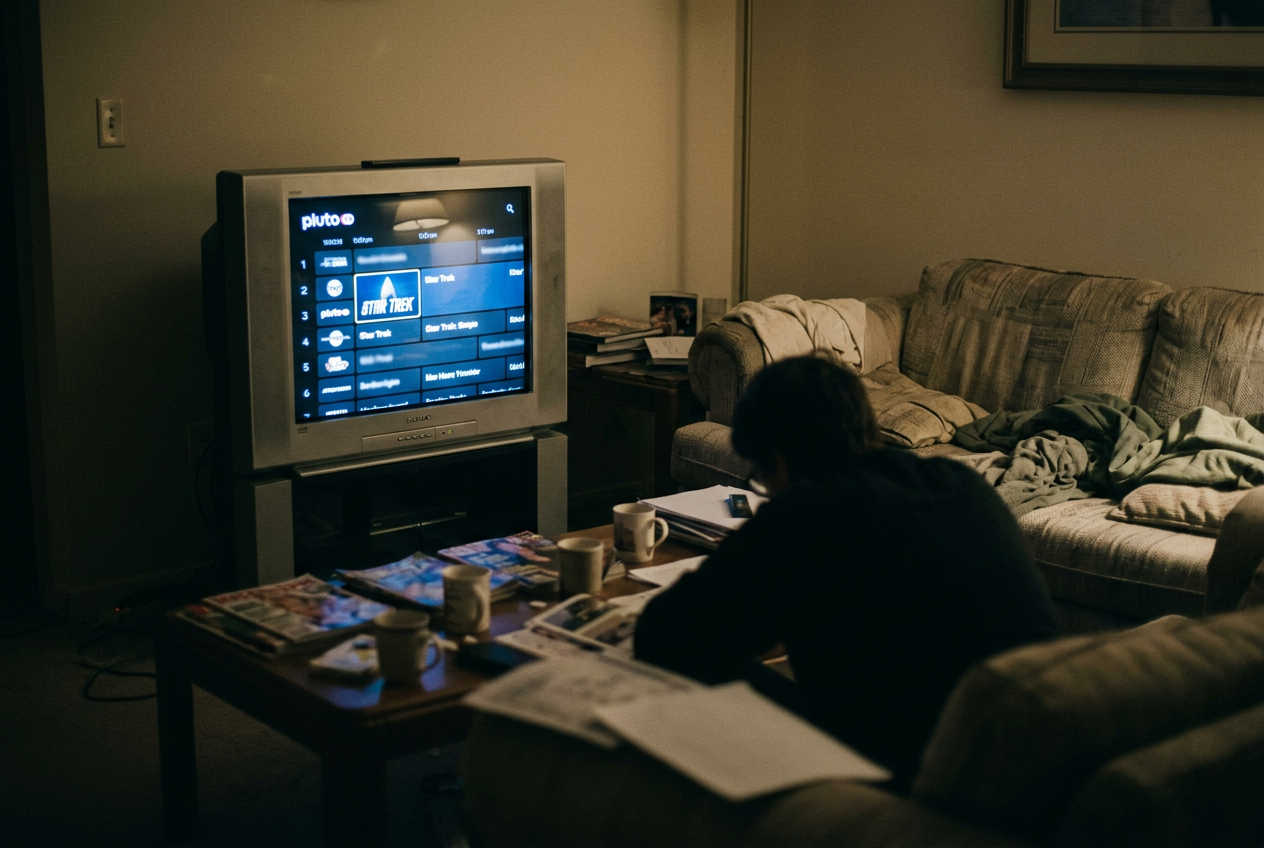
The blue Star Trek tile on Pluto TV makes a modest offer. Click it and some version of Star Trek is already happening. The episode may be halfway through. The bridge crew has a problem you did not hear explained, but the uniforms tell you enough, and another episode will begin when the schedule says it begins.
There is no season picker between you and the next hour. No row of thumbnails asks whether you would prefer a film, a documentary or six minutes of searching followed by bed. You arrive. It plays.
This is free ad-supported streaming television, or FAST: linear channels delivered over the internet without a subscription fee. Pluto TV, owned by Paramount, has made the format central to its identity. Fox-owned Tubi and The Roku Channel place similar live guides beside their on-demand libraries. Their interfaces still promise streaming abundance, but the guide quietly removes most of it.
That subtraction is the product.
The guide does the choosing
An audit of the three services’ live schedules reveals the same basic construction under different branding. Pluto TV leans heavily on channels named after franchises, series and narrow genres. Tubi’s guide mixes news feeds and entertainment channels with long runs of familiar procedural television. The Roku Channel does the same with properties including This Old House and channels assembled around recognizable libraries.
The schedules move in blocks. On Pluto’s Star Trek channel, episodes follow episodes with little need for editorial explanation. Tubi can turn Forensic Files into a continuous current of narrators, laboratories and commercial exits. The Roku Channel’s This Old House programming stretches renovation projects across a linear day, allowing one measured discussion of framing or drainage to hand viewers into the next.
These are not television networks in the old institutional sense. A synthetic channel is a programmed feed assembled from licensed files, schedule data, branding and designated commercial slots, often with far less original production or human presentation than a broadcast network required. The channel may have no newsroom, studio or coherent commissioning culture. It needs enough episodes, rights clearance and metadata to keep the row moving.
The distinction matters because FAST is often sold as the return of communal, lean-back television. There is some truth in that description. Viewers can encounter an episode already underway, and a schedule gives time shape. Yet the mechanism has less to do with restoring a lost public square than with making a catalog behave like inventory.
A large library creates a problem. Every title needs artwork, placement and a persuasive reason to be selected. Each decision gives the viewer another exit. Package a few hundred episodes into a channel, however, and one decision can produce an evening of viewing plus several opportunities to sell commercials.
The blue Star Trek tile is doing more work than it appears to be doing. It compresses multiple series, seasons and episode descriptions into a single proposition: Star Trek, now. Brand recognition replaces navigation.
Reruns fit the machine
Old episodic television works particularly well here because it was built to survive interruption. A procedural states its problem, advances it through acts and restores enough order for syndication. Commercial breaks arrive at points already shaped to release tension without ending the episode. Even when a platform inserts ads clumsily, the underlying program often carries the scar tissue of broadcast television.
That is craft, not an accident. Editors, writers and directors learned how to build an hour around act outs, recaps and viewers returning from the kitchen. FAST services inherit that work without having to invent a new viewing grammar, which is one reason an old forensic procedural can feel more structurally at home on a synthetic channel than a streaming drama designed as a ten-hour film.
Catalog television also arrives with its risk partly priced. The owners know the material, the rights can be bundled or licensed, and the audience does not require an expensive launch campaign to understand what CSI or Baywatch is. A channel name becomes its own thumbnail, trailer and recommendation system.
The suppliers benefit when dormant libraries earn licensing or advertising revenue, depending on the deal. Platforms gain hours that can be programmed repeatedly. Advertisers get connected-television impressions, meaning commercials delivered through an internet-connected set rather than conventional broadcast or cable. Viewers pay in attention and in the data used to decide which ad should fill a break.
The precise contracts are rarely visible from the couch. Some rights owners license programs for a set payment. Other arrangements divide advertising revenue or combine guarantees with performance terms. Vertically integrated companies can also circulate programming they already control through services they own, keeping more of the commercial relationship inside the same corporate family.
Paramount owns Pluto TV. Fox owns Tubi. Roku controls the operating system on many television sets and runs The Roku Channel alongside that distribution business. The guide is therefore more than a convenience layer.
It is a storefront controlled by companies that can place their own services, channels and advertising systems close to the viewer’s first click.
Every break is a small auction
FAST advertising does not require every viewer to receive the same commercial. Cue markers embedded in a program feed tell the platform where an ad may be inserted, while its advertising system chooses an eligible campaign for that device or household. Server-side ad insertion then stitches the commercial into the stream before delivery, which can make the break resemble part of the channel rather than a separate webpage loading.
In practice, the seams show. The same advertisement may return. A break may contain platform promotion when paid demand is thin. Volume and picture quality can shift.
Some slots feel abruptly cut, especially when a file was prepared for a different number or length of commercials than the service wants to serve.
Those failures expose the spreadsheet underneath. A FAST operator must balance the rights cost of the program, the expected audience, the number of commercial opportunities and the chance that an advertiser will buy them. A prestigious title with expensive rights can attract attention and still make poor channel material if the audience leaves quickly or the available ad load cannot support it. A deep, familiar series can keep generating usable hours long after anyone would approve a conventional rerun campaign for it.
This helps explain the peculiar scale of FAST guides. More channels create more labeled environments in which the same broad catalog can be divided, tested and sold. Crime can become true crime, courtroom crime, forensic crime or a channel bearing one program’s name. The distinction need not support a lasting editorial identity.
It needs to organize inventory clearly enough that viewers and advertisers know the mood.
Tubi’s live guide makes this especially plain because it sits beside a large on-demand service. One side says the library is yours. The other says here is Forensic Files, already playing. The scheduled feed wins whenever the cost of choosing feels greater than the cost of accepting what is on.
Appointment viewing without the appointment
Traditional appointment television relied on scarcity. Miss the broadcast and you might wait for a rerun, record it or lose the office conversation. FAST television has abundant underlying files, but it manufactures a softer scarcity by withholding control at the channel level. The episode is available now because the schedule says so.
If you dislike it, you can switch channels, yet switching keeps you inside the same commercial architecture.
This is appointment viewing stripped of obligation. Nobody needs to be home at nine. The appointment begins whenever a viewer opens the guide and surrenders selection.
That surrender has value because streaming interfaces have become work. Subscription services present shifting rights windows, promoted originals and recommendation rows whose apparent personalization often leads back to whatever the company needs to push. Searching across apps adds another layer. FAST does not solve that frustration.
It monetizes the desire to stop feeling it.
The Roku Channel’s This Old House feed demonstrates the softer version of the tactic. The series is patient, procedural and easy to enter without a season briefing. A viewer can watch craftspeople diagnose a physical problem, explain the repair and move through a project whose stakes remain legible even after an ad break. The channel’s continuity comes from method rather than cliffhangers.
There is real pleasure in that rhythm. Linear programming can generate encounters an on-demand menu would not, and a well-built episode deserves better than being dismissed as filler because it is old. FAST’s achievement is recognizing that craft as commercially reusable infrastructure.
Still, the abundance is cosmetic. A service may display hundreds of channels while relying on a narrower set of economic ideas: recognizable intellectual property, repeatable episodes, inexpensive scheduling and commercials sold against time spent. Adding another channel does not necessarily add another kind of television. It can mean cutting the same warehouse into another aisle.
Return to Pluto’s blue Star Trek tile. Its promise is not that the best episode has been selected for you, or even that the episode playing suits you. The promise is relief from the menu. Behind it sits a rights library, a playlist, an electronic program guide and a set of ad slots waiting to be filled.
Cable required wires, regional operators and channel bundles negotiated at industrial scale. FAST keeps the grid, the reruns and the commercials, then replaces the bundle fee with data-driven advertising and near-zero switching friction. The spreadsheet did not kill television. It found the cheapest parts to rebuild.
Questions people ask
What is a FAST channel?
A FAST channel is a scheduled internet stream supported by advertising rather than a viewer subscription. It resembles a cable channel in use, but the feed can be assembled from licensed files, program-guide data and dynamically inserted commercials without the production operation associated with a traditional network.
Why do FAST services show so many reruns?
Long-running series provide many familiar hours at a more manageable cost than a schedule built around new originals. Their episodic structures also tolerate casual entry and commercial interruption, allowing platforms to convert one recognizable title into a channel that can hold attention without repeatedly asking viewers to choose.
Are
Pluto TV, Tubi and The Roku Channel really free?
They do not charge a required subscription fee for their FAST programming. Viewers instead watch commercials, while the platforms can use device, account and viewing information to deliver and measure advertising under their respective privacy policies. The programs are free at the point of selection, not outside an economic exchange.
Who gets paid when a FAST channel runs an ad?
The advertiser pays through the platform’s sales system or an automated advertising marketplace. The platform keeps revenue and may pay or share it with the programming rights holder according to a licensing agreement, while technology vendors and intermediaries can also take part of the transaction.
One update a day
Today's story, in your inbox
One story each morning — no hype, no filler, no algorithm deciding for you.