The Secret Warehouse Address Is Deciding Who Gets In
Invite chains and last-minute location drops can keep underground parties alive. They also turn friendship, phone access and social proximity into a door policy nobody has to admit writing.
August 23, 2026 · 8 min read
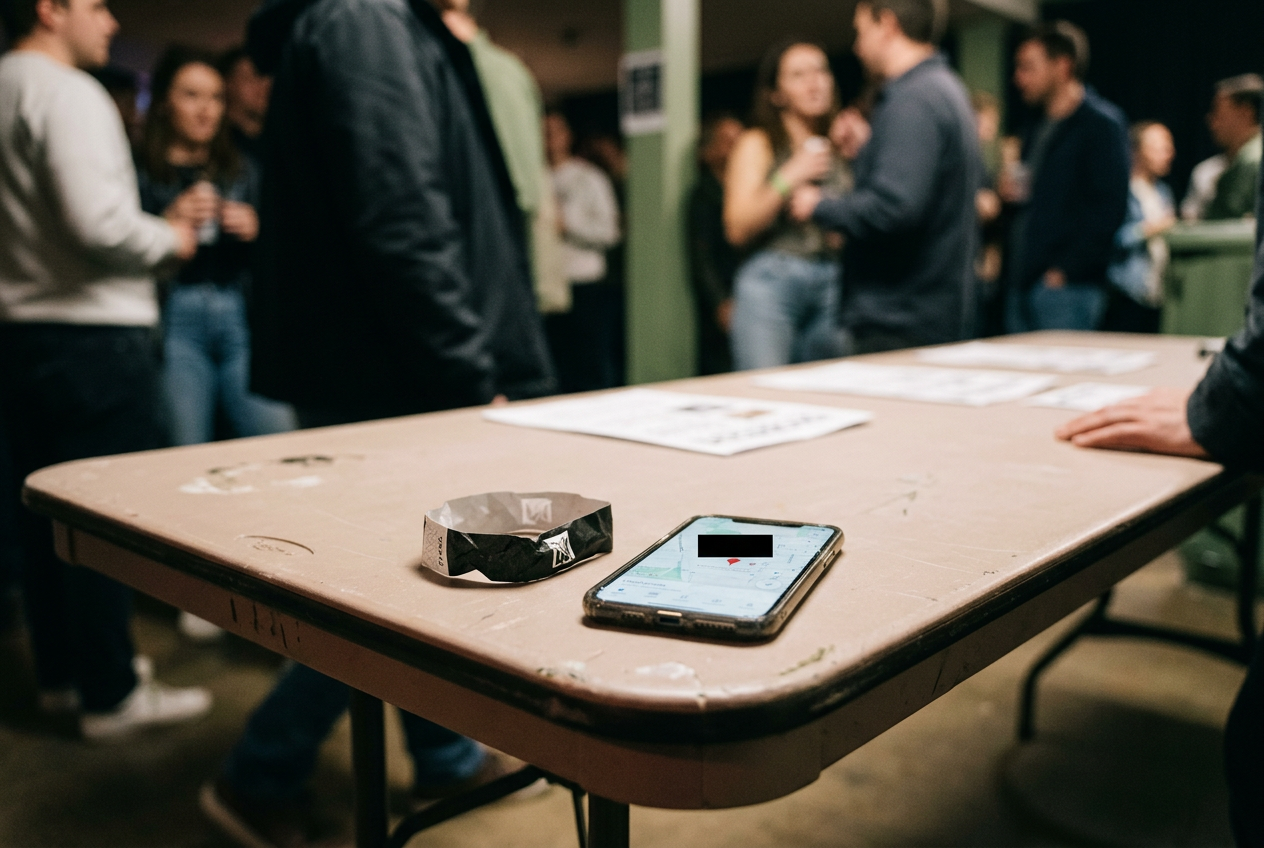
Consider a black Tyvek wristband cinched one notch too tight. Tyvek, a sheet of compressed polyethylene fibers, is cheap, water-resistant and difficult to remove without tearing; by 2 a.m., its edge has started scratching the damp skin beneath it.
At a warehouse party, that ordinary strip can represent the end of a long authentication process.
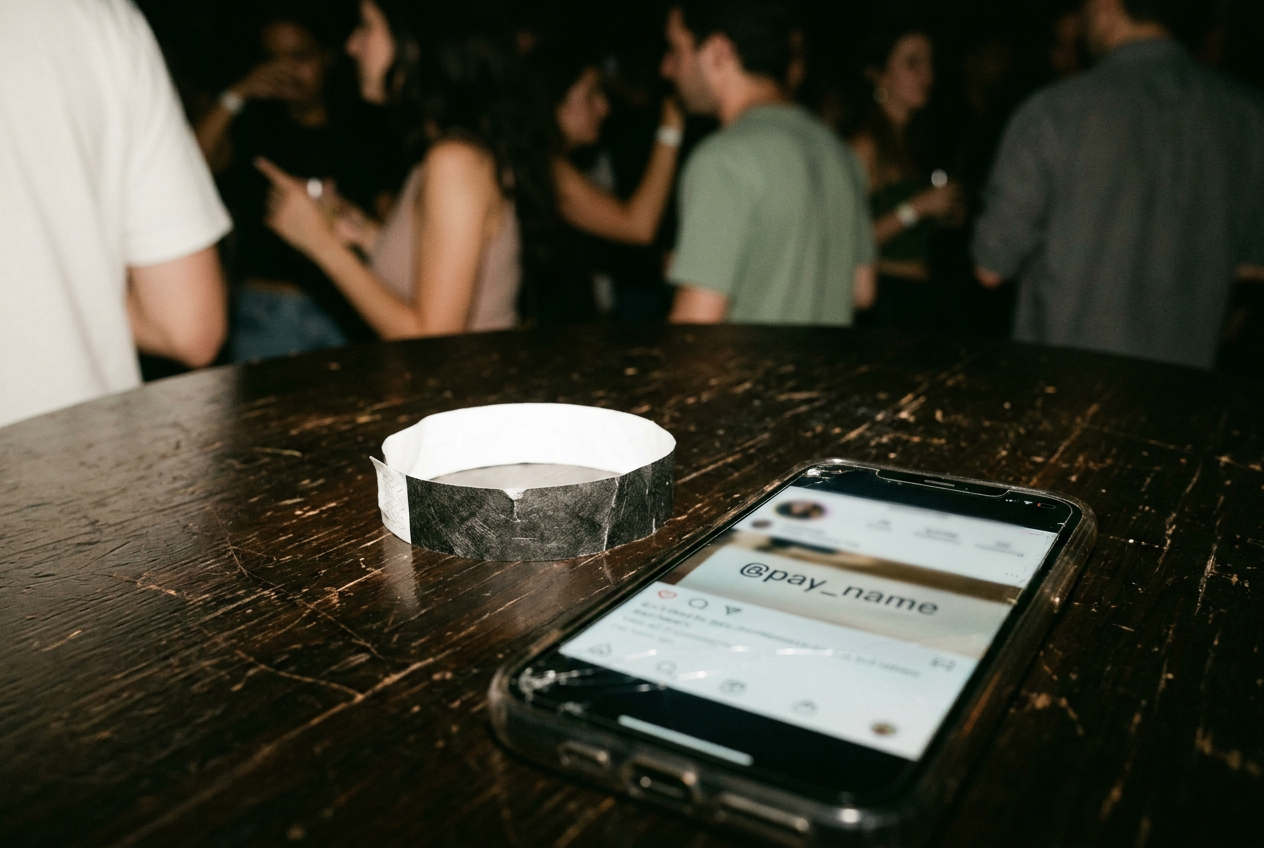
The address was absent from the listing. A friend forwarded an invite, the ticket arrived through a private link, and the location appeared hours before doors in an email or encrypted chat. At some events, the wristband may come only after a separate check-in. It looks like proof of payment.
It is also proof that several filters accepted you before anyone searched your bag.
Secret locations are usually explained as protection from police, landlords, hostile neighbors, opportunistic crowds and people who treat dance floors as content farms. Those threats are real. Public reporting on warehouse scenes in New York, Los Angeles and other cities has repeatedly shown organizers working under pressure from enforcement, rising rents and buildings never designed to function as licensed venues.
But secrecy does more than hide a room. It decides who can find it.
The guest list became a network map
A conventional club publishes an address and makes its exclusions at the door. A secret party moves much of that work upstream, into the chain that distributes the link. Access depends on whether somebody already inside the scene knows you, trusts you enough to forward the information and believes your presence will not threaten their own standing.
That is a social graph, the map of who is connected to whom. Promoters do not need to see the full map for it to govern the room. They can give a limited set of people ticket links, ask buyers not to repost them and release the address only to confirmed attendees. Each recipient becomes a minor gatekeeper, carrying the organizer’s risk into a group chat.
The mechanism works because responsibility is distributed. A promoter can deny running a broad public event. The original invite remains several forwards away from a stranger who arrives. If someone behaves badly, the chain can be traced informally through the person who vouched for them, with consequences delivered through future silence rather than a formal ban.
This is efficient. It is also opaque. A person excluded by a public ticket policy can at least read the policy; a person excluded by an invite chain receives nothing, because the rejection happens before they know an event exists. There is no posted dress code, accessibility note or sold-out screen.
Their phone stays quiet.
The black wristband therefore marks more than arrival. Its real fastening happened earlier, when someone decided the wearer was safe to include.
Secrecy transfers the cost of risk
Promoters have practical reasons to prefer this arrangement. A warehouse party must gather enough paying bodies to cover the room, sound, performers and workers without advertising so widely that it attracts enforcement or an audience the organizers cannot manage. Private distribution lowers marketing costs while preserving scarcity. It also lets a party sell tickets before revealing the exact place where the buyer is expected to spend the night.
That transfer matters. The attendee may learn too late that the warehouse is far from transit, that a rideshare will cost more than expected, or that the route from the nearest stop is poorly lit. Disabled guests cannot assess stairs, bathrooms or the distance from curb to dance floor when the building remains unnamed. Someone deciding whether to attend alone cannot inspect the surrounding block.
The organizer keeps operational flexibility; the buyer absorbs uncertainty.
Location secrecy can protect vulnerable crowds, particularly parties built by queer and trans communities whose spaces face harassment, surveillance or targeted violence. Public visibility is not an uncomplicated good. A searchable address can travel beyond the intended audience within minutes, and a viral post can replace a dance floor’s existing norms with the behavior of people who arrived to document them.
Still, a protected room and a fair room are different achievements. Referral systems tend to reproduce the networks that feed them. People with long histories in a scene accumulate links, while newcomers need somebody to recognize them before they can demonstrate that they understand the room. Race and class shape who has spare nights, flexible work, reliable transportation and friends already embedded in nightlife.
Phone access matters too. A person who does not monitor disappearing posts, private stories and several chats can miss a location drop despite having paid.
No organizer has to announce an exclusionary policy for exclusion to become predictable. The graph handles it.
The address drop is a form of moderation
A last-minute drop is often treated as logistical theater, the fun part where a blank listing becomes coordinates. It functions more like content moderation. Information is ranked for circulation, withheld from some users and released to others under conditions they cannot negotiate.
Signal offers end-to-end encryption, meaning message contents are designed to be readable only by participants in the conversation. WhatsApp also uses end-to-end encryption for personal messages, while Telegram’s ordinary group chats do not offer the same default protection. Yet encryption solves only one part of the organizer’s problem. A recipient can still screenshot an address, forward a link or hand a phone to someone else.
Technical privacy cannot manufacture social trust.
Promoters answer that weakness with timing. The later the location arrives, the shorter the window for redistribution, public posting or official intervention. Timing becomes security. It also favors people who can reorganize a night without notice, remain online and travel across a city after transit thins out.
The resulting policy is never written as such: applicants must have a charged smartphone, responsive friends, schedule flexibility and enough money to solve a surprise journey. Yet those requirements are more enforceable than many posted rules. Miss the message and the black Tyvek wristband never reaches your wrist.
Private channels can also conceal accountability. If harassment occurs, a closed invite structure may help organizers identify who brought the person responsible. It may just as easily keep warnings inside disconnected chats, leaving future attendees unable to search for reports or understand whether complaints changed anything. Informal bans depend on memory and proximity.
People at the center of a network receive context; people near its edge receive rumors.
Safety cannot stay secret from everyone
Warehouse disasters and subsequent reporting have made the conflict around unlicensed spaces impossible to dismiss. The 2016 Ghost Ship fire in Oakland was not a nightlife morality tale. It exposed what happens when artists and low-income residents are pushed into buildings with unsafe conditions while owners, regulators and city agencies fail in different ways.
Promoters may fear that disclosure invites shutdowns, especially where licensing systems make temporary cultural use expensive or functionally unavailable. Fire safety still requires concrete knowledge: usable exits, controlled capacity, clear paths, trained staff and a way for emergency responders to reach the building. Secrecy from the public cannot mean confusion among workers or hesitation about calling for help.
The same applies to harm reduction. Guests need to know whether water is available, whether there is a staffed welfare area and how to find medical support without passing an improvised social test. Publishing that information does not require publishing the address. It requires treating safety as part of admission rather than a favor revealed once someone is inside.
Better access design would not abolish secrecy. Organizers can release neighborhood-level information before purchase, provide direct accessibility details, set a reliable location-drop window and keep a public route for newcomers to request entry without begging an insider. Referral limits can slow uncontrolled forwarding, while written conduct policies can make bans less dependent on popularity. Each measure costs labor.
That is the part romantic accounts of underground autonomy tend to skip.
Somebody must answer the newcomer’s message, inspect the venue, document incidents and remain sober enough to make decisions after the room fills. Ticket revenue pays for the night unevenly, and administrative work often falls to organizers or community members whose labor is treated as devotion. Secrecy appears cheap because people absorb its costs privately.
The wristband can stay. So can the late address, when the threat model warrants it. What cannot survive scrutiny is the claim that these are neutral tools. A black Tyvek strip fits nearly any wrist, but the chain leading to it was sized long before the doors opened.
Questions people ask
Why do warehouse parties hide their addresses?
Organizers may want to reduce police attention, landlord complaints, harassment, overcrowding or viral exposure. A late location drop narrows the time available for an address to spread, although it cannot prevent screenshots or forwarding once recipients have the information.
How do invite chains exclude people?
Invite chains make existing relationships the route to admission. Newcomers, people outside dominant social circles and guests who cannot monitor private chats may never see the ticket link or location, even when no organizer has explicitly rejected them.
Are secret locations safer than public venues?
They can protect a targeted community from unwanted attention, but secrecy does not establish fire safety, accessibility or effective harm reduction. Safety depends on the building, staffing, capacity controls and emergency planning, details attendees should receive even if the exact address remains restricted.
What would a fairer secret-party policy look like?
Organizers can publish neighborhood-level travel information, accessibility details, conduct rules and a dependable time for the address drop. A direct application path for newcomers keeps privacy from becoming a closed referral loop, though reviewing those requests requires paid or acknowledged labor.
One update a day
Today's story, in your inbox
One story each morning — no hype, no filler, no algorithm deciding for you.