Tubi Is the Free Streamer Least Likely to Cut the Silence
A comparison built around Night of the Living Dead found that Tubi most often preserved complete scenes. Pluto TV exposed what happens when the commercial clock becomes the editor.
August 11, 2026 · 8 min read
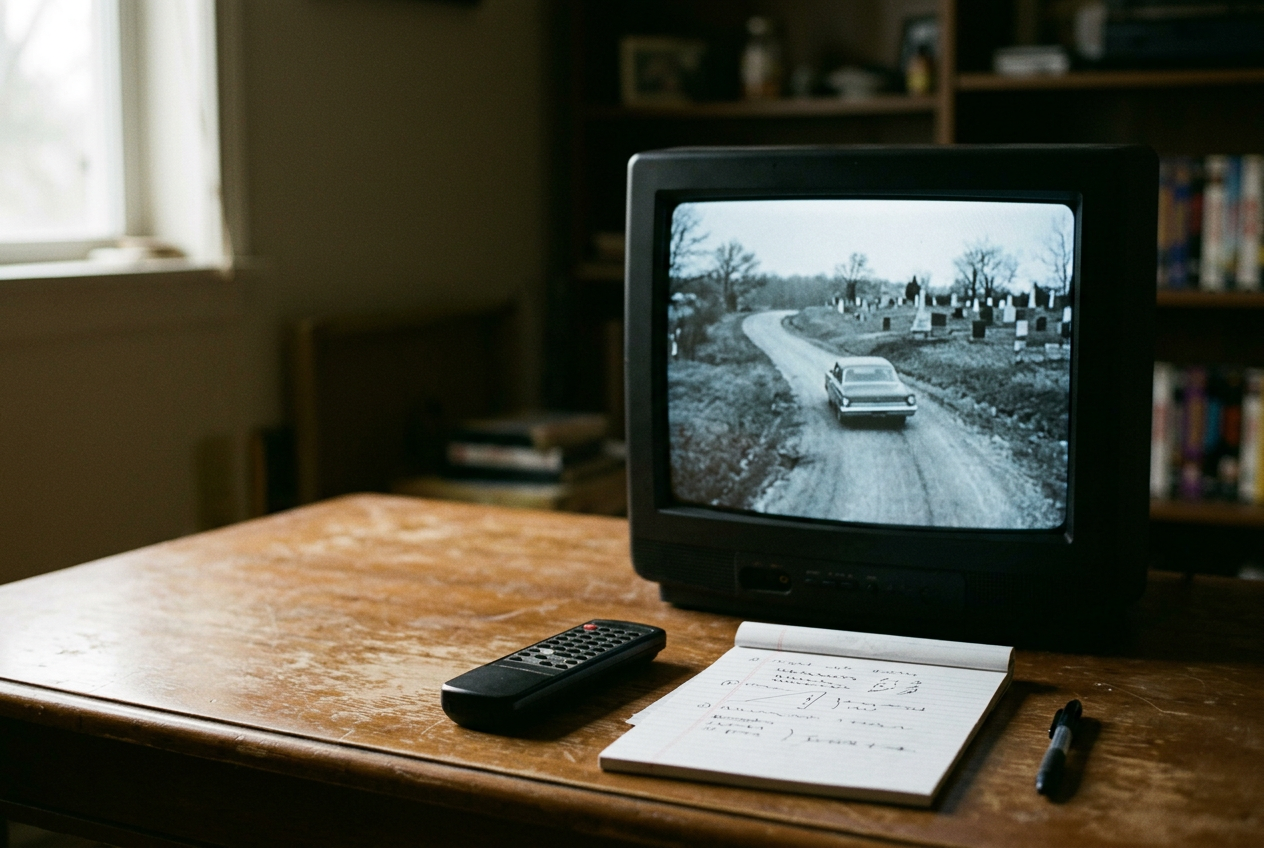
The vulnerable thing in Night of the Living Dead is not the first corpse, the first attack or the farmhouse siege. It is the car radio at the beginning, its thin signal accompanying Barbra and Johnny through an ordinary drive before the cemetery becomes hostile, because George A. Romero lets the mundane journey establish a tempo that the violence can violate.
That radio became the anchor for this comparison. I watched the film on major free, ad-supported streaming services where an on-demand version was available, following the same opening drive, cemetery attack and retreat to the farmhouse rather than pretending that differently sourced transfers could support an honest second-by-second contest. I also checked how each service handled later stretches of low-volume dialogue and suspended action. The issue was not how many commercials appeared.
It was whether the platform recognized a scene as a formal unit.
Tubi did best. The Roku Channel was inconsistent but usually legible. Plex treated narrative pressure as empty space waiting to be sold. Pluto TV’s on-demand presentation was rough, while its linear channels demonstrated the purest version of the underlying problem: once a platform owes the clock a commercial, the movie has already lost the argument.
The winner understands that a cut is not necessarily a pause
Tubi’s advantage was modest but meaningful. Its interruptions tended to arrive around visible transitions, after an action had resolved or a location had changed, rather than during the held breath before resolution. In the opening passage, the drive, radio texture and cemetery arrival retained enough continuity to function as an approach rather than a pile of content between sales messages.
This is basic editorial judgment. It is also rare.
A film cut tells the viewer that one shot has ended. It does not automatically say that the emotional event is over. Barbra reaching the farmhouse, for example, is a change of location, but the panic produced in the cemetery continues through the empty rooms, the failed telephone and her growing recognition that shelter has not restored order. An ad inserted at the doorway may look tidy to software scanning for a scene boundary.
Formally, it amputates the scene’s consequence.
Tubi was least likely to make that mistake during this pass. That does not mean its ads became invisible, and a commercial pod remains a commercial pod, complete with a volume profile and visual grammar designed to seize attention that the film has trained into another shape. Yet the service more often waited for a dramatic sentence to end. Among free platforms, restraint this small qualifies as a result.
The car radio survived as atmosphere rather than becoming a runway to the first ad. That matters because Romero’s opening does not merely deliver information. It lowers the viewer into a world where a bad signal, an irritating sibling and a long walk toward a grave still belong to recognizable life. Break that descent and the attack becomes an isolated incident.
Preserve it and the ordinary world appears to rot in real time.
Roku finds the door and still interrupts the exit
The Roku Channel generally recognized large structural divisions, but its break placement exposed the weakness of treating transitions as interchangeable. It could identify that a scene had changed without grasping whether the previous one had finished working on the viewer.
This produced interruptions that were technically defensible and rhythmically blunt. A doorway, an exterior shot or a shift in conversational focus gave the platform a clean surface for an ad, even when the film was carrying dread across that surface. The result was less damaging than a commercial dropped into the middle of a line, though that is an embarrassingly low standard for a company presenting itself as a distributor of cinema rather than a vending machine attached to a television.
Roku’s version of the bargain feels managerial. The movie receives blocks of uninterrupted time, but those blocks are divided according to visible segmentation rather than pressure, silence or performance. Quiet scenes suffer under that logic because their endings are often delayed. An actor stops speaking, the camera remains, and the meaning arrives during the hold.
Software sees inactivity. The film sees the point.
The opening radio remained intelligible here, but the broader test showed how quickly continuity can become collateral once the platform finds a plausible seam. Roku did not consistently wreck scenes. It rarely demonstrated that it understood them.
Plex mistakes low activity for low value
Plex was more erratic, particularly around passages that reduced movement or dialogue. Its interruptions felt less attached to dramatic completion and more responsive to available insertion points, producing the familiar sensation that a film had been paused by someone who was no longer watching it.
That failure reveals the central hazard of automated break placement. Dynamic ad insertion, which selects and delivers commercials to individual streams at playback, still needs a signal telling it where an ad may enter. That signal can come from cue points supplied with the program, from a distributor’s metadata or from automated systems looking for features such as cuts, fades and stretches with limited speech.
None of those features can reliably identify repose. A fade may close an act, or it may mark a memory. Silence may indicate dead space, or it may be the scene’s substance. Older films create further trouble because platforms receive transfers with inconsistent markers, altered logos, restoration cards or reel-change artifacts, leaving the service to impose a contemporary commercial pattern on work built for another exhibition system.
In Night of the Living Dead, the low-budget soundscape is not polished into constant legibility. The radio crackles. Rooms sit empty. Voices arrive from elsewhere.
Treating those intervals as underoccupied inventory does more than interrupt the film; it changes uncertainty into impatience, teaching the viewer that any reduction in information is merely time before an ad.
Plex made that lesson hardest to ignore.
Pluto TV lets the schedule take authorship
Pluto TV requires a distinction between on-demand viewing and its linear channels, which imitate broadcast television by running a continuous schedule. Its on-demand breaks can still land awkwardly, but the linear model reveals the commercial mechanism without disguise: the channel has ad windows to fill, and the work must bend toward them.
Scheduled television has always done this. Programs made for commercial broadcast often anticipate the interruption, building acts that rise toward a reveal, a reversal or a compact cliffhanger before the screen hands itself to advertisers. A theatrical film does not owe that architecture to anybody. When a linear streaming channel inserts commercials into one, the platform imports an act structure after the fact.
Pluto’s hardest breaks felt authored by the schedule rather than discovered in the film. A quiet passage could remain quiet only while it happened to fit inside the allotted program block. Once the commercial window arrived, tension, performance and shot duration became subordinate to inventory.
This is where interruption becomes revision. The viewer returns from a bright cluster of self-contained sales pitches with attention reset, ambient sound forgotten and suspense converted into recap. Romero’s car radio can survive one transition into advertising as plot information, but it cannot retain the same tactile function after the platform has replaced its weak signal with the aggressive clarity of a modern commercial mix.
Pluto TV is not uniquely cynical. It is merely less able to conceal the deal.
The ad server has become an uncredited editor
The money moves through a chain that encourages measurable delivery rather than formal care. Advertisers pay to reach categories of viewers; the platform sells impressions, meaning counted opportunities for an ad to appear; rights holders receive licensing money, revenue participation or some combination determined by agreements the viewer does not see. The audience pays with interrupted attention and the behavioral data generated around playback.
Break placement sits inside that commercial system as an optimization problem. The platform wants enough inventory to monetize the stream, enough completion to satisfy the advertiser and little enough irritation that the viewer does not leave. Preserving the duration of a glance or the residue after a death has no independent value in that equation unless damaged scenes cause measurable abandonment.
This explains why the least offensive service can change by title. A platform may receive careful cue points for one studio film and crude markers for another; a different transfer can carry different metadata, while ad load and campaign demand can shift by account, device or viewing session. The ranking here describes the observed presentations, not a permanent moral quality encoded in each app.
Still, the services make choices about how much editorial review to fund, whether to accept poor cue points and how aggressively to fill every available slot. Variability is not an alibi. It is evidence that platforms have declined to establish a dependable standard.
Tubi won because it most often behaved as though a scene had boundaries worth preserving. That is not reverence. It is competence. The others showed, in different degrees, how an advertising system trained to locate available time can redefine quiet as vacancy, then sell the vacancy it created.
Questions people ask
Which free streaming service has the least disruptive ads?
Tubi was the least disruptive in this hands-on comparison, particularly around the opening and quieter farmhouse passages of Night of the Living Dead. Results can vary by title, transfer, device and advertising demand, but Tubi more often placed breaks after dramatic units rather than inside them.
Why do streaming ads sometimes interrupt a scene mid-sentence?
The service may be following cue points delivered with the video or relying on automated detection of cuts, fades and low-dialogue passages. Dynamic ad insertion then fills those positions with available commercials. If the cue point is crude, the ad system executes the mistake efficiently.
Are live streaming channels worse for movies than on-demand services?
Usually, when rhythm matters. Linear channels must meet scheduled commercial windows, so a theatrical film can be forced into an act structure it was never designed to carry. On-demand services have more freedom to wait for a genuine scene ending, though Plex and Roku showed that having freedom does not guarantee using it.
One update a day
Today's story, in your inbox
One story each morning — no hype, no filler, no algorithm deciding for you.