TV Episodes Now Spend Their Openings Recapping Themselves
Prestige dramas increasingly repeat plot inside the episode itself. The target is not a forgetful audience so much as a distracted one returning after a long production gap.
August 11, 2026 · 8 min read
Three years separated the first and second seasons of Severance. Its answer was a man running through a white hallway.
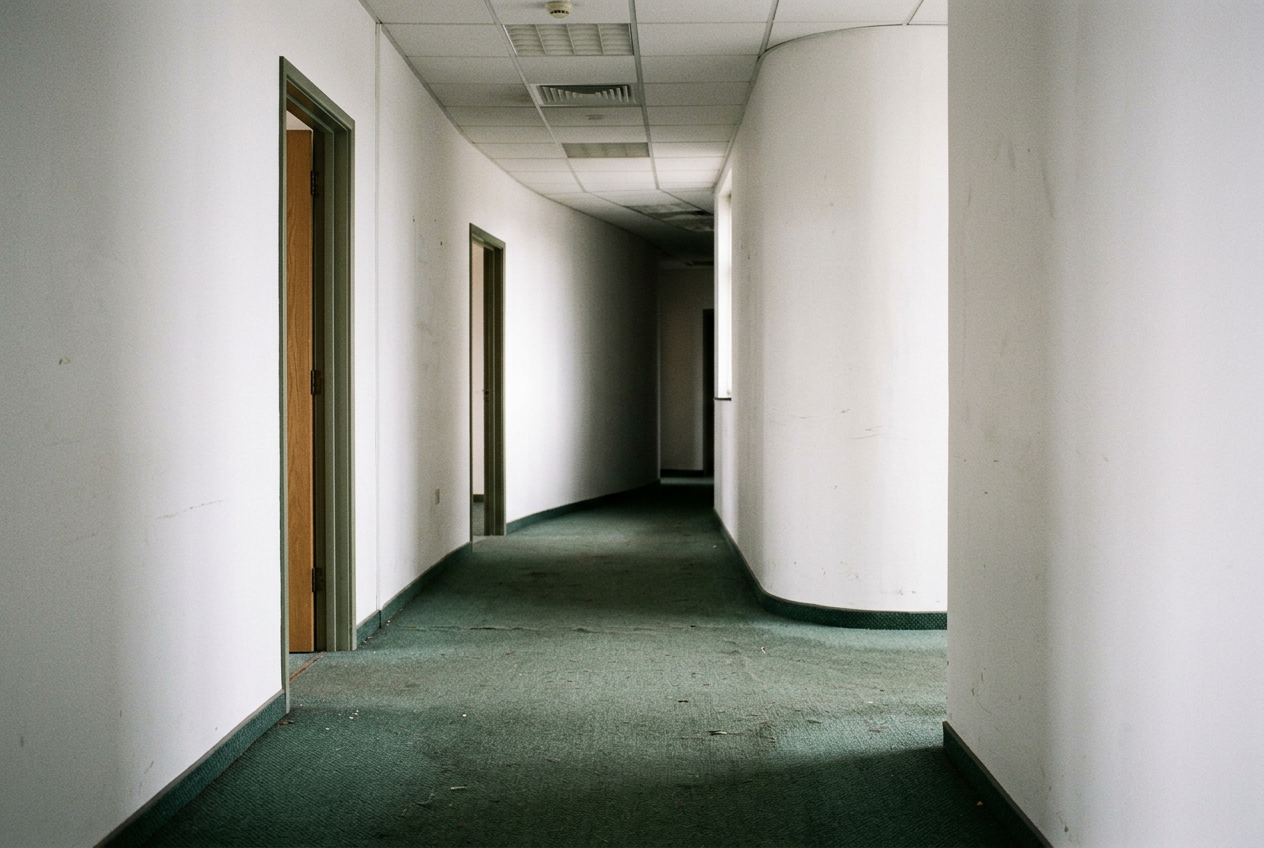
Mark S. wakes on the conference-room table, gets his bearings and bolts. The camera follows him around Lumon’s blank corners as he searches for the colleagues who were beside him when the first season stopped. White walls, green carpet, fluorescent light.
The building remains familiar while its contents have changed. No character announces that Mark’s innie, a consciousness created only inside the office, briefly reached the outside world. Nobody inventories the missing team. The sequence lets his panic retrieve the plot.
This is recap by physical memory. It depends on the viewer recognizing the hallway before remembering every proper noun attached to it, and it makes uncertainty productive: Mark does not know what happened after the overtime contingency, the procedure that woke the innies outside Lumon, so neither do we. The gap becomes part of the scene rather than a production problem the dialogue has to apologize for.
A lot of prestige television now makes the opposite choice. Its opening minutes arrive carrying a clipboard.
The recap escaped its box
The traditional “previously on” package had one clean function. It selected old footage, refreshed the necessary facts and ended before the new episode began. Viewers could watch it, skip it or resent it at the edge of the work. Streaming interfaces formalized that separation with a button.
The newer habit is embedded recap, exposition written into the dramatic scene so that it cannot be skipped without losing current material. A character repeats the last episode’s revelation to someone who largely knows it. A meeting rebuilds the balance of power before anyone changes it. Two people revisit a betrayal in language designed less for each other than for the viewer who answered messages through the betrayal itself.
The second-season premiere of The Diplomat inherits an explosion, several potential casualties and a conspiracy involving the British government. Its hospital corridors and official conversations must handle the aftermath, but they also repeatedly reconstruct the chain of suspicion. Characters identify who knew what, who may have ordered what and why an earlier theory no longer holds. The information matters.
Its density still reveals the design brief: keep the current scene moving while quietly replaying the finale.
House of the Dragon carries a harder version of the same burden. Its council scenes often combine strategy with reorientation, restating claims, family ties, military positions and prior injuries before the room can produce a new decision. Some repetition belongs to court politics, where people formalize positions in public. Some belongs to a show managing a large cast across long absences while assuming that viewers may remember a dragon more clearly than the name of its rider’s grandmother.
Calling this clumsy writing misses the mechanism. The scripts are solving a distribution problem.
Streaming made memory somebody else’s cost
A season of television can disappear for years while actors, stages, visual effects work and corporate scheduling line up. The service still presents the returning season as the next tile in a continuous product. It does not place a warning beneath the play button saying that the customer may need an evening of revision.
Weekly release complicates the problem. Streamers revived the schedule because conversation and anticipation can keep a show visible across several subscription cycles, but many series still retain binge-era plotting, with serialized episodes functioning as sections of one long story rather than discrete dramatic units. The result combines the memory demands of a novel with the interruptions of industrial filmmaking.
Then there is distracted viewing. A television episode now competes with the device that may also deliver work messages, group chats, delivery updates and a running commentary on the episode. Platforms did not invent divided attention, but their products accommodate it through pause-anywhere playback, subtitles, autoplay and interfaces built to resume material across devices. A scene that communicates a fact once, indirectly, risks becoming a scene that a portion of the audience never receives.
Embedded recap supplies narrative redundancy, meaning the same necessary information travels through more than one dramatic channel. The betrayal appears in the finale, returns in the recap package and gets described again over a desk. Redundancy can be elegant. A reaction may deepen a fact rather than repeat it.
More often, it consumes the opening minutes because those minutes are where a returning viewer is most likely to decide whether the new season feels incomprehensible.
No public dashboard is needed to see the commercial logic. A streaming service wants viewers to continue episodes and continue subscriptions. Confusion threatens both. Repetition is cheap insurance compared with asking an audience to rewatch a season, especially when the company has spent years advertising effortless access as the point of the product.
The cost lands elsewhere. Writers lose minutes that could establish a fresh conflict. Actors must make old information sound newly urgent. Attentive viewers receive dialogue calibrated for somebody who was not fully present.
The episode becomes customer support for its own plot.
What the white hallway does differently
Severance does eventually orient the audience. Milchick explains what Lumon claims happened after Mark and the others breached the severed floor’s boundaries. The company has converted the revolt into a public-relations story about reform, while Mark learns that his friends are gone and an uncertain amount of outside time has passed. These are new facts delivered through Lumon’s institutional self-interest.
The exposition changes the situation.
That distinction matters. A recap-heavy scene tells the viewer what the drama already established. An orienting scene shows what another character has done with that knowledge. Lumon’s account cannot be neutral because Lumon controls the elevator, the workplace and the partition between Mark’s two lives.
The information arrives contaminated by power.
The hallway run prepares that move. Mark’s body recognizes the turns, yet the corridor no longer leads to the social world he expected. The scene refreshes Lumon’s geography and the team’s absence at once, without requiring Mark to narrate either. Even viewers who have forgotten the finer machinery can understand the immediate problem: he is trapped somewhere familiar that has been rearranged against him.
Andor offers another version of this trust. Its second season returns after a long gap and begins with Cassian stealing an experimental Imperial fighter, placing the viewer inside a difficult operation before reviewing the rebellion’s administrative map. The scene establishes competence, danger and political scale through action. It assumes that anyone missing a committee name can catch up while the story advances.
Neither show rejects exposition. They rank it. Information needed for the present gets screen time; information preserved only to certify comprehension does not automatically receive another speech. This approach may demand more attention, but it also rewards attention already given.
Television once treated that exchange as ordinary.
The hidden audience in the room
Recap-heavy construction imagines several viewers at once. One watched the previous season closely but years ago. Another has the episode on while scrolling. A third started with the new season because the platform promoted it.
The script is asked to keep all of them without looking as if it has paused for any of them.
That mandate explains why the repetition often hides inside arguments, briefings and interrogations. Those forms let characters state facts bluntly under cover of conflict. Prestige drama already favors institutions filled with lawyers, executives, spies, doctors and aristocrats, people whose jobs plausibly require them to summarize developments. The conference table has become the streaming recap’s preferred habitat.
This can work. A repeated fact gains force when the person hearing it can punish the speaker, or when two characters disagree over what the fact means. It fails when everybody in the room shares the same information and the only real recipient sits at home. The scene may be polished, expensive and well acted.
It is still marking time.
The alternative is not deliberate obscurity. Shows can offer optional recap packages, publish accurate episode summaries and stage early scenes around consequences rather than minutes. They can also build seasons from episodes with stronger internal shapes, reducing the amount of plot that must survive a multiyear warehouse stay. Each option costs editorial labor or limits how much serialized machinery a season can carry.
Repetitive dialogue looks free because the audience pays in attention.
The white hallway is not free either. It needs controlled staging, exact camera movement and confidence that a location can carry memory without a speech explaining what it represents. Yet it gives those opening minutes back to the episode. Mark runs because he needs to find his colleagues.
The viewer remembers by trying to keep up.
Questions people ask
Why do
TV episodes repeat information after a recap?
The recap can be skipped, while dialogue inside the episode reaches everyone who keeps watching. Embedded repetition also helps viewers returning after a long season gap or dividing attention between the show and another screen, even though attentive viewers lose dramatic time to facts they already know.
Are recap-heavy openings always bad writing?
No. Repeated information can reveal power when a character distorts it, disputes it or uses it against someone else. The writing turns inert when characters restate shared knowledge without changing its meaning, leaving the scene to perform orientation work that an optional recap could have handled.
Why are prestige dramas especially prone to embedded recaps?
They tend to carry serialized plots across expensive seasons with long production gaps. Their institutional settings also make exposition easy to disguise: councils, hospitals, offices and intelligence briefings provide plausible rooms where characters can summarize events for a viewer the script cannot openly address.
Which shows trust viewers to remember?
Severance and Andor both return by creating a new immediate problem, then supply only the context needed to understand its consequences. In Severance, memory begins with Mark’s shoes hitting Lumon’s green carpet and the white hallway refusing to give him back the people he expects.
One update a day
Today's story, in your inbox
One story each morning — no hype, no filler, no algorithm deciding for you.